Molecular duo dictate weight and energy levels
February 28, 2012 in Neuroscience

Molecular duo dictate weight and energy levels

Enlarge

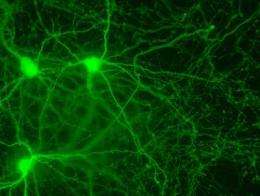
Three MCH neurons in the hypothalamus region of a mouse brain are highlighted in green. In animals, these neurons are associated with high calorie intake and lower energy levels. Yale researchers have shown how the effects of these key cells are reversed. Credit: Courtesy Yale University

Yale University researchers have discovered a key cellular mechanism that may help the brain control how much we eat, what we weigh, and how much energy we have.

The findings, published in the Feb. 28 issue of the Journal of Neuroscience, describe the regulation of a family of cells that project throughout the nervous system and originate in an area of the brain call the hypothalamus, which has been long known to control energy balances.

Scientists and pharmaceutical companies are closely investigating the role of melanin-concentrating hormone (MCH) neurons in controlling food intake and energy. Previous studies have shown that MCH makes eat more, sleep more, and have less energy. In contrast, other use the thyrotropin-releasing hormone (TRH) as a neurotransmitter, and these neurons reduce food intake and body weight, and increase physical activity.

The Yale study of brains of mice shows that the two systems appear to act in direct opposition, to help the organism keep these crucial functions in balance.

Although TRH is normally an , the Yale study shows that in mice TRH inhibits MCH cells by increasing inhibitory synaptic input. In contrast, TRH had little effect on other types of neurons also involved in .

"That these two types of neurons interact at the synaptic level gives us clues as to how the brain controls the amount of food we eat, and how much we sleep," said Anthony van den Pol, senior author and professor of neurosurgery at Yale School of Medicine.

Journal reference: Journal of Neuroscience search and more info website

Provided by Yale University search and more info website

5 /5 (3 votes)  

Rank 5 /5 (3 votes)
Related Stories
Relevant PhysicsForums posts

More news stories

For combat veterans suffering from post-traumatic stress disorder, 'fear circuitry' in the brain never rests

Chronic trauma can inflict lasting damage to brain regions associated with fear and anxiety. Previous imaging studies of people with post-traumatic stress disorder, or PTSD, have shown that these brain regions can over-or ...

Neuroscience created 6 hours ago | popularity not rated yet | comments 0 | with audio podcast

Temporal processing in the olfactory system

The neural machinery underlying our olfactory sense continues to be an enigma for neuroscience. A recent review in Neuron seeks to expand traditional ideas about how neurons in the olfactory bulb might encode information about ...

Neuroscience created 17 hours ago | popularity not rated yet | comments 0 | with audio podcast report

Melon focus headband turns to Kickstarter for rollout plans

(Medical Xpress)—What if the quality of your work depends more on your focus on the piano keys or canvas or laptop than your musical or painting or computing skills? If target users can be convinced, they ...

Neuroscience created 17 hours ago | popularity 3.7 / 5 (3) | comments 0 | with audio podcast weblog

Deep brain stimulation: A fix when the drugs don't work

Neurological disorders can have a devastating impact on the lives of sufferers and their families.

Neuroscience created 22 hours ago | popularity 5 / 5 (1) | comments 0 | with audio podcast

Brain makes call on which ear is used for cell phone

If you're a left-brain thinker, chances are you use your right hand to hold your cell phone up to your right ear, according to a newly published study from Henry Ford Hospital in Detroit.

Neuroscience created May 16, 2013 | popularity 2 / 5 (2) | comments 0 | with audio podcast


AIDS science at 30: 'Cure' now part of lexicon

Big names in medicine are set to give an upbeat assessment of the war on AIDS on Tuesday, 30 years after French researchers identified the virus that causes the disease.

Now we know why old scizophrenia medicine works on antibiotics-resistant bacteria

In 2008 researchers from the University of Southern Denmark showed that the drug thioridazine, which has previously been used to treat schizophrenia, is also a powerful weapon against antibiotic-resistant bacteria such as ...

Individuals who drink heavily and smoke may show 'early aging' of the brain

Treatment for alcohol use disorders works best if the patient actively understands and incorporates the interventions provided in the clinic. Multiple factors can influence both the type and degree of neurocognitive abnormalities ...

College women exceed NIAAA drinking guidelines more frequently than college men

In order to avoid harms associated with alcohol consumption, in 2009 the National Institute on Alcohol Abuse and Alcoholism issued guidelines that define low-risk drinking. These guidelines differ for men and women: no more ...

Study identifies new approach to improving treatment for MS and other conditions

(Medical Xpress)—Working with lab mice models of multiple sclerosis (MS), UC Davis scientists have detected a novel molecular target for the design of drugs that could be safer and more effective than current FDA-approved ...

23 dead in initiation rites in South Africa

(AP)—Twenty-three youths have died in the past nine days at initiation ceremonies that include circumcisions and survival tests, South African police said Friday.