'ROCK' off: Study establishes molecular link between genetic defect and heart malformation
February 6, 2012 in Genetics
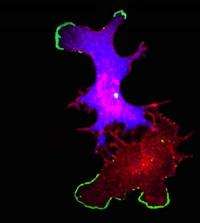
This is a single cell carrying a Noonan syndrome-associated mutation in which cell adhesion and cell shape changes have been rescued (as shown in green). Credit: Joan M. Taylor and Frank L. Conlon, UNC-Chapel Hill.
UNC researchers have discovered how the genetic defect underlying one of the most common congenital heart diseases keeps the critical organ from developing properly. According to the new research, mutations in a gene called SHP-2 distort the shape of cardiac muscle cells so they are unable to form a fully functioning heart.
The study also shows that treatment with a drug that regulates cell shape rescues the cardiac defect, pointing to therapeutic avenues that could one day benefit Noonan syndrome patients. The results, which were produced in a frog model of the disease, appeared online January 25, 2012, in the journal Development.
Genetic studies have shown that SHP-2 plays a critical role in human physiology and disease. Interestingly, different mutations in different portions of SHP-2 result in three different diseases Noonan syndrome, a severe congenital heart disease; juvenile myelo-monocytic leukemia, a lethal form of cancer; and Leopard syndrome, a rare condition with skin, facial and cardiac abnormalities. This observation has intrigued a number of researchers, including senior study author Frank Conlon, PhD.
"I've wondered how it is that one mutation gives heart disease and doesn't affect your white blood cells, and another will wipe out your white blood cells and leave your heart alone," said Conlon, an associate professor of genetics and a member of the UNC McAllister Heart Institute. He and others have explored this mystery by creating transgenic animals -- fruit flies, mice, or in Conlon's case, frogs -- that possess a mutated form of SHP-2.
When Conlon and his team genetically engineered frogs to contain the very same defects seen in humans with Noonan syndrome, they found that the frogs did in fact develop cardiac defects. But when they created them with a mutation seen in humans with leukemia, there were no heart defects. The researchers then performed 3D modeling on the animals to assess the nature of the anatomical defects, and discovered that actin filaments proteins responsible for giving structure to the cardiac muscle cells -- were the ones affected.
Conlon and his collaborator Joan Taylor, PhD, an associate professor of pathology and laboratory medicine at UNC, then tested whether they could reverse the heart malformation using a drug called fausidil that had been shown to improve cardiac function in animal models of heart failure. The drug blocks a protein called ROCK that resides in the same neighborhood or pathway of intracellular processes as SHP-2.
The researchers dissolved the drug in the mutant frogs' water tank and found that it did correct the cardiac defects. Their findings connect the dots between Noonan syndrome's underlying genetic defect and the resulting cardiac malformations.
"The human mutations could have been linked to anything, proliferation or cell death, and what this study does is it links it to cell shape changes, which are mediated by this important molecule ROCK," said Conlon. "Our lab studies heart development and heart disease, so we are interested in how this one set of mutations specifically target that one organ. Why the heart? We still have to figure that out."
Provided by
University of North Carolina School of Medicine
-
Discovery of differences in heart's precursor cells may advance treatment options
Apr 14, 2008 |
not rated yet |
0
-
Study shows rapamycin reverses myocardial defects in mouse model of LEOPARD syndrome
Feb 21, 2011 |
not rated yet |
0
-
Fruit fly research may lead to better understanding of human heart disease
Dec 02, 2008 |
not rated yet |
0
-
Why is the heart heart-shaped?
Feb 20, 2007 |
not rated yet |
0
-
Gene Mutation Leads to 'Broken Hearts'
Jul 21, 2006 |
not rated yet |
0
-
Of mice and mental models: Neuroscientific implications of risk-optimized behavior in the mouse
May 25, 2012 |
not rated yet |
0
-
Limits to growth: Scientists identify key metastasis-enabling enzyme
May 22, 2012 |
5 / 5 (4) |
0
-
Seeing is as seeing does: Spatially-structured retinal input in early development of cortical maps
Apr 26, 2012 |
5 / 5 (4) |
1
-
Dreamless nights: Brain activity during nonrapid eye movement sleep
Apr 09, 2012 |
4.4 / 5 (12) |
0
-
Take your time: Neurobiology sheds light on the superiority of spaced vs. massed learning
Mar 28, 2012 |
4.5 / 5 (21) |
3
-
Classical and Quantum Mechanics via Lie algebras
Apr 15, 2011
- More from Physics Forums - Independent Research
More news stories
Inherited DNA change explains overactive leukemia gene
A small inherited change in DNA is largely responsible for overactivating a gene linked to poor treatment response in people with acute leukemia.
Genetics
May 25, 2012 |
not rated yet |
0
|
'Personality genes' may help account for longevity
"It's in their genes" is a common refrain from scientists when asked about factors that allow centenarians to reach age 100 and beyond. Up until now, research has focused on genetic variations that offer a physiological advantage ...
Genetics
May 24, 2012 |
3 / 5 (1) |
0
|
Gene discovery points towards non-hormonal male contraceptive
A new type of male contraceptive could be created thanks to the discovery of a key gene essential for sperm development.
Genetics
May 24, 2012 |
5 / 5 (5) |
0
|
Key gene found responsible for chronic inflammation, accelerated aging and cancer
Researchers at NYU School of Medicine have, for the first time, identified a single gene that simultaneously controls inflammation, accelerated aging and cancer.
Genetics
May 24, 2012 |
not rated yet |
0
Knowing genetic makeup may not significantly improve disease risk prediction
Harvard School of Public Health (HSPH) researchers have found that detailed knowledge about your genetic makeupthe interplay between genetic variants and other genetic variants, or between genetic variants and environmental ...
Genetics
May 24, 2012 |
2 / 5 (1) |
0
|
Keep food safety in mind this memorial day weekend
(HealthDay) -- Picnics, parades and cookouts are as much a part of Memorial Day weekend as tributes to the United States' war veterans.
Travel to high altitudes tied to Crohn's, colitis flare-ups
(HealthDay) -- People with inflammatory bowel disease, which includes Crohn's disease and colitis, may be at increased risk for flare-ups when they fly or travel to high altitudes for skiing or mountain climbing, ...
Family history of Alzheimer's affects functional connectivity
(HealthDay) -- Cognitively normal individuals with a family history of late-onset Alzheimer's disease (AD) may display lower resting state functional connectivity in the default mode network (DMN) of the brain, ...
Transvaginal mesh op restores pelvic organ prolapse at price
(HealthDay) -- Transvaginal mesh (TVM) procedures are effective for anatomical restoration of pelvic organ prolapse (POP), but patients report a worsening of sexual function following surgery, according to ...
Of mice and mental models: Neuroscientific implications of risk-optimized behavior in the mouse
(Medical Xpress) -- Regardless of an organism’s biological complexity, every encephalized animal continuously makes under-informed behavioral choices that can have serious consequences. Despite its ubiquity, ...
Weight struggles? Blame new neurons in your hypothalamus
New nerve cells formed in a select part of the brain could hold considerable sway over how much you eat and consequently weigh, new animal research by Johns Hopkins scientists suggests in a study published in the May issue ...