The moth and the air freshener: The secrets of scent
University of Arizona Regents' Professor John G. Hildebrand has been elected to the Council of the National Academy of Sciences. In addition, he is being honored for his lifetime accomplishments on how olfaction, the sense of smell, influences the behavior of animals, from bugs to humans.
"From an early age, I was fascinated by what I could smell and how I reacted to it and by how flavor works and things like that," said John G. Hildebrand, a Regents' Professor in the University of Arizona's department of neuroscience. "And I was fascinated by insects."
His childhood interests would lead him into a life-long career dedicated to figuring out how insects perceive taste and smell, how their brains process them and how they elicit certain behavioral responses.
Hildebrand has been elected to serve on the Council of the National Academy of Sciences, after having been a member of the academy for almost five years. Election to membership in the academy is considered one of the highest honors a U.S. scientist or engineer can achieve.
"I was surprised enough to be nominated," Hildebrand said. "It was even more surprising and flattering to be elected, and I'm still stunned by it."
The appointment to the council, the academy's governing body, is for three years, starting July 1, and is a "working assignment, not an honorific one," he said. "The academy has to govern its own business, has to run its own finances and has to raise its own money."
Big plans lie ahead. Hildebrand said the academy is seeking to "increase its diversity in the broadest sense, not just in terms of racial, ethnic and gender diversity, but toward a more diverse geographical representation and underrepresented areas."
Goals include expanding the number of eligible scientific disciplines, electing younger scientists and strengthening international liaisons in a scientific arena that is becoming ever more global.
Hildebrand said he is especially excited about his appointment because it underscores and elevates the UA's recognition.
For his lifelong accomplishments in unraveling chemical senses, Hildebrand will receive the Max Mozell Award for Outstanding Achievement in the Chemical Senses from the Association for Chemoreception Sciences, or AChemS, at the association's annual meeting later this year. The award is named for the founder of AChemS, which has become the world's leading professional society devoted to the sciences of smell and taste.
"In academia, I think one of the highest kinds of rewards you can get is to know that your colleagues and peers think well of what you do," Hildebrand said. "Chemical senses such as smell and taste are important areas of sensory neuroscience and behavior because they play a very important role in our well-being and our enjoyment of life."
The ability to smell is important, like the ability to feel pain, Hildebrand said. "If you can't sense pain, you can burn yourself badly. If you can't smell properly, you can be asphyxiated by gas. It's important in those ways but it's also fascinating because of all the things we eat and drink and enjoy. Much of it hinges on our chemical senses."
He credits his father, a "scientific polymath interested in everything under the sun," with sparking his interest in taste and smell.
"My father was a very influential person to me. He was an expert in natural products chemistry, particularly flavor and fragrance chemistry. When I was a little kid, he used to come home from work with samples of novel perfumes or unmarked packages of chewing gum that had test flavors in them. I'd give them out to my friends for free if they just told us which ones they liked best. I made a lot of friends that way."
Combining his interests in insects and the chemical senses, Hildebrand began to study olfactory systems and sensory information processing as a young faculty member.
"We wanted to know what shaped the evolution of these systems and what they are trying to cope with," he said. "Let me give you an example."
"If you are a coffee drinker, you only need to take a whiff from a steaming cup to know that it's coffee. And if you're a real coffee drinker, you know right off from that one whiff whether it's a dark roast or light roast, or whether it's been sitting on the hot plate for a long time. You know a lot about that cup of coffee."
He explained that a whiff of coffee – which olfactory scientists call "headspace" – is made up of roughly 800 chemical compounds, depending on the brew and the roast and so forth.
"It's a very complex mixture, and for a chemist to identify 800 or more compounds and quantify them would take all the most powerful tools we have, such as mass spectrometry and, most importantly, weeks of work. But you take one whiff, and you have a lot of information."
"Isn't the fact that you can recognize a very complex pattern like that and distinguish it from a different, similarly complex pattern of a different brew or a different roast or a different age, amazing? How do we deal with something that complex?"
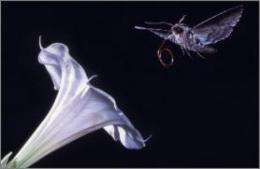
Enter the hawkmoth Manduca sexta, also known as the tobacco hornworm moth, whose habitat includes Southern Arizona, where it sucks nectar from Datura flowers at night and pollinates them in the process, lured by the flowers' scent.
Hildebrand pioneered the animal as a model organism for studying the organization of insects' sense of smell. Adult moths have a wingspan of about four inches and relatively large brains, making them much easier to study than smaller insects.
Female hawkmoths release their sex pheromone with a specialized organ that works not unlike an Air Wick® air freshener. Male moths pick up the scent plume and follow it to locate their mating partners.
"The beauty of the Manduca pheromone system is that there are only two compounds that matter to the male to find the female. Two components is the simplest possible mixture to make a scent."
Studying exactly how that pheromone mixture unlocks the mating behavior in the hawkmoths, Hildebrand's research team has gained insights into the fundamental neural mechanisms that organisms use to recognize scents, how their brains process them and how they trigger certain types of behavior. They even discovered that moths can be trained to respond to artificial odors they have never encountered in nature.
"People think of moths as dumb because they crash into our porch lights at night, but in fact they learn as well as honey bees do," Hildebrand said. "They're amazing."
The latest contribution to the field of olfactory neuroscience coming out of the Hildebrand lab is preliminary evidence that certain neurons fire at the same time to encode the significance of a behaviorally meaningful odor mixture.
Hildebrand joined the UA faculty in 1985 to establish and direct the division of neurobiology, part of the UA's Arizona Research Laboratories devoted to insect neurobiology and behavior. That unit recently became the department of neuroscience in the College of Science. He also led the creation of the university-wide Graduate Interdisciplinary Program in Neuroscience, launched in 1988.
He also is an elected fellow of the American Association for the Advancement of Science (1986); an elected member of the German National Academy of Sciences ‘Leopoldina' – the oldest academy of sciences in the world (1998); an elected Foreign Member in the Norwegian Academy of Science and Letters (1999); and an elected member of the American Academy of Arts and Sciences (2001). He holds an honorary doctorate from the University of Cagliari, Italy (2000).
Hildebrand earned his bachelor's degree in biology at Harvard College in 1964 and his doctorate in biochemistry at Rockefeller University in 1969. Before coming to Arizona, he was on the faculty at Columbia University (1980-85), Rockefeller University (1981-86) and Harvard Medical School (1970-80).
He also served as a trustee (1981-89) and member of the executive committee (1982-88) of the Marine Biological Laboratory in Woods Hole, as a trustee of Rockefeller University (1970-73) and as associate in behavioral biology in the Harvard University Museum of Comparative Zoology (1980-97).
The National Academy of Sciences is a private organization of scientists and engineers dedicated to the furtherance of science and its use for the general welfare. It was established in 1863 by a congressional act of incorporation signed by Abraham Lincoln that calls on the academy to act as an official adviser to the federal government, upon request, in any matter of science or technology.


