Seeing colors in music, tasting flavors in shapes may happen in life's early months
February 10, 2012 By Alan S. Brown in Psychology & Psychiatry
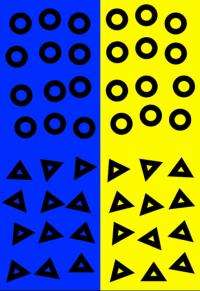
Triangles and circles placed atop different background colors were used as part of an experiment to determine if infants might have synesthesia. Credit: Katie Wagner | UCSD
Famed violinist Itzhak Perlman sees a deep forest green whenever he plays a B-flat on his Stradivarius' G string. The A on the E string is red.
For Perlman, the connection between music and color is not a metaphor. When he plays an A, he sees red the same way the rest of us see white when we look at snow.
This trait is called synesthesia, and recent research suggests that all humans may have experienced it as infants. For adults, it involves a rare cross-wiring of the brain, so that stimulating one sensory or cognitive pathway automatically and involuntary stimulates another.
"It is not an add-on. Synesthetes experience two sensory stimuli at once," said Maureen Seaberg, a synesthete who wrote a book called "Tasting the Universe" on the subject.
Nor is synesthesia limited to music and colors. Researchers have identified more than 50 types. Seaberg, for example, has grapheme-color synesthesia, in which each letter of the alphabet has its own distinctive color. Others have ordinal-linguistic personification, where numbers and days of the week have distinct personalities.
Oscar-winning actress Tilda Swinton tastes words. The word "tomato" tastes lemony to her, while "table" evokes cake. According to Seaberg, word-tasters like Swinton are the only ones who ever express any discomfort with synesthesia, since not every word tastes like cake.
Seaberg remembers that as a child, she asked her mother why the letter A was always yellow. Her mother answered that she must have memorized it that way in class.
"That was a pretty good answer for the time, but what was more perplexing was why I saw the days of week and the months in color," Seaberg recounted.
She asked other adults and quickly realized it was better to remain quiet. "I spent the vast majority of my life keeping it a secret," Seaberg said.
Synesthesia has been known for thousands of years. The ancient Greeks speculated about it, and so did Isaac Newton. The first medical paper appeared 200 years ago, and it was widely studied over the next 100 years. The rise of behaviorism, which sought to make psychology more scientific by studying measurable behaviors rather than personal experiences, ended those investigations.
Then, in 1980, neurologist Richard Cytowic began studying synesthetes. He predicted that a stimulus that would ordinarily activate one sensory pathway in the brain would light up two areas in synesthetes. Brain imaging in the 1990s proved him right.
Seaberg discovered the name for her trait in a bookstore, when she noticed a very colorful copy of Cytowic's book, "The Man Who Tasted Shapes."
"When I started reading the inner flap, I finally had a name for what had been going on all my life," Seaberg said.
Although only 1-2 percent of the population experiences synesthesia, most researchers in the field believe all infants are synesthetes early in life.
Babies' neurons begin proliferating wildly as soon as they are born, forming many random connections, explained Karen Dobkins, a professor of psychology at University of California - San Diego.
Within a few months, as infants begin to recognize shapes, sounds, and tastes, they trim away the connections they no longer need. Researchers hypothesize that synesthetes retain some of those early connections.
This hypothesis is not easy to prove. "You can't ask babies directly if they are seeing colors when they look at shapes," Dobkins remarked. She and graduate student Katie Wagner developed an experiment to tease out the truth.
First, they created two identical images of black-lined triangles. They reasoned that if the infants truly experienced synesthesia, their minds would automatically color in the triangles, the way some adults color in letters.
They placed the two images side by side, one over a red background and the other over a green background. They showed the images to 15 two-month-olds and measured how long their eye stayed on each image. Then they tried the same experiment using circles instead of triangles.
"If the shape didn't matter, you would expect their eyes to spend the same amount of time on the red triangles as the red circles," Dobkins said. Instead, the amount of time varied by 12 to 14 percent, depending on what shape was on the color. The researchers believe the preference was due to the contrast between the background and the colors the infants' minds perceived inside the shapes.
The difference was greatest in two-month-olds. It faded in three-month-olds and disappeared in eight-month-olds and adults. While the experiment does not prove definitively that two-month-olds experience synesthesia, it offers tantalizing clues about how the brain develops and how this seemingly rare condition might be something we all experienced as infants.
Provided by
Inside Science News Service
-
Brain study explores what makes colors and numbers collide
Nov 17, 2011 |
not rated yet |
0
-
Why has synesthesia survived evolution?
Nov 22, 2011 |
not rated yet |
0
-
Researchers find that hypnosis can induce synesthesia
Oct 23, 2008 |
not rated yet |
0
-
Seeing colors -- New study sheds light on sensory system quirk
Jul 24, 2007 |
not rated yet |
0
-
People who 'see' numbers have better memories for dates
Dec 15, 2009 |
not rated yet |
0
-
Of mice and mental models: Neuroscientific implications of risk-optimized behavior in the mouse
May 25, 2012 |
4.5 / 5 (2) |
0
-
Limits to growth: Scientists identify key metastasis-enabling enzyme
May 22, 2012 |
5 / 5 (4) |
0
-
Seeing is as seeing does: Spatially-structured retinal input in early development of cortical maps
Apr 26, 2012 |
5 / 5 (4) |
1
-
Dreamless nights: Brain activity during nonrapid eye movement sleep
Apr 09, 2012 |
4.4 / 5 (12) |
0
-
Take your time: Neurobiology sheds light on the superiority of spaced vs. massed learning
Mar 28, 2012 |
4.5 / 5 (21) |
3
-
Potential Breakthrough in Seizure Control
May 26, 2012
-
Popping/Cracked sternum.
May 25, 2012
-
Which Mental Illness Encompasses This Problem?
May 25, 2012
-
A question about drug tolerance
May 23, 2012
-
Poor nutrition leading to overeating?
May 23, 2012
-
Math and dyslexia?
May 21, 2012
- More from Physics Forums - Medical Sciences
More news stories
More mental health care urged for kids who self-harm
(HealthDay) -- Doctors have long known that some kids suffering severe emotional turmoil find relief in physical pain -- cutting or burning or sticking themselves with pins to achieve a form of release.
Psychology & Psychiatry
May 25, 2012 |
not rated yet |
0
Questionable research practices surprisingly common
(Medical Xpress) -- Not all scientific misconduct is flat-out fraud. Much falls into the murkier realm of questionable research practices. A new study finds that in one field, psychology, these practices are surprisingly ...
Psychology & Psychiatry
May 25, 2012 |
5 / 5 (1) |
0
|
Feeling strong emotions makes peoples' brains 'tick together'
Experiencing strong emotions synchronises brain activity across individuals, research team at Aalto University and Turku PET Centre in Finland has revealed.
Psychology & Psychiatry
May 24, 2012 |
5 / 5 (1) |
0
Formal recognition of PMDD will lift stigma for women
A decision to recognise premenstrual dysphoric disorder as a genuine psychiatric condition will finally provide validation for this awful and poorly understood syndrome and alleviate the stigma ...
Psychology & Psychiatry
May 24, 2012 |
2 / 5 (1) |
1
Long-term meditation leads to different brain organization
(Medical Xpress) -- People who practice mindfulness meditation learn to accept their feelings, emotions, and states of mind without judging or resisting them. They simply live in the moment.
Psychology & Psychiatry
May 24, 2012 |
5 / 5 (9) |
0
|
T cells 'hunt' parasites like animal predators seek prey, study shows
By pairing an intimate knowledge of immune-system function with a deep understanding of statistical physics, a cross-disciplinary team at the University of Pennsylvania has arrived at a surprising finding: T cells use a movement ...
Same gene that stunts infants' growth also makes them grow too big: research
UCLA geneticists have identified the mutation responsible for IMAGe* syndrome, a rare disorder that stunts infants' growth. The twist? The mutation occurs on the same gene that causes Beckwith-Wiedemann syndrome, which makes ...
Almost half of new vets seek disability
(AP) -- America's newest veterans are filing for disability benefits at a historic rate, claiming to be the most medically and mentally troubled generation of former troops the nation has ever seen.
Color-changing contact lenses to help diabetics (w/ Video)
For the millions of Americans with diabetes, the inconvenient and often painful method of testing blood sugar levels is a way of life. But research and innovative product design by scientists at The University of Akron may ...
Missouri opts for untested drug for executions
(AP) -- The same anesthetic that caused the overdose death of pop star Michael Jackson is now the drug of choice for executions in Missouri, causing a stir among critics who question how the state can guarantee ...
Thioridazine kills cancer stem cells in human while avoiding toxic side-effects of conventional cancer treatments
A team of scientists at McMaster University has discovered a drug, thioridazine, successfully kills cancer stem cells in the human while avoiding the toxic side-effects of conventional cancer treatments.
Feb 10, 2012
Rank: not rated yet
Feb 11, 2012
Rank: not rated yet
50 types to work with at present.
Nothing experienced in the womb comes close to your prenatal existence. Many postnatal experiences receive no reinforcement prenatally. So neuronal 'pruning':
http://medicalxpr...une.html
will lead to 'fading'.
Prenatally, your senses are still 'put to the test or put through trails runs' - with the only means a womb provides. This is not 'cross wiring', this is the only 'wiring' available with the means available to provide 'wiring'.
Kudos to all.
Feb 14, 2012
Rank: not rated yet
Feb 14, 2012
Rank: not rated yet
All humans experience loss of hearing - in layman's terms, loss of 'octaves' with progressive aging.
No matter what 'octaves' you lose with aging, 'the colors of sound' you see are the perfect internal mental state substitute for the actual loss of mechanical auditory sensory perceptions associated with advancing age.
What better substitute for the loss of hearing, if the internal mental visual perceptual color spectrum invokes the same internal mental auditory states of sound processed at an earlier stage of life.
Seeing is believing?
No.
Seeing is hearing.
Nature's noninvasive 'medical hearing aid'.
There is more than one way to 'neurologically' wire sound.
Your mind and brain. Never at a loss.