Norway: New legal limits in traffic for drugs other than alcohol
February 13, 2012 in Medications

New legal limits in traffic for drugs other than alcohol

Enlarge

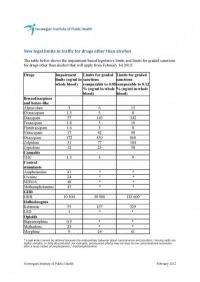
New legal limits in traffic for drugs other than alcohol : table showing the impairment based legislative limits and limits for graded sanctions for drugs other than alcohol, from Feb. 1, 2012. Credit: Copyright: Norwegian Institute of Public Health

Legal limits for twenty illegal drugs and medicines with an abuse potential have been introduced by the Norwegian government. Norway is the first country to define both impairment-based legislative limits and limits for graded sanctions for drugs other than alcohol. The Norwegian Institute of Public Health participated to provide the scientific basis for the new limits.

It is a criminal offence to drive a car or other motorised vehicle (mopeds, motorcycles, tractors, etc.) under the influence of alcohol, illegal drugs and medicines in Norway. Since 1936, there have been statutory limits on driving under the influence of alcohol, where the law "in all cases" assumes that driving skills are impaired. Since 2001, this limit has been 0.2 grams/litre. Punishment (fines, loss of driver's licence and / or imprisonment) is closely linked to alcohol levels in from the suspect.

20 substances covered by the new rules

There have not been similar limits for and medicines with an abuse potential (such as and ). In such cases, the degree of impairment has been assessed by in each case. This assessment was made based on the concentration of intoxicants in blood samples, results from the standard , and any other relevant information.

With effect from February 1st 2012, the government introduced fixed concentration limits for 20 substances with an abuse potential. This will result in more equal laws for alcohol and other intoxicants and the judiciary will use significantly fewer resources to pass judgment. It is also an important signal that influence by non-alcohol drugs is not compatible with safe driving.

Exception for prescribed medicines

The system does not apply to therapeutic use of medicines with an abuse potential prescribed by a doctor. In such cases, the current system of individual evaluation will be used. This is partly because the accident risk is considered to be less for therapeutic use than for sporadic, illegal use because of tolerance development and the beneficial effect of treatment.

No rapid tests yet

There are currently no reliable rapid tests that can be used to indicate the influence of drugs other than alcohol at the roadside. The police will still have to evaluate impairment by means of field sobriety tests. In cases where the police suspect driving under the influence of drugs, a blood sample is sent for analysis by the Norwegian Institute of Public Health, and in recent years the number of positive samples has remained well above 90 per cent.

Provided by Norwegian Institute of Public Health

not rated yet  

Rank not rated yet
Related Stories
Relevant PhysicsForums posts

More news stories

Feds fight morning-after pill age ruling in NY

(AP)—Department of Justice lawyers have again asked a federal appeals court in New York to delay lifting age restrictions and prescription requirements on an emergency contraceptive popularly known as the morning-after ...

Medications created 19 hours ago | popularity not rated yet | comments 0

Merck ends development of Parkinson's disease drug

(AP)—Merck & Co. says it is ending development of an experimental Parkinson's disease drug because the drug wasn't working.

Medications created May 23, 2013 | popularity 1 / 5 (1) | comments 0

J&J expects 10-plus new drug applications by 2017

(AP)—Johnson & Johnson is developing what could eventually be game-changing treatments for depression and pain, and it's aiming to apply for approval of more than 10 new medicines by 2017, executives said Thursday during ...

Medications created May 23, 2013 | popularity 5 / 5 (1) | comments 0

Experts favor US approval of Merck sleeping pill (Update)

An independent panel of experts on Wednesday recommended US approval of a new Merck sleeping pill called suvorexant, but expressed concerns over the highest dosage and risks of drowsy daytime driving.

Medications created May 22, 2013 | popularity not rated yet | comments 0

Glaxo, US partnering to develop new antibiotics

GlaxoSmithKline PLC says it's starting an unusual collaboration with the U.S. government to develop several antibiotics for both bioterrorism threats and bacterial infections resistant to current medicines.

Medications created May 22, 2013 | popularity not rated yet | comments 0


First drug to improve heart failure mortality in over a decade

Coenzyme Q10 decreases all cause mortality by half, according to the results of a multicentre randomised double blind trial presented today at Heart Failure 2013 congress. It is the first drug to improve heart failure mortality ...

Seniors more likely to crash when driving with pet, study finds

(HealthDay)—Animals make great companions for senior citizens, but elderly people who always drive with a pet in the car are far more likely to crash than those who never drive with a pet, researchers have ...

Heart failure accelerates male 'menopause'

Heart failure accelerates the aging process and brings on early andropausal syndrome (AS), according to research presented today at the Heart Failure Congress 2013. AS, also referred to as male 'menopause', was four times ...

New immune system discovered

(Medical Xpress)—A research team, led by Jeremy Barr, a biology post-doctoral fellow, unveils a new immune system that protects humans and animals from infection.

Death highest in heart failure patients admitted in January, on Friday, and overnight

Mortality and length of stay are highest in heart failure patients admitted in January, on Friday, and overnight, according to research presented today at the Heart Failure Congress 2013. The analysis of nearly 1 million ...

Brain can be trained in compassion, study shows

Until now, little was scientifically known about the human potential to cultivate compassion—the emotional state of caring for people who are suffering in a way that motivates altruistic behavior.