Just another pretty face: Professor investigates neural basis of prosopagnosia
February 1, 2012 in Psychology & Psychiatry
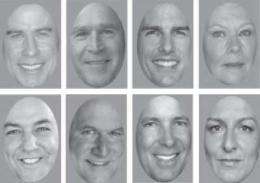
These are examples of famous faces and non-famous faces used in Bradley Duchaine’s prosopagnosia experiment. Paired famous and non-famous faces are shown in corresponding positions. Credit: Bradley Duchaine
For Bradley Duchaine, there is definitely more than meets the eye where faces are concerned.
With colleagues at Birkbeck College in the University of London, he is investigating the process of facial recognition, seeking to understand the complexity of what is actually taking place in the brain when one person looks at another.
His studies target people who display an inability to recognize faces, a condition long known as prosopagnosia. Duchaine is trying to understand the neural basis of the condition while also make inferences about what is going wrong in terms of information processingwhere in the stages that our brains go through to recognize a face is the system breaking down. A paper published in Brain details the most recent experimental results.
"We refer to prosopagnosia as a 'selective' deficit of face recognition, in that other cognitive process do not seem to be affected," explains Duchaine, an associate professor of psychological and brain sciences. "[People with the condition] might be able to recognize voices perfectly, which demonstrates that it is really a visual problem. In what we call pure cases, people can recognize cars perfectly, and they can recognize houses perfectly. It is just faces that are a problem."
The condition may be acquired as the result of a stroke, for example. But in the recent study, Duchaine focused on developmental prosopagnosia, in which a person fails to develop facial recognition abilities.
"Other parts of the brain develop apparently normally," Duchaine says. "These are intelligent people who have good jobs and get along fine but they can't recognize faces."
The primary experimental tool in this experiment was the electroencephalogram (EEG), which has the advantage of providing excellent temporal resolutionpinpointing the timing of the brain's electrical response to a given stimulus.
Duchaine and his colleagues placed a series of electrodes around the scalps of prosopagnosics and showed them images of famous faces and non-famous faces, recording their responses. As expected, many of the famous faces were not recognized.
They found an electrical response at about 250 milliseconds (ms) after seeing the faces. Among the control group of non-prosopagnosics, a real difference was observed between their responses to famous and non-famous faces. In half the prosopagnosics there was not. Surprisingly, however, in the other half of the prosopagnosic test subjects they did find a difference.
"On the many trials where half failed to categorize a famous face as familiar, they nevertheless showed an EEG difference around 250ms after stimulus presentation between famous and non-famous faces like normal subjects do. Normal subjects also show a difference between famous and non-famous about 600ms after presentation, but the prosopagnosics did not show this difference," Duchaine observes.
This pattern of results suggests the prosopagnosics unconsciously recognized the famous faces at an early stage (250ms) but this information was lost by the later stage (600ms). Duchaine concludes that even though they are not consciously aware that this is a famous face, some part of their brain at this stage in the process is aware and is recognizing that face, a phenomenon termed covert face recognition.
He suggests that the other half of the prosopagnosics, who showed no difference between responses at 250ms, were experiencing a malfunction in their face processing system already at this early stage suggesting a different type of prosopagnosia.
"The temporal lobe contains a number of face processing areas, so you can imagine there are many different ways that this system can malfunction. Not only can an area not work, connections between areas might not work yielding probably dozens of these different variants of this condition," he surmises.
Covert recognition has been demonstrated in prosopagnosia acquired through brain damage, but Duchaine's work is the first convincing demonstration of covert recognition in developmental prosopagnosia, the much more common form.
Provided by Dartmouth College
-
When the brain remembers but the patient doesn't
Jul 14, 2011 |
not rated yet |
0
-
Are you phonagnosic?
Oct 27, 2008 |
not rated yet |
0
-
The brain needs to remember faces in 3-dimensions
Sep 09, 2010 |
not rated yet |
0
-
Genes responsible for ability to recognize faces
Feb 22, 2010 |
not rated yet |
0
-
Face blindness research shows emotions are key in the study of face recognition
Sep 17, 2008 |
not rated yet |
0
-
Of mice and mental models: Neuroscientific implications of risk-optimized behavior in the mouse
May 25, 2012 |
not rated yet |
0
-
Limits to growth: Scientists identify key metastasis-enabling enzyme
May 22, 2012 |
5 / 5 (4) |
0
-
Seeing is as seeing does: Spatially-structured retinal input in early development of cortical maps
Apr 26, 2012 |
5 / 5 (4) |
1
-
Dreamless nights: Brain activity during nonrapid eye movement sleep
Apr 09, 2012 |
4.4 / 5 (12) |
0
-
Take your time: Neurobiology sheds light on the superiority of spaced vs. massed learning
Mar 28, 2012 |
4.5 / 5 (21) |
3
-
Potential Breakthrough in Seizure Control
19 hours ago
-
Popping/Cracked sternum.
May 25, 2012
-
Which Mental Illness Encompasses This Problem?
May 25, 2012
-
A question about drug tolerance
May 23, 2012
-
Poor nutrition leading to overeating?
May 23, 2012
-
Math and dyslexia?
May 21, 2012
- More from Physics Forums - Medical Sciences
More news stories
More mental health care urged for kids who self-harm
(HealthDay) -- Doctors have long known that some kids suffering severe emotional turmoil find relief in physical pain -- cutting or burning or sticking themselves with pins to achieve a form of release.
Psychology & Psychiatry
May 25, 2012 |
not rated yet |
0
Questionable research practices surprisingly common
(Medical Xpress) -- Not all scientific misconduct is flat-out fraud. Much falls into the murkier realm of questionable research practices. A new study finds that in one field, psychology, these practices are surprisingly ...
Psychology & Psychiatry
May 25, 2012 |
5 / 5 (1) |
0
|
Feeling strong emotions makes peoples' brains 'tick together'
Experiencing strong emotions synchronises brain activity across individuals, research team at Aalto University and Turku PET Centre in Finland has revealed.
Psychology & Psychiatry
May 24, 2012 |
5 / 5 (1) |
0
Formal recognition of PMDD will lift stigma for women
A decision to recognise premenstrual dysphoric disorder as a genuine psychiatric condition will finally provide validation for this awful and poorly understood syndrome and alleviate the stigma ...
Psychology & Psychiatry
May 24, 2012 |
2 / 5 (1) |
1
Long-term meditation leads to different brain organization
(Medical Xpress) -- People who practice mindfulness meditation learn to accept their feelings, emotions, and states of mind without judging or resisting them. They simply live in the moment.
Psychology & Psychiatry
May 24, 2012 |
5 / 5 (7) |
0
|
Keep food safety in mind this memorial day weekend
(HealthDay) -- Picnics, parades and cookouts are as much a part of Memorial Day weekend as tributes to the United States' war veterans.
Travel to high altitudes tied to Crohn's, colitis flare-ups
(HealthDay) -- People with inflammatory bowel disease, which includes Crohn's disease and colitis, may be at increased risk for flare-ups when they fly or travel to high altitudes for skiing or mountain climbing, ...
Family history of Alzheimer's affects functional connectivity
(HealthDay) -- Cognitively normal individuals with a family history of late-onset Alzheimer's disease (AD) may display lower resting state functional connectivity in the default mode network (DMN) of the brain, ...
Transvaginal mesh op restores pelvic organ prolapse at price
(HealthDay) -- Transvaginal mesh (TVM) procedures are effective for anatomical restoration of pelvic organ prolapse (POP), but patients report a worsening of sexual function following surgery, according to ...
Of mice and mental models: Neuroscientific implications of risk-optimized behavior in the mouse
(Medical Xpress) -- Regardless of an organism’s biological complexity, every encephalized animal continuously makes under-informed behavioral choices that can have serious consequences. Despite its ubiquity, ...
Weight struggles? Blame new neurons in your hypothalamus
New nerve cells formed in a select part of the brain could hold considerable sway over how much you eat and consequently weigh, new animal research by Johns Hopkins scientists suggests in a study published in the May issue ...
Feb 01, 2012
Rank: 3.8 / 5 (4)
Newborns are able to recognize what a face is and are able from very early ages to distinguish known faces from each other, and from the faces of strangers.
It has been speculated that the common dread of clowns comes from this instinct and the recognition that there is something inherently 'wrong' with a clown face.
Feb 01, 2012
Rank: not rated yet
Feb 01, 2012
Rank: not rated yet
To the medical community - which of the subjects or 'patients' do not recognize the image from a mirror of themselves?
Feb 02, 2012
Rank: not rated yet
Feb 02, 2012
Rank: not rated yet
For prevalnce according to groups (e.g. people who can recognize other's faces but not their own, people who can recognize neither, etc. )
see here:
http://idea.libra...rzin.pdf
Feb 02, 2012
Rank: not rated yet
Utter nonsense.