Scientists work to detach protein that HIV uses as protective shield
February 13, 2012 in HIV & AIDS
Scientists work to detach protein that HIV uses as protective shield

Enlarge

Andy Qigui Yu, M.D., Ph.D., assistant professor of microbiology and immunology at Indiana University School of Medicine, is researching a compound that could help the immune system, more effectively fight HIV. Credit: Indiana University

One of the frustrations for scientists working on HIV/AIDS treatments has been the human immunodeficiency virus' ability to evade the body's immune system. Now an Indiana University researcher has discovered a compound that could help put the immune system back in the hunt.

It's not that the human doesn't recognize HIV. Indeed, an infection causes the body to unleash antibodies that attack the virus, and initially some HIV is destroyed.

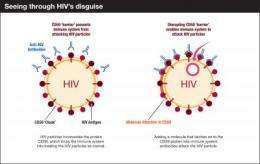
But HIV is able to quickly defend itself by co-opting a part of the innate — the immune system people are born with, called the complement. The complement includes a vital mechanism that prevents immune system cells from attacking the body's own cells. HIV is able to incorporate a key protein in that self-protection mechanism, CD59, and by doing so makes itself appear to be one of the body's normal cells, not an infective agent.

In laboratories at the Indiana University School of Medicine, Andy Qigui Yu, M.D., Ph.D., assistant professor of microbiology and immunology, is testing a promising compound that may counteract HIV's ability to hijack the immune system's protection mechanism.

"HIV is very clever. As it replicates inside cells, it takes on the CD59. The virus is covered with CD59, so the immune system treats the virus like your own normal cells," Dr. Yu said.

In November, the Bill & Melinda Gates Foundation announced it had awarded nine new Grand Challenges Explorations Phase II grants, one of them to Dr. Yu. The Phase II grants were awarded to researchers who had received initial $100,000 awards and had shown promising results.

The new grant will support not only Dr. Yu's research into compounds that may block the ability of HIV to hide behind the CD59 "cloak," but also his work to identify the mechanism the virus uses to incorporate CD59.

"If we find that mechanism, then we can develop something to block that incorporation, and HIV may lose that protection from the immune system," Dr. Yu said.

Researchers have been able in the past to generate antibodies that successfully attacked HIV in the laboratory. But these antibodies have failed in human testing because the virus in the body escapes from immune system attacks, Dr. Yu said.

In an attempt to disrupt HIV's hijacking of CD59, Yu and colleagues at IU and Harvard University crafted a molecule from a bacterial toxin that is known to bind to the CD59 protein. In laboratory tests, they administered the molecule to blood samples taken from patients with HIV. The bacteria toxin molecule latched on to the CD59 proteins, revealing the viral particles to be invaders and enabling the to attack the virus.

Reporting their findings in the Journal of Immunology in December 2010, the researchers suggested that the molecule could potentially be developed into a new therapy to fight /.

More recent experiments have indicated that the administration of the molecule enabled the antibody-complement to attack infected cells and not just the particles found in the blood samples. The next steps will include more extensive testing of the molecule in a broader range of patient samples, Dr. Yu said.

Provided by Indiana University School of Medicine

5 /5 (1 vote)  

Rank 5 /5 (1 vote)
Related Stories
Relevant PhysicsForums posts

More news stories

Mortality rates decrease, chronic disease rates increase among HIV+ ICU patients

The expanded use of antiretrovirals, potent drugs used to treat retroviral infections such as human immunodeficiency virus (HIV), has been linked to significant decreases in hospital mortality rates among severely ill HIV-positive(HIV+) ...

HIV & AIDS created May 23, 2012 | popularity not rated yet | comments 0

Newly discovered breast milk antibodies help neutralize HIV

Antibodies that help to stop the HIV virus have been found in breast milk. Researchers at Duke University Medical Center isolated the antibodies from immune cells called B cells in the breast milk of infected mothers in Malawi, ...

HIV & AIDS created May 22, 2012 | popularity 5 / 5 (3) | comments 1 | with audio podcast

Reactions to HIV drug have autoimmune cause, reports AIDS journal

Potentially severe hypersensitivity reactions to the anti-HIV drug abacavir occur through an autoimmune mechanism, resulting from the creation of drug-induced immunogens that are attacked by the body's immune system, according ...

HIV & AIDS created May 22, 2012 | popularity 5 / 5 (1) | comments 0

Is the U.S. ready for home HIV tests?

At the pharmacy, you can buy anything from tea kettles to Tylenol. But what if you could buy a rapid HIV test over the counter and test yourself in the privacy of your own home?

HIV & AIDS created May 21, 2012 | popularity not rated yet | comments 0 | with audio podcast

Reduced glycerin formulation of tenofovir vaginal gel safe for rectal use

A change in the formulation of tenofovir gel, an anti-HIV gel developed for vaginal use, may make it safer to use in the rectum, suggests a study published online this week in the Journal of Antimicrobial Chemotherapy. In lab ...

HIV & AIDS created May 17, 2012 | popularity 5 / 5 (1) | comments 0


Keep food safety in mind this memorial day weekend

(HealthDay) -- Picnics, parades and cookouts are as much a part of Memorial Day weekend as tributes to the United States' war veterans.

Travel to high altitudes tied to Crohn's, colitis flare-ups

(HealthDay) -- People with inflammatory bowel disease, which includes Crohn's disease and colitis, may be at increased risk for flare-ups when they fly or travel to high altitudes for skiing or mountain climbing, ...

Family history of Alzheimer's affects functional connectivity

(HealthDay) -- Cognitively normal individuals with a family history of late-onset Alzheimer's disease (AD) may display lower resting state functional connectivity in the default mode network (DMN) of the brain, ...

Transvaginal mesh op restores pelvic organ prolapse at price

(HealthDay) -- Transvaginal mesh (TVM) procedures are effective for anatomical restoration of pelvic organ prolapse (POP), but patients report a worsening of sexual function following surgery, according to ...

Of mice and mental models: Neuroscientific implications of risk-optimized behavior in the mouse

(Medical Xpress) -- Regardless of an organism’s biological complexity, every encephalized animal continuously makes under-informed behavioral choices that can have serious consequences. Despite its ubiquity, ...

Weight struggles? Blame new neurons in your hypothalamus

New nerve cells formed in a select part of the brain could hold considerable sway over how much you eat and consequently weigh, new animal research by Johns Hopkins scientists suggests in a study published in the May issue ...