Study: No significant rise in seizure risk from common kids' vaccine
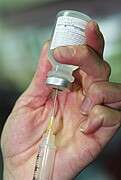
(HealthDay) -- Children who receive a combination vaccine known as DTaP-IPV-Hib have no significant increased risk of febrile seizure, a convulsion triggered by a fever, during the week after vaccination, researchers in Denmark report.
The vaccine protects children from five life-threatening illnesses: diptheria, tetanus, pertussis (whooping cough), polio and Haemophilus influenzae type b, a bacterium that causes meningitis.
The study also found no association between febrile seizures and developing epilepsy, a seizure disorder.
"These data indicate there is no significant risk associated with the combined DTaP-IPV-Hib vaccine," said Dr. Gary Freed, director of the child health evaluation and research unit at University of Michigan, Ann Arbor, who was not involved with the study. "There is no increased risk of epilepsy, and the risk of febrile seizures in the seven days following immunization showed no differences between those who were vaccinated and those who weren't."
The study is in the Feb. 22 issue of the Journal of the American Medical Association.
According to the U.S. National Institute of Neurological Disorders and Stroke, about one in 25 children, mainly between 6 months and 5 years old, will have at least one febrile seizure. They typically outgrow them.
Although scary for parents, febrile seizures are harmless, said Dr. David Kimberlin, a professor of pediatrics at University of Alabama at Birmingham. "They're not dangerous at all," Kimberlin said.
The full name for DTaP-IPV-Hib vaccine is "diphtheria-tetanus toxoids-acellular pertussis-inactivated poliovirus-Haemophilus influenzae type b."
In the study, researchers from Aarhus University analyzed records on nearly 400,000 children given the combined vaccine.
In Denmark, children get the combination vaccine at 3, 5 and 12 months. The U.S. vaccine schedule calls for kids' initial doses at 2, 4 and 6 months and a slightly different version of the pertussis vaccine, Kimberlin noted.
Slightly more than 2 percent of children (7,811) were diagnosed with febrile seizures before 18 months.
Researchers found a slightly increased risk of febrile seizures on the day of the first and second vaccine doses, but not on the day of the third vaccine dose.
And overall, children didn't have higher risks of febrile seizures the first week after the vaccinations compared with a group of children not vaccinated in the last week. The absolute risk of any one child having a febrile seizure remained very low -- about one for every 25,000 children vaccinated.
Experts say it's crucial for parents to get their children vaccinated on schedule to protect the kids -- and others around them -- from potentially devastating illnesses.
"The most important thing is parents continuing to get their kids immunized on schedule. The longer parents wait, the more their children are at risk of life-threatening diseases," Freed said.
Kimberlin suspects that the kids who had febrile seizures around the time of vaccination were probably already getting sick, the vaccine pushed their temperature up a little higher, "and they had the seizure a little bit sooner than they would have otherwise," he said.
Parental surveys and other research have documented a sizable contingent of parents who mistrust vaccines and who are either not getting their kids vaccinated, or who aren't getting their kids immunized on the recommended schedule.
Some of the fears stemmed from a long-since discredited report linking the measles-mumps-rubella vaccine to autism. That study was formally retracted by the journal that published it, and nearly all of the authors have repudiated it.
In 2010, California experienced the worse outbreak of pertussis in 60 years. At least 10 infants died during the outbreak, according to the U.S. Centers for Disease Control and Prevention.
Dr. Roya Samuels, a pediatrician at Cohen Children's Medical Center in New Hyde Park, N.Y., said numerous nationwide outbreaks of pertussis raise concerns about waning immunity in older children, teenagers and adults. "It is imperative that infants be fully vaccinated against this potentially life-threatening illness," she said.
Kimberlin added that other diseases are out there as well. Diptheria, a serious respiratory disease, still circulates in Russia, for example. "It's 12 hours away from us right now," Kimberlin said.
Polio, which can leave children paralyzed, is close to being eradicated worldwide, because of vaccines.
"At the turn of the 20th century, 16 of every 100 kids died of an infectious disease before age 5," Kimberlin added. "It was the norm to bury a child. It's not anymore and the reason is because of vaccines. Parents, please don't turn your back on this lifeline."
More information: Sun, Y. et al. J. Am. Med. Assoc. 307, 823–831 (2012).
Check out the recommended vaccine schedule for kids and adults at the U.S. Centers for Disease Control and Prevention.
Copyright © 2012 HealthDay. All rights reserved.


