It's not solitaire: Brain activity differs when one plays against others
February 6, 2012 in Neuroscience
It's not solitaire: Brain activity differs when one plays against others

Enlarge

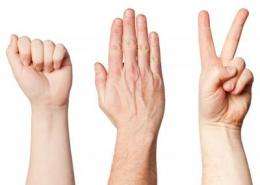
Rock, paper or scissors? Learning while playing a strategic game against others involves a different pattern of brain activity than learning from the consequences of one's own actions, researchers found. Credit: L. Brian Stauffer

Researchers have found a way to study how our brains assess the behavior – and likely future actions – of others during competitive social interactions. Their study, described in a paper in the Proceedings of the National Academy of Sciences, is the first to use a computational approach to tease out differing patterns of brain activity during these interactions, the researchers report.

"When players compete against each other in a game, they try to make a mental model of the other person's intentions, what they're going to do and how they're going to play, so they can play strategically against them," said University of Illinois postdoctoral researcher Kyle Mathewson, who conducted the study as a doctoral student in the Beckman Institute with graduate student Lusha Zhu and economics professor and Beckman affiliate Ming Hsu, who now is at the University of California, Berkeley. "We were interested in how this process happens in the ."

Previous studies have tended to consider only how one learns from the consequences of one's own actions, called reinforcement learning, Mathewson said. These studies have found heightened activity in the basal ganglia, a set of brain structures known to be involved in the control of muscle movements, goals and learning. Many of these structures signal via the neurotransmitter dopamine.

"That's been pretty well studied and it's been figured out that dopamine seems to carry the signal for learning about the outcome of our own actions," Mathewson said. "But how we learn from the actions of other people wasn't very well characterized."

Researchers call this type of learning "belief learning."

To better understand how the brain processes information in a competitive setting, the researchers used functional magnetic resonance imaging (fMRI) to track activity in the brains of participants while they played a competitive game, called a Patent Race, against other players. The goal of the game was to invest more than one's opponent in each round to win a prize (a patent worth considerably more than the amount wagered), while minimizing one's own losses (the amount wagered in each trial was lost). The fMRI tracked activity at the moment the player learned the outcome of the trial and how much his or her opponent had wagered.

A computational model evaluated the players' strategies and the outcomes of the trials to map the brain regions involved in each type of learning.

"Both types of learning were tracked by activity in the ventral striatum, which is part of the basal ganglia," Mathewson said. "That's traditionally known to be involved in reinforcement learning, so we were a little bit surprised to see that belief learning also was represented in that area."

Belief learning also spurred activity in the rostral anterior cingulate, a structure deep in the front of the brain. This region is known to be involved in error processing, regret and "learning with a more social and emotional flavor," Mathewson said.

The findings offer new insight into the workings of the brain as it is engaged in strategic thinking, Hsu said, and may aid the understanding of neuropsychiatric illnesses that undermine those processes.

"There are a number of mental disorders that affect the brain circuits implicated in our study," Hsu said. "These include schizophrenia, depression and Parkinson's disease. They all affect these dopaminergic regions in the frontal and striatal brain areas. So to the degree that we can better understand these ubiquitous social functions in strategic settings, it may help us understand how to characterize and, eventually, treat the social deficits that are symptoms of these diseases."

Journal reference: Proceedings of the National Academy of Sciences search and more info website

Provided by University of Illinois at Urbana-Champaign search and more info website

4.8 /5 (6 votes)  

Filter


Move the slider to adjust rank threshold, so that you can hide some of the comments.


Display comments: newest first

tadchem
Feb 06, 2012

Rank: not rated yet
This is relevant to studies in autistic spectrum disorders. Autistic people do not connect 'emotions' with physical activity within themselves as well as unaffected people.
These are NOT 'ubiquitous social functions' for the autistic.
Consequently we have difficulty in recognizing the visual cues of emotions in others' facial expressions.
While we may have a keener understanding of game mechanics, we are deficient in the gamesmanship aspect of reading our opponents' "tells" - physical manifestations of their thoughts and moods.
Call it a 'disease' if you will; you will only mislead yourself and inhibit your own understanding. This is a genetically linked alternative brain structure 'option.'
Tausch
Feb 06, 2012

Rank: not rated yet
"When players compete against each other in a game, they try to make a mental model of the other person's intentions, what they're going to do and how they're going to play, so they can play strategically against them," said University of Illinois postdoctoral researcher Kyle Mathewson, who conducted the study as a doctoral student in the Beckman Institute with graduate student Lusha Zhu and economics professor and Beckman affiliate Ming Hsu..


Let's say chess players of elo >2400 all disagree with you!
:)
Rank 4.8 /5 (6 votes)
Relevant PhysicsForums posts
  • Potential Breakthrough in Seizure Control
    created19 hours ago
  • Popping/Cracked sternum.
    createdMay 25, 2012
  • Which Mental Illness Encompasses This Problem?
    createdMay 25, 2012
  • A question about drug tolerance
    createdMay 23, 2012
  • Poor nutrition leading to overeating?
    createdMay 23, 2012
  • Math and dyslexia?
    createdMay 21, 2012
  • More from Physics Forums - Medical Sciences

More news stories

Of mice and mental models: Neuroscientific implications of risk-optimized behavior in the mouse

(Medical Xpress) -- Regardless of an organism’s biological complexity, every encephalized animal continuously makes under-informed behavioral choices that can have serious consequences. Despite its ubiquity, ...

Neuroscience created May 25, 2012 | popularity not rated yet | comments 0 | with audio podcast feature

Persistent sensory experience is good for aging brain

Despite a long-held scientific belief that much of the wiring of the brain is fixed by the time of adolescence, a new study shows that changes in sensory experience can cause massive rewiring of the brain, even as one ages. ...

Neuroscience created May 24, 2012 | popularity not rated yet | comments 0

Boundary stops molecule right where it needs to be

A molecule responsible for the proper formation of a key portion of the nervous system finds its way to the proper place not because it is actively recruited, but instead because it can't go anywhere else.

Neuroscience created May 24, 2012 | popularity not rated yet | comments 0 | with audio podcast

Locating ground zero: How the brain's emergency workers find the disaster area

Like emergency workers rushing to a disaster scene, cells called microglia speed to places where the brain has been injured, to contain the damage by 'eating up' any cellular debris and dead or dying neurons. ...

Neuroscience created May 24, 2012 | popularity 5 / 5 (2) | comments 0 | with audio podcast

Genetic 'reset switch' enables signaling pathway to induce multiple developmental outcomes for olfactory neurons

Within the nervous system, a handful of signaling pathways modulate development of a cornucopia of different neuronal subtypes. “Even small alterations in neuron differentiation pathways can disrupt subsequent ...

Neuroscience created May 24, 2012 | popularity not rated yet | comments 0


Keep food safety in mind this memorial day weekend

(HealthDay) -- Picnics, parades and cookouts are as much a part of Memorial Day weekend as tributes to the United States' war veterans.

Travel to high altitudes tied to Crohn's, colitis flare-ups

(HealthDay) -- People with inflammatory bowel disease, which includes Crohn's disease and colitis, may be at increased risk for flare-ups when they fly or travel to high altitudes for skiing or mountain climbing, ...

Family history of Alzheimer's affects functional connectivity

(HealthDay) -- Cognitively normal individuals with a family history of late-onset Alzheimer's disease (AD) may display lower resting state functional connectivity in the default mode network (DMN) of the brain, ...

Transvaginal mesh op restores pelvic organ prolapse at price

(HealthDay) -- Transvaginal mesh (TVM) procedures are effective for anatomical restoration of pelvic organ prolapse (POP), but patients report a worsening of sexual function following surgery, according to ...

Weight struggles? Blame new neurons in your hypothalamus

New nerve cells formed in a select part of the brain could hold considerable sway over how much you eat and consequently weigh, new animal research by Johns Hopkins scientists suggests in a study published in the May issue ...

Color-changing contact lenses to help diabetics (w/ Video)

For the millions of Americans with diabetes, the inconvenient and often painful method of testing blood sugar levels is a way of life. But research and innovative product design by scientists at The University of Akron may ...