February 6, 2012 report
Research team takes new approach to studying differences between human and monkey brains
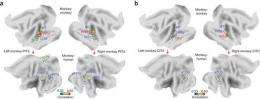
(Medical Xpress) -- In order to provide more insight into how human and monkey brains are similar and how they’re different, a research team has taken a different approach to studying both to find out which parts of the brains of each respond in similar ways, and which, if any, differ, when exposed to a shared experience. In this case, the team, as they describe in their paper published in Nature Methods, describe how they exposed groups of humans and monkeys to the same section of a Hollywood movie, while monitoring them via fMRI and found some brain areas responded in both groups as expected, while others were a complete surprise.
Researchers have known for some time that if several people watch the same movie, the same general parts of their brains light up during the same scenes (referred to as neurocinematics) suggesting a rough commonality in how people perceive the same stimuli. Other species have been shown to demonstrate the same basic trait. What’s not been studied is how certain parts of brain reactions compare between humans and other species; this is because most prior studies comparing human and monkey brains tended to rest on the underlying assumption that the two shared the same basic physiology, i.e. both use the same basic brain regions to do the same kinds of mental processing.
In this new research, the team set out to challenge this idea. They wondered if perhaps as the human brain evolved, some brain functions might have shifted to other regions. To find out, or at least to learn more, they enlisted 24 human volunteers and four rhesus monkeys. Both groups were tested individually by exposing them to the same thirty minute segment from the movie, the “The Good, The Bad and The Ugly” starring Clint Eastwood, while also performing brain scans using fMRI.
Not surprisingly, they found many instances where the human and monkey brains lit up in basically the same ways. Those brain regions responsible for vision, for example, all responded to changes on the screen by lighting up the part of the cortex known to be responsible for performing those chores.
The team also found some significant differences too however, such as in parts of the visual cortex that are involved in making sense of what is seen. In this case, some areas were activated in completely different parts of the brain and in other cases activations were delayed in time, suggesting the two species use different parts of the their brains to perform some of the same basic functions.
These findings don’t of course prove that humans have moved functionality over time, as it’s possible the monkeys simply grew bored watching scenes unfold they couldn’t understand, but it does shed some light on the idea that human brains really aren’t just bigger, fancier versions of monkey brains, but are more evolved in ways that aren’t really understood at all.
More information: Interspecies activity correlations reveal functional correspondence between monkey and human brain areas, Nature Methods (2012) doi:10.1038/nmeth.1868
Abstract
Evolution-driven functional changes in the primate brain are typically assessed by aligning monkey and human activation maps using cortical surface expansion models. These models use putative homologous areas as registration landmarks, assuming they are functionally correspondent. For cases in which functional changes have occurred in an area, this assumption prohibits to reveal whether other areas may have assumed lost functions. Here we describe a method to examine functional correspondences across species. Without making spatial assumptions, we assessed similarities in sensory-driven functional magnetic resonance imaging responses between monkey (Macaca mulatta) and human brain areas by temporal correlation. Using natural vision data, we revealed regions for which functional processing has shifted to topologically divergent locations during evolution. We conclude that substantial evolution-driven functional reorganizations have occurred, not always consistent with cortical expansion processes. This framework for evaluating changes in functional architecture is crucial to building more accurate evolutionary models.
© 2011 PhysOrg.com


