Atlas shows how genes organize the surface of the brain
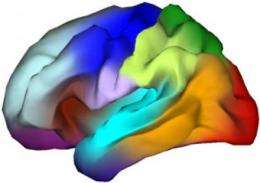
The first atlas of the surface of the human brain based upon genetic information has been produced by a national team of scientists, led by researchers at the University of California, San Diego School of Medicine and the VA San Diego Healthcare System. The work is published in the March 30 issue of the journal Science.
The atlas reveals that the cerebral cortex – the sheet of neural tissue enveloping the brain – is roughly divided into genetic divisions that differ from other brain maps based on physiology or function. The genetic atlas provides scientists with a new tool for studying and explaining how the brain works, particularly the involvement of genes.
"Genetics are important to understanding all kinds of biological phenomena," said William S. Kremen, PhD, professor of psychiatry at the UC San Diego School of Medicine and co-senior author with Anders M. Dale, PhD, professor of radiology, neurosciences, and psychiatry, also at the UC San Diego School of Medicine.
According to Chi-Hua Chen, PhD, first author and a postdoctoral fellow in the UC San Diego Department of Psychiatry, "If we can understand the genetic underpinnings of the brain, we can get a better idea of how it develops and works, information we can then use to ultimately improve treatments for diseases and disorders."
The human cerebral cortex, characterized by distinctive twisting folds and fissures called sulci, is just 0.08 to 0.16 inches thick, but contains multiple layers of interconnected neurons with key roles in memory, attention, language, cognition and consciousness.
Other atlases have mapped the brain by cytoarchitecture – differences in tissues or function. The new map is based entirely upon genetic information derived from magnetic resonance imaging (MRI) of 406 adult twins participating in the Vietnam Era Twin Registry (VETSA), an ongoing longitudinal study of cognitive aging supported in part by grants from the National Institutes of Health (NIH). It follows a related study published last year by Kremen, Dale and colleagues that affirmed the human cortical regionalization is similar to and consistent with patterns found in other mammals, evidence of a common conservation mechanism in evolution.
"We are excited by the development of this new atlas, which we hope will help us understand aging-related changes in brain structure and cognitive function now occurring in the VETSA participants," said Jonathan W. King, PhD, of the National Institute on Aging, part of the NIH.
The atlas plots genetic correlations between different points on the cortical surface of the twins' brains. The correlations represent shared genetic influences and reveal that genetic brain divisions do not map one-to-one with traditional brain divisions that are based on structure and function. "Yet, the pattern of this genetic map still suggests that it is neuroanatomically meaningful," said Kremen.
Kremen said the genetic brain atlas may be especially useful for scientists who employ genome-wide association studies, a relatively new tool that looks for common genetic variants in people that may be associated with a particular trait, condition or disease.


