CDC launching graphic anti-smoking ad campaign
March 15, 2012 By MIKE STOBBE , AP Medical Writer in Health
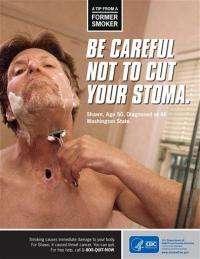
This image provided on Wednesday, March 14, 2012 by the Centers for Disease Control shows Shawn Wright who had a tracheotomy after being diagnosed with head and neck cancer. Tobacco taxes and smoking bans haven't budged the U.S. smoking rate in years. Now the government is trying to shock smokers into quitting with a graphic nationwide advertising campaign. (AP Photo/Centers for Disease Control)
(AP) -- Tobacco taxes and smoking bans haven't budged the U.S. smoking rate in years. Now the government is trying to shock smokers into quitting with a graphic nationwide advertising campaign.
The billboards and print, radio and TV ads show people whose smoking resulted in heart surgery, a tracheotomy, lost limbs or paralysis. The $54 million campaign is the largest and starkest anti-smoking push by the Centers for Disease Control and Prevention and its first national advertising effort.
The agency is hoping the spots, which begin Monday, will persuade as many as 50,000 Americans to stop smoking.
"This is incredibly important. It's not every day we release something that will save thousands of lives," CDC Director Dr. Thomas Frieden said in a telephone interview.
That bold prediction is based on earlier research that found aggressive anti-smoking campaigns using hard-hitting images sometimes led to decreases in smoking. After decades of decline, the U.S. smoking rate has stalled at about 20 percent in recent years.
Advocates say it's important to jolt a weary public that has been listening to government warnings about the dangers of smoking for nearly 50 years.
"There is an urgent need for this media campaign," Matthew Myers, president of the Campaign for Tobacco-Free Kids, said in a statement.
The CDC was set to announce the three-month campaign on Thursday.
One of the print ads features Shawn Wright from Washington state who had a tracheotomy after being diagnosed with head and neck cancer four years ago. The ad shows the 50-year-old shaving, his razor moving down toward a red gaping hole at the base of his neck that he uses to speak and breathe.
An advertising firm, Arnold Worldwide, found Wright and about a dozen others who developed cancer or other health problems after smoking for the ads.
Federal health agencies have gradually embraced graphic anti-smoking imagery. Last year, the Food and Drug Administration approved nine images to be displayed on cigarette packages. Among them were a man exhaling cigarette smoke through a tracheotomy hole in his throat, and a diseased mouth with what appear to be cancerous lesions.
Last month, a federal judge blocked the requirement that tobacco companies put the images on their packages, saying it was unconstitutional.
Graphic ads are meant to create an image so striking that smokers and would-be smokers will think of it whenever they have an urge to buy a pack of cigarettes, said Glenn Leshner, a University of Missouri researcher who has studied the effectiveness of anti-smoking ads.
Leshner and his colleagues found that some ads are so disturbing that people reacted by turning away from the message rather than listening. So while spots can shock viewers into paying attention, they also have to encourage people that quitting is possible, he said.
The CDC campaign includes information on a national quit line and offers advice on how to kick the habit, CDC officials said.
More information: CDC: http://www.cdc.gov/tobacco/
©2012 The Associated Press. All rights reserved. This material may not be published, broadcast, rewritten or redistributed.
-
Smoking rate has plummeted in New York City
Jun 21, 2007 |
not rated yet |
0
-
US smoking rate still stuck at 1 in 5 adults
Sep 07, 2010 |
not rated yet |
0
-
Cigarette health warnings push smokers to quit: study
May 26, 2011 |
not rated yet |
0
-
Adult smoking rate edges down slightly: CDC data
Sep 06, 2011 |
not rated yet |
0
-
Tobacco firms sue US over graphic cigarette labels
Aug 17, 2011 |
not rated yet |
0
-
Motion perception revisited: High Phi effect challenges established motion perception assumptions
Apr 23, 2013 |
3 / 5 (2) |
2
-
Anything you can do I can do better: Neuromolecular foundations of the superiority illusion (Update)
Apr 02, 2013 |
4.5 / 5 (11) |
5
-
The visual system as economist: Neural resource allocation in visual adaptation
Mar 30, 2013 |
5 / 5 (2) |
9
-
Separate lives: Neuronal and organismal lifespans decoupled
Mar 27, 2013 |
4.9 / 5 (8) |
0
-
Sizing things up: The evolutionary neurobiology of scale invariance
Feb 28, 2013 |
4.8 / 5 (10) |
14
-
Classical and Quantum Mechanics via Lie algebras
Apr 15, 2011
- More from Physics Forums - Independent Research
More news stories
Survey reveals the success of personal budgets in social care
Over 70 per cent of people who hold a personal budget for social care said it led to greater independence and support according to the latest survey.
Health
2 hours ago |
not rated yet |
0
Scientists develop smartphone 'assistance agent' for older people
A new smartphone application, developed by scientists at the University of Ulster, which could help older people engage fully in an increasingly self-serve society, may be ready for use by the end of the ...
Health
3 hours ago |
not rated yet |
0
Can you put a price on health?
As health services strive to improve quality and reduce costs, researchers study the benefits – and the pitfalls – of 'pay for performance' in hospitals.
Health
3 hours ago |
not rated yet |
0
|
Air travel during pregnancy poses no significant risk, say experts
(Medical Xpress)—There is no significant risk directly associated with air travel during pregnancy, even at advanced gestation, says report by the University of Liverpool.
Health
3 hours ago |
not rated yet |
0
50 percent of Australians who oppose vaccination get their information from the Internet
To coincide with the broadcast of Jabbed: Love, Fear and Vaccines (SBS ONE, Sunday 26 May at 8.30pm) the first ever national survey on Australian attitudes to vaccination reveals surprising statistics including half of Australians ...
Health
3 hours ago |
not rated yet |
0
Researchers suggest boosting body's natural flu killers
A known difficulty in fighting influenza (flu) is the ability of the flu viruses to mutate and thus evade various medications that were previously found to be effective. Researchers at the Hebrew University of Jerusalem have ...
Anxious men fare worse during job interviews, study finds
Nervous about that upcoming job interview? You might want to take steps to reduce your jitters, especially if you are a man.
Breakthrough on Huntington's disease
Researchers at Lund University have succeeded in preventing very early symptoms of Huntington's disease, depression and anxiety, by deactivating the mutated huntingtin protein in the brains of mice.
Frequent heartburn may predict cancers of the throat and vocal cord
Frequent heartburn was positively associated with cancers of the throat and vocal cord among nonsmokers and nondrinkers, and the use of antacids, but not prescription medications, had a protective effect, according to data ...
Second-generation TAVI device—Lotus Valve—shows good performance in REPRISE II
22 May 2013, Paris, France: The Lotus Valve, a second-generation transcatheter aortic valve implantation (TAVI) device, was successfully implanted in all of the first 60 patients in results from REPRISE II reported at EuroPCR ...
Major human drug trial underway for Alzheimer's
A potentially ground-breaking human drug trial is currently underway, which aims to discover whether blood pressure medication can slow or halt the progression of Alzheimer's Disease (AD). This is the latest ...