Dengue virus turns on mosquito genes that make them hungrier
March 29, 2012 in Diseases, Conditions, Syndromes
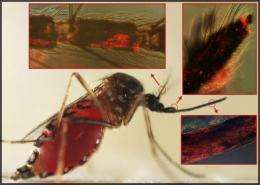
This picture shows the presence of the dengue virus in the mosquitoes chemosensory (antennae and palp) and feeding organs (proboscis). Credit: Johns Hopkins Bloomberg School of Public Health
Researchers at the Johns Hopkins Bloomberg School of Public Health have, for the first time, shown that infection with dengue virus turns on mosquito genes that makes them hungrier and better feeders, and therefore possibly more likely to spread the disease to humans. Specifically, they found that dengue virus infection of the mosquito's salivary gland triggered a response that involved genes of the insect's immune system, feeding behavior and the mosquito's ability to sense odors. The researchers findings are published in the March 29 edition of PLoS Pathogens.
Dengue virus is primarily spread to people by the mosquito Aedes aegypti. Over 2.5 billion people live in areas where dengue fever is endemic. The World Health Organization estimates that there are between 50 million and 100 million dengue infections each year.
"Our study shows that the dengue virus infects mosquito organs, the salivary glands and antennae that are essential for finding and feeding on a human host. This infection induces odorant-binding protein genes, which enable the mosquito to sense odors. The virus may, therefore, facilitate the mosquito's host-seeking ability, and couldat least theoreticallyincrease transmission efficiency, although we don't fully understand the relationships between feeding efficiency and virus transmission," said George Dimopoulus, PhD, senior author of the study and professor with the Bloomberg School's Malaria Research Institute. "In other words, a hungrier mosquito with a better ability to sense food is more likely to spread dengue virus."
For the study, researchers performed a genome-wide microarray gene expression analysis of dengue-infected mosquitoes. Infection regulated 147 genes with predicted functions in various processes including virus transmission, immunity, blood-feeding and host-seeking. Further analysis of infected mosquitoes showed that silencing, or "switching off," two odorant-binding protein genes resulted in an overall reduction in the mosquito's blood-acquisition capacity from a single host by increasing the time it took the for mosquito to probe for a meal.
"We have, for the first time shown, that a human pathogen can modulate feeding-related genes and behavior of its vector mosquito, and the impact of this on transmission of disease could be significant," said Dimopoulos.
"Dengue virus infection of the Aedes aegypti salivary gland and chemosensory apparatus induces genes that modulate infection and blood-feeding behavior" was written by Shuzhen Sim, Jose L. Ramirez and George Dimopoulos.
More information: S Sim et al. Dengue virus infection of the Aedes aegypti salivary gland and chemosensory apparatus induces genes that modulate infection and blood-feeding behavior. PLoS Pathogens DOI: 10.1371/journal.ppat.1002631 (2012). dx.plos.org/10.137… ppat.1002631
Provided by
Johns Hopkins University Bloomberg School of Public Health
-
Researchers determine how mosquitoes survive dengue virus infection
Feb 13, 2009 |
not rated yet |
0
-
Smaller mosquitoes are more likey to be infected with viruses causing human diseases
Nov 03, 2008 |
not rated yet |
0
-
Specialized mosquitoes may fight tropical disease
Aug 24, 2011 |
not rated yet |
0
-
Scientists find bacterium can halt dengue virus transmission
Apr 01, 2010 |
not rated yet |
0
-
Scientists closing the zap on dengue fever
Jan 01, 2009 |
not rated yet |
0
-
Motion perception revisited: High Phi effect challenges established motion perception assumptions
Apr 23, 2013 |
3 / 5 (2) |
2
-
Anything you can do I can do better: Neuromolecular foundations of the superiority illusion (Update)
Apr 02, 2013 |
4.5 / 5 (11) |
5
-
The visual system as economist: Neural resource allocation in visual adaptation
Mar 30, 2013 |
5 / 5 (2) |
9
-
Separate lives: Neuronal and organismal lifespans decoupled
Mar 27, 2013 |
4.9 / 5 (8) |
0
-
Sizing things up: The evolutionary neurobiology of scale invariance
Feb 28, 2013 |
4.8 / 5 (10) |
14
-
Classical and Quantum Mechanics via Lie algebras
Apr 15, 2011
- More from Physics Forums - Independent Research
More news stories
Mild hypothyroidism raises mortality risk among heart failure patients
Patients with underlying heart failure are more likely to experience adverse outcomes from mild hypothyroidism, according to a recent study accepted for publication in The Endocrine Society's Journal of Clinical Endocrinology & ...
Diseases, Conditions, Syndromes
1 hour ago |
not rated yet |
0
Acne treatment: Natural substance-based formula is more effective than artificial compounds
University of Granada scientists have patented a new treatment for acne that is based on completely natural substances and is much more effective than artificial formulas because it does not create resistance ...
Diseases, Conditions, Syndromes
3 hours ago |
not rated yet |
0
Study finds COPD is over-diagnosed among uninsured patients
More than 40 percent of patients being treated for COPD at a federally funded clinic did not have the disease, researchers found after evaluating the patients with spirometry, the diagnostic "gold standard" for chronic obstructive ...
Diseases, Conditions, Syndromes
5 hours ago |
not rated yet |
0
Mysterious illness kills two in southeast Alabama
(AP)—Alabama health officials say a mysterious respiratory illness has left five people hospitalized and two dead in the southeastern part of the state.
Diseases, Conditions, Syndromes
8 hours ago |
not rated yet |
0
Researchers find genetic risk factor for pulmonary fibrosis
A paper recently published in the New England Journal of Medicine and co-written by physicians and scientists at the University of Colorado School of Medicine finds that an important genetic risk factor for pulmonary fibros ...
Diseases, Conditions, Syndromes
21 hours ago |
not rated yet |
0
Enzyme-activating antibodies revealed as marker for most severe form of rheumatoid arthritis
In a series of lab experiments designed to unravel the workings of a key enzyme widely considered a possible trigger of rheumatoid arthritis, researchers at Johns Hopkins have found that in the most severe ...
Researchers complete largest genetic sequencing study of human disease
Researchers from Queen Mary, University of London have led the largest sequencing study of human disease to date, investigating the genetic basis of six autoimmune diseases.
Slowing the aging process—only with antibiotics
Swiss scientists reveal the mechanism responsible for aging hidden deep within mitochondria—and dramatically slow it down in worms by administering antibiotics to the young.
Research offers promising new approach to treatment of lung cancer
Researchers have developed a new drug delivery system that allows inhalation of chemotherapeutic drugs to help treat lung cancer, and in laboratory and animal tests it appears to reduce the systemic damage ...
Overeating learned in infancy, study suggests
In the long run, encouraging a baby to finish the last ounce in their bottle might be doing more harm than good.
Researchers analyse hunting behaviour of fish larvae in virtual reality
Moving objects attract greater attention – a fact exploited by video screens in public spaces and animated advertising banners on the Internet. For most animal species, moving objects also play a major ...