Shining light in the ears may alleviate SAD symptoms
March 7, 2012 by Lisa Zyga in Medical research report

sad light therapy

Enlarge

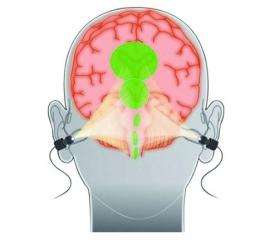
Light shone in the ears reaches light-sensitive proteins on the brain's surface. Image credit: Valkee

(Medical Xpress) -- Millions of people experience depression and lower levels of energy in the winter due to seasonal-affective disorder (SAD), or the “winter blues.” Since the disorder is thought to arise due to a shortage of natural light, one common form of treatment is light therapy, in which the person sits in front of a bright, full-spectrum light at certain times of day. But the effectiveness of light therapy has been unclear, and now researchers from Oulu, Finland, think they know why: light-sensitive regions of the brain may actually play a larger role in SAD symptoms than those in the eyes. For this reason, they’ve designed earphones that shine light through the ear canal to light-sensitive proteins on the brain’s surface, with encouraging results.

Juuso Nissilä, a physiologist at Oulu University, designed the device after his research revealed light-sensitive proteins on the surface of animal brains. Investigating further, he discovered that a light-sensitive protein found on the human retina, opsin-3, is also located in 18 separate regions of the human brain. Further, the proteins are abundant in areas involved with the production and storage of the neurotransmitters serotonin, melatonin, and dopamine, which are involved in mood and sleep. Nissilä explains that these proteins in the brain, not those in the eyes, may have the greater impact on mood fluctuations associated with daylight changes. And the may be the best way to reach these areas.
sad light therapy
Enlarge

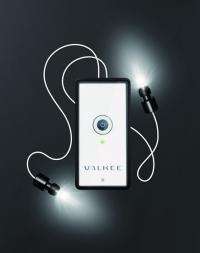
The bright light headset contains white LEDs that produce wavelengths close to that of sunlight. Image credit: Valkee

“Shining into the brain through the ears is a far better way to deliver bright than staring at a lamp,” Nissilä said. “There’s no evidence that shining light in your eyes has any effect on mood, whereas we now have evidence that these brain-surface proteins are involved. Bone is actually quite a good transmitter of light - put a torch inside a skull and you’ll see the beam very clearly - so I now think that it’s the light reaching your brain surface through your skull which is the important factor.

“There are two good reasons to use the ears,” he added. “The first is that the skull is thin around the ear canal area, and a very good proportion of the light gets through. The second is that there are comparatively few blood vessels on the surface of the brain at that point,” and blood strongly absorbs light.

In order to develop a bright light headset, Nissilä co-founded a company called Valkee. The devices they make contain a white LED in each earphone that produce wavelengths close to that of sunlight, although the company says that the bluer wavelengths have the strongest effect.

Researchers at Valkee have recently published the results from their first clinical trial in the journal Medical Hypothesis. In the trial, patients received 8-12 minutes of 6.0-8.5 lumen bright light daily into both ear canals for four weeks. The results showed that 92% of the patients with severe SAD symptoms achieved full remission when measured by a self-rated questionnaire designed for psychological studies, and 77% as measured by a psychiatrist-rated questionnaire. Given the positive results, the researchers plan to further investigate the therapy with randomized placebo-controlled and dose-finding study designs.

The headset is commercially available in Europe for £185 ($290), but cannot yet be shipped to the US. On Valkee’s website, the company claims that the headset can treat mood conditions like anxiety, tiredness and reduced cognitive performance due to SAD. The researchers are also investigating whether the device can be used for jet lag and migraines.

More information: Markku Timonen, et al. “Can transcranial brain-targeted bright light treatment via ear canals be effective in relieving symptoms in seasonal affective disorder? - A pilot study.” Med Hypotheses (2012), DOI:10.1016/j.mehy.2012.01.019

via: The Engineer

© 2011 PhysOrg.com

4.9 /5 (9 votes)  

Filter


Move the slider to adjust rank threshold, so that you can hide some of the comments.


Display comments: newest first

Eikka
Mar 07, 2012

Rank: 5 / 5 (1)
Pretty smart to set the company up before the final results arrive. That way you can establish a presence on the market before the effect is declared bunk, and the initial marketing push creates a popular following to the idea regardless.

Fantastic news travel faster than the truth that follows.
wealthychef
Mar 07, 2012

Rank: not rated yet
Yes, will there be a study on whether this therapy actually works? :-)
hemitite
Mar 07, 2012

Rank: not rated yet
So does this have anything to do with that light bulb that pops up when someone has an idea?
ormondotvos
Mar 07, 2012

Rank: not rated yet
RIDICULOUS price. Two LEDs and a battery?
Daylight LEDs retail at six bucks each.
gwrede
Mar 07, 2012

Rank: not rated yet
But hey, these are Very Special Extra Continuous Smooth Non-interrupted-spectrum Real Daylight Leds, manufactured to their specifications, in small series!

It pays to be careful with dosage and quality even if you are using snake oil.
Tausch
Mar 07, 2012

Rank: not rated yet
lol
"Shedding light" acquires a new twist.
jimbo92107
Mar 07, 2012

Rank: not rated yet
Now fellows, don't conclude this is a scam before the rumors are confirmed...to be rumors.

By the way, you could rig up something like this yourself for about twenty bucks. Buy a couple USB reading LED's, then strap them to an old set of ear phones. Guaranteed the savings will relieve depression, and all your friends will giggle with glee.
jgreen
Mar 07, 2012

Rank: 4 / 5 (1)
Just tried this experiment minutes ago on myself.

All that resulted was the light providing an extremely subtle sensation of warmth in my left ear, while a beam of light simultaneously began emanating from within my right ear thus causing the emanating light to reflect on the wall 2 feet away.

I will now attempt to interpret the results and write a paper!

JRi
Mar 08, 2012

Rank: not rated yet
They have also found that reaction rate of ice hockey players improved by ~20% during winter time by using ear lights. For me, it is still hard to believe this really works, but I may as well give it a try next winter. Don't know if I'm going to do it with these expensive devices, but rather try something home built device.

http://translate....aukaloon
Veneficus
Mar 08, 2012

Rank: not rated yet
This one has actually been around for a wile, but apparently they just released some "research".
If I understand correctly from this article, they haven't done any placebo studies yet, so the effect they describe could be a placebo effect, or indeed an effect of a slight increase in temperature, not the light.
I'll wait for the randomized clinical trials to be completed before jumping to conclusions...
barakn
Mar 08, 2012

Rank: 5 / 5 (1)
Good news, people, Opsin-3 is also found in large quantities in testes. Now nobody will see your goofy ear lights because they'll be down your pants.
cyberCMDR
Mar 10, 2012

Rank: 5 / 5 (1)
Ah, they've got that ear caught in the headlights look!
Rank 4.9 /5 (9 votes)
Related Stories
Relevant PhysicsForums posts

More news stories

Baby's life saved with groundbreaking 3-D printed device that restored his breathing

Every day, their baby stopped breathing, his collapsed bronchus blocking the crucial flow of air to his lungs. April and Bryan Gionfriddo watched helplessly, just praying that somehow the dire predictions ...

Medical research created 13 hours ago | popularity 5 / 5 (2) | comments 0

Research shows how immune system peacefully co-exists with 'good' bacteria

The human gut is loaded with commensal bacteria – "good" microbes that, among other functions, help the body digest food. The gastrointestinal tract contains literally trillions of such cells, and yet the ...

Medical research created 17 hours ago | popularity 5 / 5 (3) | comments 0 | with audio podcast

Slowing the aging process—only with antibiotics

Swiss scientists reveal the mechanism responsible for aging hidden deep within mitochondria—and dramatically slow it down in worms by administering antibiotics to the young.

Medical research created 17 hours ago | popularity 4.9 / 5 (9) | comments 1 | with audio podcast

How healthy are you for your age?

On May 22, JoVE will publish details of a technique to measure the health of human genetic material in relation to a patient's age. The method is demonstrated by the laboratory of Dr. Gil Atzmon at New York's Albert Einste ...

Medical research created 21 hours ago | popularity not rated yet | comments 0

A molecular explanation for age-related fertility decline in women

(Medical Xpress)—Scientists supported by the National Institutes of Health have a new theory as to why a woman's fertility declines after her mid-30s. They also suggest an approach that might help slow ...

Medical research created 22 hours ago | popularity not rated yet | comments 0 | with audio podcast


US teen birth rate drops to record low

US teen births have dropped to a record low, but the country still has one of the highest rates among developed nations, the US Centers for Disease Control and Prevention said Thursday.

Researchers complete largest genetic sequencing study of human disease

Researchers from Queen Mary, University of London have led the largest sequencing study of human disease to date, investigating the genetic basis of six autoimmune diseases.

Brain can be trained in compassion, study shows

Until now, little was scientifically known about the human potential to cultivate compassion—the emotional state of caring for people who are suffering in a way that motivates altruistic behavior.

Rate of bicycle-related fatalities significantly lower in states with helmet laws

Existing research shows that bicyclists who wear helmets have an 88 percent lower risk of brain injury, but researchers at Boston Children's Hospital found that simply having bicycle helmet laws in place showed a 20 percent ...

Having both migraines, depression may mean smaller brain

(HealthDay)—Migraines and depression can each cause a great deal of suffering, but new research indicates the combination of the two may be linked to something else entirely—a smaller brain.

Novel approach for influenza vaccination shows promise in early animal testing

A new approach for immunizing against influenza elicited a more potent immune response and broader protection than the currently licensed seasonal influenza vaccines when tested in mice and ferrets. The vaccine ...