Electrical stimulation of the brain is a safe treatment for depression
March 6, 2012 By Justin Norrie in Psychology & Psychiatry

Electrical stimulation of the brain is a safe treatment for depression

Enlarge

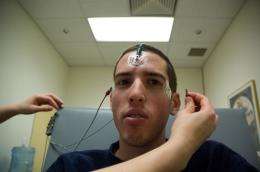
Gentle electrical stimulation of the brain can help with depression and maybe also boost attention. Credit: Flickr/Rohan Phillips

The use of weak electrical currents to stimulate the brain is a safe treatment for depression and might even improve attention and reduce pain elsewhere in the body, an Australian study has found.

Medical researchers from the University of and the Black Dog Institute found that up to half of the 64 participants in the study reported substantial improvements after receiving transcranial Direct Current Stimulation (tDCS) daily for six weeks.

The treatment passes a mild, painless current into the brain through on the scalp. Patients remain awake during the procedure. Previous studies have shown that it may boost , and can also improve in .

“We are excited about these results,“ said trial leader, Professor Colleen Loo, from the university’s School of Psychiatry. "This is the largest randomised controlled trial of transcranial direct current stimulation ever undertaken and, while the results need to be replicated, they confirm previous reports of significant antidepressant effects.”

The findings of Professor Loo’s team have been published in the British Journal of Psychiatry.

Professor Loo said that participants in the study had not benefited from at least two other depression treatments.

“Most of the people who went into this trial had tried at least two other antidepressant treatments and got nowhere. So the results are far more significant than they might initially appear – we weren’t dealing with people who were easy to treat,” Professor Loo said.

The results improved gradually, suggesting the treatment is best applied over an extended period. Participants who improved during the trial were offered weekly follow-up treatments. Of those people, 85% showed no relapse after three months.

The research team also reported unexpected physical and mental benefits in , including improved attention.

“One participant with a long-standing reading problem said his reading had improved after the trial and others commented that they were able to think more clearly,“ Professor Loo said.

“Another participant with chronic neck pain reported that the pain had disappeared during the trial. We think that is because tDCS actually changes the brain’s perception of pain. We believe these cognitive benefits are another positive aspect of the treatment worthy of investigation."

The researchers are now considering an additional trial to include people with bipolar disorder. Early results from overseas suggest tDCS is just as effective in this group.

Paul Fitzgerald, a Professor of Psychiatry at Monash University, cautioned that although research into tDCS had produced some positive results, it was “still early days”.

“There have been some positive studies, but not all of them have been positive – there have also been some studies that have failed to show a difference between active treatment and placebos.

“A lot of the studies that have been conducted to date have been involved a relatively small patient population, and with limited duration of follow-up after the end of treatment. You’d really need to build up a greater series of studies with large patient numbers and longer-term follow ups to really get a handle on how effective this treatment might be.”

Professor Fitzgerald said that patients who suffered from very severe depression and who did not get better with the “standard treatment options” were often open to new treatment possibilites, including electrical brain stimulation.

Journal reference: British Journal of Psychiatry search and more info website

Source: The Conversation

This story is published courtesy of the The Conversation (under Creative Commons-Attribution/No derivatives).

5 /5 (2 votes)  

Filter


Move the slider to adjust rank threshold, so that you can hide some of the comments.


Display comments: newest first

daedalusII
Mar 06, 2012

Rank: not rated yet
I have used tDCS for treatment-resistant chronic pain, including neuralgia, migraine, fibromyalgia and CRPS, for the last 4 years. tDCS is easy to do, safe and inexpensive and even at this stage of development, provides significant benefit for the treatment-refractory patient. Stimulation of the left DLPFC provides relief for the emotional component of pain, as well as, reducing symptoms of depression and improving cognitive functioning. tDCS also demonstrates benefit for the treatment of stroke, addiction, disabilities and for the enhancement of learning. In time, with further research, appropriate education and supervision, tDCS may become available for individual use.
Rank 5 /5 (2 votes)
Relevant PhysicsForums posts

More news stories

Storm chasers: born to be wild?

(HealthDay)—We've all seen them: the surfers who race to the beach when a hurricane hits, the guy who decides to ride out the storm in his overmatched boat, the tornado chasers who fearlessly steer their ...

Psychology & Psychiatry created 47 minutes ago | popularity not rated yet | comments 0

Hormone levels may provide key to understanding psychological disorders in women

Women at a particular stage in their monthly menstrual cycle may be more vulnerable to some of the psychological side-effects associated with stressful experiences, according to a study from UCL.

Psychology & Psychiatry created 1 hour ago | popularity not rated yet | comments 0 | with audio podcast

Are there atheists in foxholes? Study says they're the minority

Ernie Pyle – an iconic war correspondent in World War II – reportedly said "There are no atheists in foxholes." A new joint study between two brothers at Cornell and Virginia Wesleyan found that only ...

Psychology & Psychiatry created 4 hours ago | popularity 2.5 / 5 (4) | comments 0

Breathing exercises help veterans find peace after war, scholar says

(Medical Xpress)—Research by Stanford scholar Emma Seppala at the Center for Compassion and Altruism Research and Education found that post-traumatic stress disorder decreased in veterans who participated ...

Psychology & Psychiatry created 4 hours ago | popularity not rated yet | comments 0

Depression raises diabetics' risk of severe low blood sugar episodes

(Medical Xpress)—Patients with diabetes who are depressed are much more likely to develop episodes of dangerously low blood sugars, or hypoglycemia, than are those who are not depressed, a new study has ...

Psychology & Psychiatry created 5 hours ago | popularity not rated yet | comments 0 | with audio podcast


Bulletin provides guidelines for second-trimester abortion

(HealthDay)—New evidence-based guidelines provide guidance on medical and surgical methods for second-trimester abortion and management of associated complications, according to a practice bulletin published ...

About one in four uninsured could be excluded from ACA

(HealthDay)—More than one in four of those eligible for new premium assistance tax credits under the Affordable Care Act (ACA) do not have a checking account and will not be able to receive premiums from ...

Modulating the immune system to combat metastatic cancer

Cancer cells spread and grow by avoiding detection and destruction by the immune system. Stimulation of the immune system can help to eliminate cancer cells; however, there are many factors that cause the immune system to ...

New fluorescent tools for cancer diagnosis

In recent years, microRNAs (miRNAs) and other non-coding RNAs are small molecules that help control the expression of specific proteins. In recent years they have emerged as disease biomarkers. miRNA profiles have been used ...

Top-ranked golfer beats scoliosis

(HealthDay)—As a world-class golfer, Stacy Lewis' accomplishments are remarkable. But it was a physical challenge in her childhood that defined her ascent to the top of her sport.

Going live: Immune cell activation in multiple sclerosis

Biological processes are generally based on events at the molecular and cellular level. To understand what happens in the course of infections, diseases or normal bodily functions, scientists would need to ...