Friendly to a fault, yet tense: Personality traits traced in brain
March 20, 2012 in Neuroscience
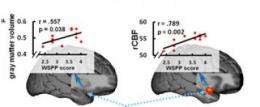
The severity of abnormalities in insula (red structure near bottom of brain), gray matter volume (left) and brain activity (right) predicted the extent of aberrant personality traits in Williams syndrome patients -- as reflected in their scores (red dots) on personality rating scales (WSPP). Credit: Karen Berman, M.D., NIMH Clinical Brain Disorders Branch
A personality profile marked by overly gregarious yet anxious behavior is rooted in abnormal development of a circuit hub buried deep in the front center of the brain, say scientists at the National Institutes of Health. They used three different types of brain imaging to pinpoint the suspect brain area in people with Williams syndrome, a rare genetic disorder characterized by these behaviors. Matching the scans to scores on a personality rating scale revealed that the more an individual with Williams syndrome showed these personality/temperament traits, the more abnormalities there were in the brain structure, called the insula.
"Scans of the brain's tissue composition, wiring, and activity produced converging evidence of genetically-caused abnormalities in the structure and function of the front part of the insula and in its connectivity to other brain areas in the circuit," explained Karen Berman, M.D., of the NIH's National Institute of Mental Health (NIMH).
Berman, Drs. Mbemda Jabbi, Shane Kippenham, and colleagues, report on their imaging study in Williams syndrome online in the journal Proceedings of the National Academy of Sciences.
"This line of research offers insight into how genes help to shape brain circuitry that regulates complex behaviors such as the way a person responds to others and thus holds promise for unraveling brain mechanisms in other disorders of social behavior," said NIMH Director Thomas R. Insel, M.D.
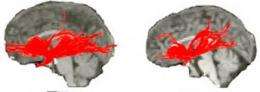
Long distance connections, white matter, between the insula and other parts of the brain are aberrant in Williams syndrome. Neuronal fibers of normal controls (left) extend further than those of Williams syndrome patients (right). Picture shows diffusion tensor imaging data from each patient superimposed on anatomical MRI of the median patient. Credit: Karen Berman, M.D., NIMH Clinical Brain Disorders Branch
Williams syndrome is caused by the deletion of some 28 genes, many involved in brain development and behavior, in a particular section of chromosome 7. Among deficits characteristic of the syndrome are a lack of visual-spatial ability such as is required to assemble a puzzle and a tendency to be overly-friendly with people, while overly anxious about non-social matters, such as spiders or heights. Many people with the disorder are also mentally challenged and learning disabled, but some have normal IQs.Previous imaging studies by the NIMH researchers found abnormal tracts of the neuronal fibers that conduct long-distance communications between brain regions -- likely resulting from neurons migrating to the wrong destinations during early development.
Evidence suggests that genes influence our temperament and the development of mental disorders via effects on brain circuits that regulate behavior. Yet direct demonstration of this in humans has proven elusive. Since the genetic basis of Williams syndrome is well known, it offers a unique opportunity to explore such effects with neuroimaging, reasoned the researchers.
Although the insula had not previously been studied in such detail in the disorder, it was known to be related to brain circuitry and certain behaviors, such as empathy, which is also highly prominent in the disorder. Berman and colleagues hypothesized that the insula's anatomy, function and connectivity would predict patients' scores for Williams syndrome-associated traits on personality rating scales. Fourteen intellectually normal Williams syndrome participants and 23 healthy controls participated in the study.
Magnetic resonance imaging (MRI) revealed that patients had decreased gray matter the brain's working tissue in the bottom front of the insula, which integrates mood and thinking. By contrast, they had increased gray matter in the top front part of the insula, which has been linked to social/emotional processes.
Diffusion tensor imaging, which by detecting the flow of water in nerve fibers can identify and measure the connections between brain areas, showed reduced white matter the brain's long-distance wiring between thinking and emotion hubs.
Tracking radioactively-tagged water in order to measure brain blood flow at rest, via positron emission tomography (PET), exposed activity aberrations consistent with the MRI abnormalities. The PET scans also revealed altered functional coupling between the front of the insula and key structures involved in thinking, mood and fear processing. These structural and functional abnormalities in the front of the insula correlated with the Williams syndrome personality profile.
"Our findings illustrate how brain systems translate genetic vulnerability into behavioral traits" explained Berman.
More information: The Williams syndrome chromosome 7q11.23 hemideletion confers hypersocial, anxious personality coupled with altered insula structure and function. Jabbi M, Kippenhan JS, Kohn P, Marenco S, Mervis CB, Morris CA, Meyer-Lindenberg A, Berman KF. Proc Natl Acad Sci. 2012 Mar 12. [Epub ahead of print] PMID: 22411788
Provided by National Institutes of Health
-
Scientists learn how brains process images of faces
May 12, 2010 |
not rated yet |
0
-
Depression gene may weaken mood-regulating circuit
May 09, 2005 |
not rated yet |
0
-
Biofeedback for your brain?
Sep 09, 2010 |
not rated yet |
0
-
Barrow scientist leads insula research
Jul 07, 2010 |
not rated yet |
0
-
2 genes influence social behavior, visual-spatial performance in people with Williams syndrome
Feb 11, 2009 |
not rated yet |
0
-
Motion perception revisited: High Phi effect challenges established motion perception assumptions
Apr 23, 2013 |
3 / 5 (2) |
2
-
Anything you can do I can do better: Neuromolecular foundations of the superiority illusion (Update)
Apr 02, 2013 |
4.5 / 5 (11) |
5
-
The visual system as economist: Neural resource allocation in visual adaptation
Mar 30, 2013 |
5 / 5 (2) |
9
-
Separate lives: Neuronal and organismal lifespans decoupled
Mar 27, 2013 |
4.9 / 5 (8) |
0
-
Sizing things up: The evolutionary neurobiology of scale invariance
Feb 28, 2013 |
4.8 / 5 (10) |
14
-
Pressure-volume curve: Elastic Recoil Pressure don't make sense
May 18, 2013
-
If you became brain-dead, would you want them to pull the plug?
May 17, 2013
-
MRI bill question
May 15, 2013
-
Ratio of Hydrogen of Oxygen in Dessicated Animal Protein
May 13, 2013
-
Alcohol and acetaminophen
May 13, 2013
-
Marie Curie's leukemia
May 13, 2013
- More from Physics Forums - Medical Sciences
More news stories
Study shows premature birth interrupts vital brain development processes leading to reduced cognitive abilities
Researchers from King's College London have for the first time used a novel form of MRI to identify crucial developmental processes in the brain that are vulnerable to the effects of premature birth. This new study, published ...
Neuroscience
24 minutes ago |
not rated yet |
0
|
Researchers find far-reaching, microvascular damage in uninjured side of brain after stroke
While the effects of acute stroke have been widely studied, brain damage during the subacute phase of stroke has been a neglected area of research. Now, a new study by the University of South Florida reports that within a ...
Neuroscience
2 hours ago |
not rated yet |
0
|
Neurons that can multitask greatly enhance the brain's computational power, study finds
Over the past few decades, neuroscientists have made much progress in mapping the brain by deciphering the functions of individual neurons that perform very specific tasks, such as recognizing the location ...
Neuroscience
5 hours ago |
5 / 5 (5) |
0
|
For combat veterans suffering from post-traumatic stress disorder, 'fear circuitry' in the brain never rests
Chronic trauma can inflict lasting damage to brain regions associated with fear and anxiety. Previous imaging studies of people with post-traumatic stress disorder, or PTSD, have shown that these brain regions can over-or ...
Neuroscience
May 18, 2013 |
5 / 5 (1) |
0
|
Temporal processing in the olfactory system
The neural machinery underlying our olfactory sense continues to be an enigma for neuroscience. A recent review in Neuron seeks to expand traditional ideas about how neurons in the olfactory bulb might encode information about ...
Neuroscience
May 17, 2013 |
4 / 5 (1) |
0
|
Do salamanders hold the solution to regeneration?
Salamanders' immune systems are key to their remarkable ability to regrow limbs, and could also underpin their ability to regenerate spinal cords, brain tissue and even parts of their hearts, scientists have ...
Scientists identify molecular trigger for Alzheimer's disease
Researchers have pinpointed a catalytic trigger for the onset of Alzheimer's disease – when the fundamental structure of a protein molecule changes to cause a chain reaction that leads to the death of neurons ...
Leading explanations for whooping cough's resurgence don't stand up to scrutiny
Whooping cough has exploded in the United States and some other developed countries in recent decades, and many experts suspect ineffective childhood vaccines for the alarming resurgence.
CT radiation risk less than risk of examination indicator
(HealthDay)—For young adults needing either a chest or abdominopelvic computed tomography (CT), the short-term risk of death from underlying morbidity is greater than the long-term risk of radiation-induced ...
Music therapy reduces anxiety, use of sedatives for patients receiving ventilator support
New research suggests that for some hospitalized ICU patients on mechanical ventilators, using headphones to listen to their favorite types of music could lower anxiety and reduce their need for sedative medications.
First long-term study reveals link between childhood ADHD and obesity
A new study conducted by researchers at the Child Study Center at NYU Langone Medical Center found men diagnosed as children with attention-deficit/hyperactivity disorder (ADHD) were twice as likely to be obese in a 33-year ...
