Genome study confirms immune system link to disfiguring leg swelling
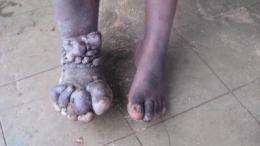
Podoconiosis, a type of elephantiasis (leg swelling) found in farming communities in the tropics, is triggered by an abnormal reaction to irritant mineral particles found in soils of volcanic origins amongst people who cannot afford shoes. Credit: Gail Davey
Genetic variants in a region of the genome linked to our immune response have been linked to increased risk of podoconiosis, a disfiguring and disabling leg swelling caused by an abnormal reaction to the minerals found in soil. An estimated 4 million people worldwide suffer from the condition.
In a study published today in the New England Journal of Medicine, researchers funded by the Wellcome Trust and the Association of Physicians of Great Britain and Ireland compared the genomes of 194 people affected by the disease from southern Ethiopia against 203 people who were unaffected. They identified three genetic variants that increased the risk of developing the condition.
Podoconiosis, or 'podo', as it is often called, was added to the World Health Organization's list of neglected tropical diseases in 2011. It is a type of elephantiasis (leg swelling) found in farming communities in the tropics and is triggered by an abnormal reaction to irritant mineral particles found in soils of volcanic origins amongst people who cannot afford shoes.
Many years of walking, ploughing or playing barefoot on these soils appears to trigger inflammatory changes within the lymph system in the legs, which in time can lead to foot swelling and ultimately elephantiasis.
The disease often runs in families, implying that there is a hereditary component to the disease, but until now, no genetic variants had been identified which confer increased risk. The genetic variants discovered in this new study all fall within a region of the genome known as the HLA class II, which is important in controlling immune responses. Combined, the three variants increase the risk of developing podoconiosis by a factor of two to three.
Prof Melanie Newport from Brighton & Sussex Medical School, who led the study, says: "The region where we have found these susceptibility genes for podoconiosis plays an important role in controlling our immune system. It confirms what we had expected, that there is an immunological basis to the disease. Although this is still early days for identifying potential treatments, it suggests that drugs that target immune responses may be useful."
First author Dr Fasil Tekola Ayele from the Armauer Hansen Research Institute, Ethiopia, adds: "Genome wide association studies on African populations are still fairly novel. However, this study highlights the importance of such studies in helping us understand the origins of diseases that are particularly common on the continent." Dr Ayele is currently on a postdoctoral attachment at the National Human Genome Research Institute, USA.
Dr Abraham Aseffa, also from the Armauer Hansen Research Institute, says: "Our next step is to try to pinpoint exactly which molecules are involved in podoconiosis, and which specific genetic mutations affect the function of these molecules. This will shed a lot more light on potential therapeutic options."
Professor Newport and colleagues have recently launched Footwork, an international initiative to bring together public and private partners to prevent and treat podoconiosis Footwork aims to integrate podoconiosis control with that of other neglected tropical diseases wherever possible, and to partner with organizations working in foot-related conditions to advocate for shoes as cost-effective interventions to tackle such diseases.
"There are still many places round the world where people cannot afford a pair of shoes," says Dr Gail Davey, co-author on the study and Executive Director of Footwork. "For some people, this means cold, cut or bruised feet, but for others it can lead to podoconiosis, which can have a significant impact on their quality of life. We hope that shoes can become the 'new bed-nets': simple, cost-effective interventions that mean that in future there is no reason for anyone's life to be destroyed for the want of a shoe."
Commenting on the findings, Dr Jimmy Whitworth, Head of International Activities at the Wellcome Trust, adds: "Podoconiosis is finally getting the attention it deserves as a disease that blights the lives of millions of people. The success of this international collaboration is testament to the importance of providing opportunities for training and building capacity for African researchers to take a lead on important work such as this."
More information: Ayele, FT et al. The HLA class II locus confers susceptibility to podoconiosis. NEJM; 29 March 2012
Provided by
Wellcome Trust
-
Shoes could wipe out tropical disease affecting millions
Mar 22, 2012 |
not rated yet |
0
-
Genome study identifies genetic variant linked to TB susceptibility in Africans
Aug 08, 2010 |
not rated yet |
0
-
New genetic risk factors of lupus found in study of African-American women
Jun 24, 2011 |
not rated yet |
0
-
Massive genome studies identify genetics behind white blood cell counts
Jun 30, 2011 |
not rated yet |
0
-
Discovery of new family of genetic mutations involved in inflammatory intestinal disease
Jun 02, 2008 |
not rated yet |
0
-
Motion perception revisited: High Phi effect challenges established motion perception assumptions
Apr 23, 2013 |
3 / 5 (2) |
2
-
Anything you can do I can do better: Neuromolecular foundations of the superiority illusion (Update)
Apr 02, 2013 |
4.5 / 5 (11) |
5
-
The visual system as economist: Neural resource allocation in visual adaptation
Mar 30, 2013 |
5 / 5 (2) |
9
-
Separate lives: Neuronal and organismal lifespans decoupled
Mar 27, 2013 |
4.9 / 5 (8) |
0
-
Sizing things up: The evolutionary neurobiology of scale invariance
Feb 28, 2013 |
4.8 / 5 (10) |
14
-
Classical and Quantum Mechanics via Lie algebras
Apr 15, 2011
- More from Physics Forums - Independent Research
More news stories
Researchers develop model for better testing, targeting of malignant peripheral nerve sheath tumors
University of Minnesota Medical School researchers from the Masonic Cancer Center, University of Minnesota, in partnership with the University's Brain Tumor Program, have developed a new mouse model of malignant peripheral ...
Genetics
15 hours ago |
5 / 5 (1) |
0
|
Researchers identify new circadian clock component
Northwestern University scientists have shown a gene involved in neurodegenerative disease also plays a critical role in the proper function of the circadian clock.
Genetics
May 16, 2013 |
3 / 5 (1) |
1
|
Returning genetic incidental findings without patient consent violates basic rights, experts say
Informed consent is the backbone of patient care. Genetic testing has long required patient consent and patients have had a "right not to know" the results. However, as 21st century medicine now begins to use the tools of ...
Genetics
May 16, 2013 |
5 / 5 (1) |
3
|
Ethicists provide framework supporting new recommendations on reporting incidental findings in gene sequencing
In a paper published in Science Express, a group of experts led by bioethicists in the Center for Medical Ethics and Health Policy at Baylor College of Medicine provide a framework for the new American College of Medical Geneti ...
Genetics
May 16, 2013 |
not rated yet |
0
Experts urge caution over use of new genetic sequencing techniques
The use of genome-wide analysis (GWA), where the entirety of an individual's DNA is examined to look for the genomic mutations or variants which can cause health problems is a massively useful technology for diagnosing disease. ...
Genetics
May 16, 2013 |
not rated yet |
0
Study identifies superior hypertension treatment, efficacy between sexes
(Medical Xpress)—In a recent subgroup analysis of the largest blood pressure treatment trial in history, University of Alabama at Birmingham (UAB) researchers found that women and men react the same to ...
Analgesics prescribed more heavily to women than to men, study finds
Regardless of pain, social class or age, a woman is more likely to be prescribed pain-relieving drugs. A study published in Gaceta Sanitaria (Spanish health scientific journal) affirms that this phenomenon is inf ...
New factor to control oncogene-induced senescence
An article published on the journal Nature describes the major role that Pyruvate dehydrogenase (PDH) —an enzyme of cellular energy metabolism— plays in the regulation of the cellular senescence induce ...
Cancer and birth defects in Iraq: The nuclear legacy
Ten years after the Iraq war of 2003 a team of scientists based in Mosul, northern Iraq, have detected high levels of uranium contamination in soil samples at three sites in the province of Nineveh which, coupled with dramatically ...
Warning images for cigarette packs do not make a strong enough emotional impact
The warning images Brussels proposes to include on tobacco packages in order to reduce consumption do not make the desired impact on smokers because they only find some of them really unpleasant. So, if the ...
Do men's and women's hearts burn fuel differently?
Researchers at the University of Illinois at Chicago College of Medicine will study gender differences in how the heart uses and stores fat—its main energy source—and how changes in fat metabolism play ...