The impossible staircase in our heads: how we visualise the world around us
March 23, 2012 in Psychology & Psychiatry

The impossible staircase in our heads: how we visualise the world around us

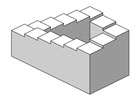
A ‘Penrose stairs’ optical illusion, or impossible staircase. Credit: Sakurambo on  Wikipedia.

(Medical Xpress) -- Our interpretation of the world around us may have more in common with the impossible staircase illusion than it does the real world, according to research published today in the open access journal PLoS ONE. The study, which was funded by the Wellcome Trust, suggests that we do not hold a three-dimensional representation of our surroundings in our heads as was previously thought.

Artists, such as Escher, have often exploited the paradoxes that emerge when a 3D scene is depicted by means of a flat, two-dimensional picture. In Escher's famous picture 'Waterfall', for example, it is impossible to tell whether the start of the waterfall is above or below its base.

Paradoxes like this can be generated in a drawing, but it is not possible to create such a 3D structure. The is possible because drawings of 3D scenes are inherently ambiguous, so there is no one-to-one relationship between the picture and 3D locations in space.

Most theories of 3D vision and how we represent space in our visual system assume that we generate a one-to-one 3D model of space in our brains, where each point in real space maps to a unique point in our model. However, there is an ongoing debate about whether this is really the case.

To test this idea, researchers at the University of Reading placed participants wearing a in a in which they had to judge which of two objects was the nearest. On some occasions, the size of the room was increased four-fold - previous research by the team showed that participants fail to notice this expansion.

In this new study, the researchers found that people's of the relative depth of objects depended on the order in which the objects were compared. Although the results are readily explained in relation to the expansion of the room, the participants had no idea that the room changed at any stage during the experiment. It is the properties of this that the experiment tested.

Dr. Andrew Glennerster from the University of Reading, who led the study, explains: "In the impossible staircase illusion, you cannot tell whether the back corner is higher or lower than the front one as it depends which route you take to get there. The same is true, we find, in our task. This means that our own internal representations of space must be rather like Escher's paradoxes, with no one-to-one relationship to real space."

"Even when the size of the room increases four-fold, people think they are in a stable room throughout the experiment. Their interpretation of the room does not update itself when the room itself changes.

"Does it make sense for their representation of the room to have 3D coordinates, as a proper staircase would? No - there is no way to write down the coordinates of the objects that could explain the judgements people made. Visual space - the internal representation - is much more like the paradoxical staircase than a physically realisable model."

More information: Svarverud E et al. A demonstration of ‘broken’ visual space. PLoS ONE 2012 (epub ahead of print).

Journal reference: PLoS ONE search and more info website

Provided by Wellcome Trust search and more info website

4.6 /5 (5 votes)  

Filter


Move the slider to adjust rank threshold, so that you can hide some of the comments.


Display comments: newest first

Isaacsname
Mar 23, 2012

Rank: 5 / 5 (1)
Dang, all this time I thought it was assembled in the brain and projected on the back of the lenses in my eyes through my hyaloid.

..too many Tom and Jerry cartoons as a kid I guess.
hyongx
Mar 23, 2012

Rank: 5 / 5 (1)
researchers at the University of Reading placed participants wearing a virtual reality headset in a virtual room...

the participants had no idea that the room changed at any stage during the experiment...

Did anyone think to question validity of the virtual reality system? I.E., would the same results be found if the experiment were performed in a real physical room? Somehow I doubt it.
DavidW
Mar 23, 2012

Rank: 1 / 5 (1)
While their research reveals interesting observations, the conclusion of "...This means that our own internal representations of space must be rather like Escher's paradoxes, with no one-to-one relationship to real space", silly. It seems to me that people use Truth as the third point of perspective over z-axis, and that they use life to get Truth.
Eikka
Mar 23, 2012

Rank: not rated yet
I just see the picture as if the stairs were angled like overlapping roof tiles. That's the only way it makes intuitive sense to me in an isometric projection like that.
RitchieGuy
Mar 23, 2012

Rank: 2.5 / 5 (2)
I have part of a wall in my den full of M.C.Escher poster size photographs, such as concave and convex; ascending and descending; Belvedere and others.

I think that the brain perceives changes and adapts to it in a split second even before the person is conscious of the change in the virtual reality experiment which could be a bit dangerous in real situations. This could be caused by the concentration on which of the 2 objects are closer, to the exclusion of the room size change stimulus. Multi-tasking ability might eliminate that problem. IMO

I'd like the researchers to do an experiment in virtual reality with a tesseract.
Tausch
Mar 25, 2012

Rank: not rated yet
The mind 'insists' on convergence.

The 'expression' for this 'insistence' is labeled or called mathematics - one of many parts of the human language.

What other parts of human languages is capable of more paradoxes or illusions?

Nature 'insists'...

(apologies to all those wanting to cleanse the human languages of all anthropogenic/anthropocentric 'contamination')

...on as few illusions as possible.

Why?
This gives 'evolution' a 'chance' to evolve to what we label 'life' (or what some label the image of God! - us!).
Rank 4.6 /5 (5 votes)
Relevant PhysicsForums posts

More news stories

'Boys will be boys' in US, but not in Asia

A new study shows there is a gender gap when it comes to behavior and self-control in American young children – one that does not appear to exist in children in Asia.

Psychology & Psychiatry created 2 hours ago | popularity not rated yet | comments 0

Brain can be trained in compassion, study shows

Until now, little was scientifically known about the human potential to cultivate compassion—the emotional state of caring for people who are suffering in a way that motivates altruistic behavior.

Psychology & Psychiatry created 3 hours ago | popularity not rated yet | comments 2 | with audio podcast

Good marriage can buffer effects of dad's depression on young children

What effect does a father's depression have on his young son or daughter? When fathers report a high level of emotional intimacy in their marriage, their children benefit, said a University of Illinois study.

Psychology & Psychiatry created 4 hours ago | popularity not rated yet | comments 0

American, Nepalese kids a world apart on social duties

(Medical Xpress)—Preschoolers universally recognize that one's choices are not always free – that our decisions may be constrained by social obligations to be nice to others or follow rules set by parents ...

Psychology & Psychiatry created 11 hours ago | popularity not rated yet | comments 0

Ethicists' behavior not more moral, study finds

(Medical Xpress)—Do ethicists engage in better moral behavior than other professors? The answer is no. Nor are they more likely than nonethicists to act according to values they espouse, according to researchers from the ...

Psychology & Psychiatry created 11 hours ago | popularity 5 / 5 (1) | comments 0


Calorie information in fast food restaurants used by 40 percent of 9-18 year olds when making food choices

A new study published online today (Thursday) in the Journal of Public Health has found that of young people who visited fast food or chain restaurants in the U.S. in 2010, girls and youth who were obese were more likely ...

Having both migraines, depression may mean smaller brain

(HealthDay)—Migraines and depression can each cause a great deal of suffering, but new research indicates the combination of the two may be linked to something else entirely—a smaller brain.

Slowing the aging process—only with antibiotics

Swiss scientists reveal the mechanism responsible for aging hidden deep within mitochondria—and dramatically slow it down in worms by administering antibiotics to the young.

Experts favor US approval of Merck sleeping pill (Update)

An independent panel of experts on Wednesday recommended US approval of a new Merck sleeping pill called suvorexant, but expressed concerns over the highest dosage and risks of drowsy daytime driving.

Researchers complete largest genetic sequencing study of human disease

Researchers from Queen Mary, University of London have led the largest sequencing study of human disease to date, investigating the genetic basis of six autoimmune diseases.

Systematic screening of med adherence will ID barriers

(HealthDay)—Implementation of systematic monitoring for medication adherence will allow for identification of barriers to adherence and tailoring of interventions, according to a viewpoint piece published ...