New research may have discovered how memories are encoded in our brains
March 19, 2012 in Neuroscience
University of Alberta led research may have discovered how memories are encoded in our brains.
Scientists understand memory to exist as strengthened synaptic connections among neurons. However components of synaptic membranes are relatively short-lived and frequently re-cycled while memories can last a lifetime.
Based on this information, U of A physicist and lead researcher Jack Tuszynski, his graduate student Travis Craddock and University of Arizona professor Stuart Hameroff investigated the molecular mechanism of memory encoding in neurons.
The team looked into structures at the cytoskeletal level of brain structure. They found components that fit together and were capable of creating the information processing and storage capacity that the brain needs to form and retain memory.
The practical implications of understanding the mechanism of memory encoding are enormous.
"This could open up amazing new possibilities of dealing with memory loss problems, interfacing our brains with hybrid devices to augment and 'refresh' our memories," says Tuszynski. "More importantly, it could lead to new therapeutic and preventive ways of dealing with neurological diseases such as Alzheimer's and dementia, whose incidence is growing very rapidly these days."
Q & A with Jack Tuszynski
Why did you decide to tackle the question of where the information pertinent to memory is stored?
This is one of the key open and most intriguing problems in neuroscience. We read a paper on experiments that were able to safely erase memories in animals. These experiments implicated a specific molecule (the enzyme called calcium-calmodulin dependent kinase complex II) that is instrumental in encoding and erasing memory in the brain. We noticed an amazing similarity in its geometry to a patch of tubulin dimers in a microtubule. Microtubules fill the interiors of our brain's neurons, especially in axons and dendrites where most of the activity takes place. We undertook to find out if this similarity is accidental or not. This led to the generation of a very accurate computational model of the interaction between CaMKII and microtubules. It looks to us that a mechanism for memory encoding has now been found.
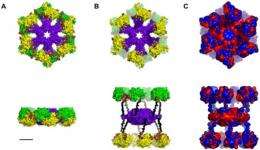
What are we looking at in figures 1 through 6 of the paper?
These figures were generated by a computational reconstruction of the molecules that play key roles in memory encoding: tubulin, microtubules and CaMKII. We know their atomic-resolution 3D structures from crystallographic data that are publicly available. We then built computer models of higher level organization of these protein complexes. These models allow us to test the spatial compatibility of the protein-protein interactions as well as to calculate interaction energies to see if they attract themselves under specific conditions and if so, how strongly.
Could an understanding of this mechanism lead to improvements or repairs to the memory function and could memories themselves be restored?
Yes, all of this is entirely possible. We can potentially use this insight to improve quality of memory storage, memory recall, information processing as well as the amount of data stored.
Are you planning follow-up research to this paper?
We are already working on various applied aspects related to this paper. Another paper has been just accepted for publication, based on our collaboration with University of Arizona, Harvard and Boston University, where we propose a molecular mechanism of Alzheimer's disease progression. This should soon be published in PLos One and it'll lead to specific therapeutic solutions as our next project. It turns out that the concentration of zinc plays a crucial role in stabilizing microtubules but also in fueling the buildup of amyloid plaques. We developed a physical model of the process. A third paper in this series stemming from Travis Craddock's PhD thesis discusses the effects of anesthetic molecules on memory blockage in brain's microtubules.
More information: Their paper, "Cytoskeletal Signaling: Is Memory Encoded in Microtuble Lattices by CaMKII Phosphorylation?" was published in the journal, PLoS Computational Biology.
Journal reference:
PLoS Computational Biology
Provided by
University of Alberta
-
Cracking brain memory code
Mar 09, 2012 |
not rated yet |
0
-
Study provides potential explanation for mechanisms of associative memory
Dec 13, 2011 |
not rated yet |
0
-
Brain rehearsal time ensures lasting memory performance
Feb 14, 2012 |
not rated yet |
0
-
Shedding light on the dynamics of memory: Researchers find mechanism that maintains memories
Apr 13, 2010 |
not rated yet |
0
-
Team isolates nerve cells involved in storing long term memory and gene proteins associated with them
Feb 10, 2012 |
not rated yet |
0
-
Motion perception revisited: High Phi effect challenges established motion perception assumptions
Apr 23, 2013 |
3 / 5 (2) |
2
-
Anything you can do I can do better: Neuromolecular foundations of the superiority illusion (Update)
Apr 02, 2013 |
4.5 / 5 (11) |
5
-
The visual system as economist: Neural resource allocation in visual adaptation
Mar 30, 2013 |
5 / 5 (2) |
9
-
Separate lives: Neuronal and organismal lifespans decoupled
Mar 27, 2013 |
4.9 / 5 (8) |
0
-
Sizing things up: The evolutionary neurobiology of scale invariance
Feb 28, 2013 |
4.8 / 5 (10) |
14
-
Why is zone 1 in liver more prone to ischemic injury?
May 23, 2013
-
How can there be villous adenoma in colon, if there are no villi there
May 22, 2013
-
How can there be a term called "intestinal metaplasia" of stomach
May 21, 2013
-
Pressure-volume curve: Elastic Recoil Pressure don't make sense
May 18, 2013
-
If you became brain-dead, would you want them to pull the plug?
May 17, 2013
-
MRI bill question
May 15, 2013
- More from Physics Forums - Medical Sciences
More news stories
New neuron formation could increase capacity for new learning, at the expense of old memories
New research presented today shows that formation of new neurons in the hippocampus - a brain region known for its importance in learning and remembering - could cause forgetting of old memories by causing a reorganization ...
Neuroscience
May 24, 2013 |
4 / 5 (4) |
0
Help at hand for people with schizophrenia
How can healthy people who hear voices help schizophrenics? Finding the answer for this is at the centre of research conducted at the University of Bergen.
Neuroscience
May 24, 2013 |
4 / 5 (2) |
2
Japanese research organizations contribute to Human Brain Project
One of the major frontiers of modern science is a comprehensive understanding of the human brain and its functions to guide the development of new technologies in information and communication. In a major announcement for ...
Neuroscience
May 24, 2013 |
3.7 / 5 (3) |
0
Controlling mood through the motions of mitochondria
(Medical Xpress)—Regulating the distribution of power in neurons is done by a system that makes the national electric grid look simple by comparison. Each neuron has several thousand mitochondria confined ...
Neuroscience
May 23, 2013 |
4.9 / 5 (9) |
0
|
Brain uses internal 'average voice' prototype to identify who is talking
(Medical Xpress)—The human brain is able to identify individuals' voices by comparing them against an internal 'average voice' prototype, according to neuroscientists.
Neuroscience
May 23, 2013 |
3.7 / 5 (3) |
3
|
First drug to improve heart failure mortality in over a decade
Coenzyme Q10 decreases all cause mortality by half, according to the results of a multicentre randomised double blind trial presented today at Heart Failure 2013 congress. It is the first drug to improve heart failure mortality ...
Seniors more likely to crash when driving with pet, study finds
(HealthDay)—Animals make great companions for senior citizens, but elderly people who always drive with a pet in the car are far more likely to crash than those who never drive with a pet, researchers have ...
Heart failure accelerates male 'menopause'
Heart failure accelerates the aging process and brings on early andropausal syndrome (AS), according to research presented today at the Heart Failure Congress 2013. AS, also referred to as male 'menopause', was four times ...
Death highest in heart failure patients admitted in January, on Friday, and overnight
Mortality and length of stay are highest in heart failure patients admitted in January, on Friday, and overnight, according to research presented today at the Heart Failure Congress 2013. The analysis of nearly 1 million ...
Feds fight morning-after pill age ruling in NY
(AP)—Department of Justice lawyers have again asked a federal appeals court in New York to delay lifting age restrictions and prescription requirements on an emergency contraceptive popularly known as the morning-after ...
New immune system discovered
(Medical Xpress)—A research team, led by Jeremy Barr, a biology post-doctoral fellow, unveils a new immune system that protects humans and animals from infection.