Raiders of the lost blood spots
March 13, 2012 By Nonie Arora in Medical research

Raiders of the lost blood spots

Enlarge

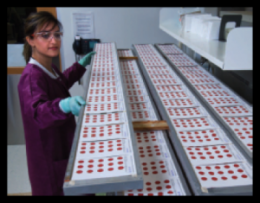
Blood Spots Assessed by CDC

Almost every newborn in the United States is pricked on the heel within hours of birth for a few drops of blood that are then tested for conditions like PKU, sickle cell anemia, and cystic fibrosis. But then the sample is often put on small piece of blotter paper and filed away by the state. Few parents know about these millions of residual dried blood spots.

Alex Kemper, Duke professor of pediatrics and community and family medicine, spoke at the Genomics and Personalized Medicine Forum on the “raiders” of these lost , researchers who might use them to improve public health. Along with issues of science, he addressed the negative public reaction to research using stored blood spots. “Why does the government have my DNA?”

Dried blood spots have many uses beyond early detection of diseases. They can be used to improve quality of current screening tests and new screening approaches. In a few cases, dried blood spots have been valuable in forensic analysis to identify an abducted child. In this era of increasingly personalized medicine, being able to use blood spots for genomic analysis would provide answers to new research questions, Kemper said.

However, the differences in the way blood spots are stored present research challenges. Kemper is very interested in how environmental toxins affect children’s health. When his research team attempted to use dried blood spots to study how flame-retardants affect thyroid problems, they ran into a major problem. Because blood spots are often stored in an environment more like the warehouse from Raiders of the Lost Ark than a controlled lab environment, the specimens were too contaminated to use for research.

Besides the inherent quality concerns, the public is wary of researchers using blood spots because of the lack of consent and confidentiality. (See “Texas Newborn Bloodspot Saga”) Should researchers be able to use blood spots from infants without consent from ? Should the blood spots be anonymized to protect privacy even though anonymization limits the types of research that can be performed?

These questions do not have easy answers.

States differ on legislation about the retention, confidentiality, and parental control of blood spots. Some states have no rules at all. Kemper claimed that many of these laws are currently in “a state of flux” because of pending lawsuits and changing public perceptions. As the rules change, one thing is almost certain: improving the genetic literacy of the public is essential to advancing uses of dried blood spots.

Provided by Duke University search and more info website

not rated yet  

Filter


Move the slider to adjust rank threshold, so that you can hide some of the comments.


Display comments: newest first

tkjtkj
Mar 13, 2012

Rank: not rated yet
re: "..As the rules change, one thing is almost certain: improving the genetic literacy of the public is essential to advancing uses of dried blood spots."

yes , that is 'oNe thing' but there are others equally important, if not more-so:
Eg, the public must become assured and confident that government/science access and use of genetic information is adequately provided by very strong privacy laws!! I personally do not think this is possible, given news reports on near-daily basis involving inappropriate access to internet data collections. Further, why are governments storing this information??? It is patently outrageous that once the collected samples have satisfied 'neonatal testing' that the samples are not returned to the parent !!
Rank not rated yet
Relevant PhysicsForums posts

More news stories

Study suggests new source of kidneys for transplant

Nearly 20 percent of kidneys that are recovered from deceased donors in the U.S. are refused for transplant due to factors ranging from scarring in small blood vessels of the kidney's filtering units to the organ going too ...

Medical research created 7 hours ago | popularity 5 / 5 (1) | comments 0 | with audio podcast

Discovery of circadian clock in mice hair reveals period of time when damage from radiotherapy can be quickly repaired

Discovering that mouse hair has a circadian clock - a 24-hour cycle of growth followed by restorative repair - researchers suspect that hair loss in humans from toxic cancer radiotherapy and chemotherapy ...

Medical research created 8 hours ago | popularity 5 / 5 (2) | comments 1 | with audio podcast

Do salamanders hold the solution to regeneration?

Salamanders' immune systems are key to their remarkable ability to regrow limbs, and could also underpin their ability to regenerate spinal cords, brain tissue and even parts of their hearts, scientists have ...

Medical research created 9 hours ago | popularity 5 / 5 (4) | comments 2 | with audio podcast

New study finds blind people have the potential to use their 'inner bat' to locate objects

New research from the University of Southampton has shown that blind and visually impaired people have the potential to use echolocation, similar to that used by bats and dolphins, to determine the location of an object.

Medical research created 11 hours ago | popularity not rated yet | comments 1 | with audio podcast

Germ-fighting vaccine system makes great strides in delivery

A novel vaccine study from South Dakota State University (SDSU) will headline the groundbreaking research that will be unveiled at the American Association of Pharmaceutical Scientists' (AAPS) National Biotechnology Conference ...

Medical research created 12 hours ago | popularity not rated yet | comments 0


Early-life traffic-related air pollution exposure linked to hyperactivity

Early-life exposure to traffic-related air pollution was significantly associated with higher hyperactivity scores at age 7, according to new research from the University of Cincinnati (UC) and Cincinnati Children's Hospital ...

Resistance to last-line antibiotic makes bacteria resistant to immune system

Bacteria resistant to the antibiotic colistin are also commonly resistant to antimicrobial substances made by the human body, according to a study in mBio, the online open-access journal of the American Society for Microb ...

The compound in the Mediterranean diet that makes cancer cells 'mortal'

New research suggests that a compound abundant in the Mediterranean diet takes away cancer cells' "superpower" to escape death. By altering a very specific step in gene regulation, this compound essentially re-educates cancer ...

Scientists identify molecular trigger for Alzheimer's disease

Researchers have pinpointed a catalytic trigger for the onset of Alzheimer's disease – when the fundamental structure of a protein molecule changes to cause a chain reaction that leads to the death of neurons ...

Practice makes perfect? Not so much

Turns out, that old "practice makes perfect" adage may be overblown. New research led by Michigan State University's Zach Hambrick finds that a copious amount of practice is not enough to explain why people ...

Older prostate cancer patients should think twice before undergoing treatment

Older prostate cancer patients with other underlying health conditions should think twice before committing to surgery or radiation therapy for their cancer, according to a multicenter study led by researchers in the UCLA ...