Rainforest remedy could spell end of dental pain
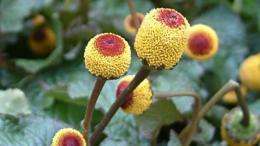
(Medical Xpress) -- An ancient Incan toothache remedy – for centuries handed down among an indigenous people in the rainforests of Peru – could be on the cusp of revolutionising worldwide dental practice.
The remedy, made from an Amazonian plant species from varieties of Acmella Oleracea and turned into a gel for medical use, has proved hugely successful during the first two phases of clinical trials and may hasten the end of current reliance on local anaesthetics in dental use and Non-Steroid Anti-Inflammatory Drugs (NSAIDs) in specific applications.
Cambridge University anthropologist Dr. Françoise Barbira Freedman, the first westerner to be invited to live with the Keshwa Lamas in Amazonian Peru, is leading efforts to bring this wholly natural painkiller to the global marketplace as an organic alternative to synthetic painkillers.
In doing so, the company she founded, Ampika Ltd (a spin-out from Cambridge Enterprise, the University’s commercialisation arm) will be run according to strict ethical guidelines, and will be able to channel a percentage of any future profits back to the Keshwa Lamas community who agreed to share their expertise with her.
With no known side-effects during the past five years of Phase I and II trials, Dr. Freedman, who has continued to visit and live among the Keshwa Lamas over the past 30 years, is confident the stringent Phase III trials (multi-location trials across a diverse population mix) will be the final hurdle to clear. If successful, Ampika’s plan is to bring the product to market in 2014/15.
She said: “The story began in 1975 when I first went to live among the indigenous people of Peru. We were trekking through the rainforest and I was having terrible trouble with my wisdom teeth. One of the men with me noticed and prepared a little wad of plants to bite onto. The pain went away. When it came back a few hours later, he had foreseen the need and kept plant material in his hunters’ bag for me.
“I forgot all about the wisdom teeth problem for many years until Cambridge-based neuroscientist Dr. Mark Treherne asked me to bring some medicinal plant samples back in order to test them for neurological research. Almost as an afterthought I remembered to include the one I’d used on my teeth. It was added to the bottom of the list, but somehow the list got reversed and it was the first one tested back in the UK. It was immediately successful and we’ve never looked back.
“During the time I have spent with the Keshwa Lamas I’ve learnt all about the different plants and leaves they use for everyday illnesses and ailments. I first went to Peru as a young researcher hoping to learn more about what was a secretive community who were experts in shamanism. Along the way I’ve learnt a great deal about natural medicines and remedies; everything from toothache to childbirth.”
“This treatment for toothache means we could be looking at the end of some injections in the dentist’s surgery. We’ve had really clear result from the tests so far, particularly for peridodontological procedures such as root scaling and planing, and there are many other pop ptential applications. The native forest people described to me exactly how the medicine could and should work and they were absolutely right. There are a range of mucous tissue applications it could benefit, and may even help bowel complaints such as IBS (irritable bowel syndrome).”
The Keshwa Lamas remedy represents the first clinical trial of a natural product in Peru using the International Convention of Clinical Trials, of which Peru is a signatory, the gold-standard for clinical trials that is recognised across the Pacific and Atlantic regions.
Dr Freedman, who will visit the Peruvian community again in the coming weeks, has already been able to channel some early funding to the Keshwa Lama to help in the creation of a medicinal plant garden to conserve plants and plant knowledge related to women’s health and maternity care – with the express aim of preserving wisdom for future generations.
She added: “We think the remedy is better than current treatments because NSAID drugs are systemic and have long-term effects; the plant product is not systemic and does not have any known side-effects. We think people prefer to use natural products and this is particularly the case for baby teething – for which, to my knowledge, there is no clinically tested natural alternative.”
The dentists who carried out the Phase 2 trial reported a high level of satisfaction among their patients who disliked injections and did not need to use painkillers after the periodontological procedures.
There was also a higher rate of patient return for further appointments than average for the group with which the plant gel was used. The gel works by blocking nerve endings (sodium channel pathways).
Ampika has a portfolio of plant-based drug development, particularly related to women’s health conditions and Type 2 diabetes, which it hopes to develop in the coming years.


