Virginia man injured in gun accident gets new face (Update)
March 27, 2012 SARAH BRUMFIELD , Associated Press in Surgery
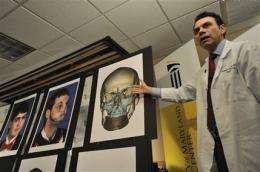
Eduardo D. Rodriguez, M.D., Chief of Plastic, Reconstructive and Maxillofacial surgery at the University Medical Center, explains the most extensive full face transplant completed to date performed on Richard Lee Norris, pictured at left, during a news conference Tuesday, March 27,2012 at the University of Maryland Medical Center in Baltimore.(AP Photo/Gail Burton)
(AP) -- After 15 years of wearing a mask and living as a recluse, a 37-year-old Virginia man disfigured in a gun accident got a new face, nose, teeth and jaw in what University of Maryland physicians say is the most extensive face transplant ever performed.
Richard Lee Norris of Hillsville is recovering well after last week's surgery, beginning to feel his face and already brushing his teeth and shaving, University of Maryland Medical Center officials announced Tuesday. He's also regained his sense of smell, which he had lost after the accident.
Norris, who was selected from among five possible candidates for the surgery, has been living as a recluse, doing his shopping at night. It's hoped the transplant will give him his life back, said Dr. Eduardo Rodriguez, the lead surgeon.
"It's a surreal experience to look at him. It's hard not to stare. Before, people used to stare at Richard because he wore a mask and they wanted to see the deformity," Rodriguez said. "Now, they have another reason to stare at him, and it's really amazing."
Rodriguez showed a 1993 prom photo of Norris, "as we all want to be remembered," beside a pre-transplant photo of Norris' shortened face with a sunken mouth and flattened nose. He then revealed a photo of Norris taken on Monday, where his face appears ordinary, other than stiches along his hairline and neck and scarring around his eyelids. Although he now has the donor's face, he doesn't resemble the donor, Rodriguez said.
"It's a combination of two individuals, a true blend," he said.
Norris' vision was largely unaffected by the accident. Because of numerous reconstructive surgeries, his forehead and neck were mostly scar tissue. Norris had no teeth, no nose and only part of his tongue. He was still able to taste but could not smell.
"He could not smell for the past 15 years, and that was the most dramatic thing - immediately, on day three, he could finally smell," Rodriguez said.
Doctors gave few details about the donor, citing the family's desire for privacy. They said the donor's organs went to several people. But the donor's family was consulted specifically about donating the face, said Charles Alexander, president of the Living Legacy Foundation. He said that consenting to be an organ donor does not automatically extend to face donations.
The 36-hour operation was the most extensive because it included transplantation of the teeth, upper and lower jaw, a portion of the tongue and all facial tissue from the scalp to the base of the neck, Rodriguez said. Because it included so much facial tissue, the incisions are farther back and less visible, he said.
The most dramatic moment came when the team had finished removing all the previous attempts at reconstruction. All Norris had left was a bit of tongue and minimal protection for his eyes. Rodriguez called it the point of no return.
"At that point, we had to be successful," he said. Norris will require minor revisions, but those will be outpatient procedures, he said.
It was the 23rd face transplant since doctors began doing the procedure seven years ago. The first full face transplant was performed in France in 2005 on a woman who was mauled by her dog. The Cleveland Clinic performed the first face transplant in the U.S. in 2008.
The Department of Defense has been funding some face and hand surgeries with the goal of helping wounded soldiers. More than 1,000 troops have lost an arm or leg in Afghanistan or Iraq, and the government estimates that 200 troops might be eligible for face transplants.
The University of Maryland's research on transplants was funded by a grant from the Office of Naval Research, and doctors said they hope to begin operating soon on military patients.
Researchers found that transplants involving large amount of bone marrow with its own blood supply saw fewer or no rejections, transplant surgeon Dr. Rolf Barth said. Norris will have to take immunosuppression drugs for the rest of his life to keep his body from rejecting the donated face, but the jaw transplant could mean he will need less and may be able to go off steroids, he said.
"This was the perfect patient to put into practice what we had discovered in the laboratory," Barth said.
Officials provided little detail on Norris or the circumstances of the accident that took his face. He graduated from high school in his small southwest Virginia hometown in 1993 and was employed at the time of the accident. Since then, he has lived with his parents and has not had a full-time job, Rodriguez said.
"This accidental injury just destroyed everything. The rest of his friends and colleagues went on to start getting married, having children, owning homes," Rodriguez told The Associated Press. "He wants to make up for all of that."
©2012 The Associated Press. All rights reserved. This material may not be published, broadcast, rewritten or redistributed.
-
Boston hospital performs 2nd full-face transplant
Apr 26, 2011 |
not rated yet |
0
-
World's first face, hands transplant patient dies
Jun 15, 2009 |
not rated yet |
0
-
US proposes regulating face, hand transplants
Jan 05, 2012 |
not rated yet |
0
-
'It works' -- face transplants now mainstream
Aug 11, 2011 |
not rated yet |
0
-
Spain's 1st face transplant patient can smile now
Aug 23, 2009 |
not rated yet |
0
-
Motion perception revisited: High Phi effect challenges established motion perception assumptions
Apr 23, 2013 |
3 / 5 (2) |
2
-
Anything you can do I can do better: Neuromolecular foundations of the superiority illusion (Update)
Apr 02, 2013 |
4.5 / 5 (11) |
5
-
The visual system as economist: Neural resource allocation in visual adaptation
Mar 30, 2013 |
5 / 5 (2) |
9
-
Separate lives: Neuronal and organismal lifespans decoupled
Mar 27, 2013 |
4.9 / 5 (8) |
0
-
Sizing things up: The evolutionary neurobiology of scale invariance
Feb 28, 2013 |
4.8 / 5 (10) |
14
-
question on coriolis effect with drag force
5 hours ago
-
Question of reflection and transmission of TEM wave in normal incidenc
10 hours ago
-
the rudyak-krasnolutski effective potencial
11 hours ago
-
Normal force for a lever model
13 hours ago
-
gravity is std. therefore can we rate a 'mass at height' by watts?
18 hours ago
-
Calculating on-axis elements of a solenoid
May 22, 2013
- More from Physics Forums - Classical Physics
More news stories
Researchers rewrite obsolete blood-ordering rules
Johns Hopkins researchers have developed new guidelines—the first in more than 35 years—to govern the amount of blood ordered for surgical patients. The recommendations, based on a lengthy study of blood use at The Johns ...
Surgery
May 22, 2013 |
4 / 5 (1) |
0
Indian medics reconstruct baby's swollen head
Indian doctors said Wednesday they have successfully carried out a first round of reconstructive surgery on the skull of a baby suffering from a rare disorder that caused her head to nearly double in size.
Surgery
May 22, 2013 |
not rated yet |
0
Polish man gets quick face transplant after injury (Update)
A 33-year-old Polish man received a face transplant just three weeks after being disfigured in a workplace accident, in what his doctors said Wednesday is the fastest time frame to date for such an operation. ...
Surgery
May 22, 2013 |
not rated yet |
0
Sexual function in older adults with thoracolumbar-pelvic instrumentation
Surgeons investigated sexual function in 62 patients, 50 years and older, who had received extensive spinal–pelvic instrumentation for spinal deformity at the University of Virginia Health Center. Based on their results, ...
Surgery
May 21, 2013 |
not rated yet |
0
Challenges encountered in surgical management of spine trauma in morbidly obese patients
Physicians at Monash University and The Alfred Hospital in Melbourne, Australia describe the logistic, medical, and societal challenges faced in treating spine trauma in morbidly obese patients. Based on a case series of ...
Surgery
May 21, 2013 |
not rated yet |
0
Controlling mood through the motions of mitochondria
(Medical Xpress)—Regulating the distribution of power in neurons is done by a system that makes the national electric grid look simple by comparison. Each neuron has several thousand mitochondria confined ...
Motion quotient: IQ predicted by ability to filter motion (w/ video)
A brief visual task can predict IQ, according to a new study. This surprisingly simple exercise measures the brain's unconscious ability to filter out visual movement. The study shows that individuals whose ...
Multiple research teams unable to confirm high-profile Alzheimer's study
Teams of highly respected Alzheimer's researchers failed to replicate what appeared to be breakthrough results for the treatment of this brain disease when they were published last year in the journal Science.
Scientists discover molecule triggers sensation of itch
Scientists at the National Institutes of Health report they have discovered in mouse studies that a small molecule released in the spinal cord triggers a process that is later experienced in the brain as ...
Researchers find common childhood asthma unconnected to allergens or inflammation
Little is known about why asthma develops, how it constricts the airway or why response to treatments varies between patients. Now, a team of researchers at Weill Cornell Medical College, Columbia University Medical Center ...
Diabetes' genetic underpinnings can vary based on ethnic background, studies say
Ethnic background plays a surprisingly large role in how diabetes develops on a cellular level, according to two new studies led by researchers at the Stanford University School of Medicine.