Young infants' imitation not guided by rational thinking
March 27, 2012 in Psychology & Psychiatry
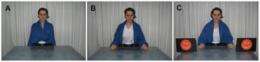
The model before performing the head touch action in the hands-occupied and hands-occupied familiarization condition (A), the hands-free condition (B), and the hands-free distraction condition (C). Credit: MPI for Human Cognitive and Brain Sciences.
In a widely noticed study, developmental psychologists reported that 14-month-old infants imitate an unusual action if it was chosen deliberately by the person they observed, but not if it could be attributed to external constraints. This selective imitation was put forth as evidence for an early understanding of rational action and action goals. Scientists at the Max Planck Institute for Human Cognitive and Brain Sciences in Leipzig now present a much simpler explanation for the finding. A replication study revealed that the observed differences in imitation were likely caused by a distraction during the experiments.
Infant imitation is a key factor in early learning and has been studied by developmental psychologists for a long time. In 2002, a study published in the journal Nature seemingly showed astonishing cognitive abilities in children that were only 14 months old. In the experiment, a child would observe an adult performing the unconventional action of illuminating a lamp by touching it with the head. Being presented with the lamp later on, 70 percent of the children would copy this curious behaviour but only if the hands of the person were free during the observed action. If the hands were occupied by holding a blanket wrapped around the body, which was before worn loosely over the shoulders, imitation rates dropped to around 20 percent.
This result has been explained with the children evaluating the rationality of the model's actions. Had the model freely chosen to use her head for illuminating the lamp, they may have assumed that there must be good reasons for it. But if the model acted under obvious constraints that they themselves did not have, there was no reason to imitate. It seemed that infants were able not only to understand the goals but also to follow the situational context of the observed behaviour.
This interpretation may now have to be revised, due to a factor that had previously not been taken into account. "The eye-catching sight of the person wrapped in a blanket may have distracted infants from the action they were observing", says Miriam Beisert of the Research Group "Infant Cognition and Action". To test if the outcome of the experiment was indeed influenced, the scientists replicated the original study, but added two additional conditions.
One alteration underlined how much eye- catching distractions influenced the children's response: When two red Smileys were put on the table before the experiment, imitation of the "hands-free"-condition dropped considerably. In order to reduce distraction during the second condition, the children were given time to familiarize themselves with the sight of the blanket in a five-minute warm-up phase, which preceded the demonstration of the head touch action. The imitation rate went up to around 70 percent, showing that it made no actual difference whether the model person's hands were free or not.
"Assuming rational imitation, seeing the blanket-wrapped person for a longer time should have, if anything, resulted in an even lower imitation rate", says Moritz Daum, head of the research group. "With these results, rational thinking can be ruled out as a reason for children's selective imitation at this age."
More information: Beisert M, Zmyj N, Liepelt R, Jung F, Prinz W, et al. (2012) Rethinking 'Rational Imitation' in 14-Month-Old Infants: A Perceptual Distraction Approach. PLoS ONE 7(3): e32563. doi:10.1371/journal.pone.0032563
Journal reference:
PLoS ONE
Provided by
Max-Planck-Gesellschaft
-
Social imitation found in rhesus monkeys
Sep 05, 2006 |
not rated yet |
0
-
Rock-paper-scissors players are natural copycats
Jul 20, 2011 |
not rated yet |
0
-
Seeing eye to eye is key to copying, say scientists
Aug 16, 2011 |
not rated yet |
0
-
Autism researchers make exciting strides
Dec 12, 2011 |
not rated yet |
0
-
Automatic imitation is not only a human trait, research finds
Jul 30, 2008 |
not rated yet |
0
-
Motion perception revisited: High Phi effect challenges established motion perception assumptions
Apr 23, 2013 |
3 / 5 (2) |
2
-
Anything you can do I can do better: Neuromolecular foundations of the superiority illusion (Update)
Apr 02, 2013 |
4.5 / 5 (11) |
5
-
The visual system as economist: Neural resource allocation in visual adaptation
Mar 30, 2013 |
5 / 5 (2) |
9
-
Separate lives: Neuronal and organismal lifespans decoupled
Mar 27, 2013 |
4.9 / 5 (8) |
0
-
Sizing things up: The evolutionary neurobiology of scale invariance
Feb 28, 2013 |
4.8 / 5 (10) |
14
-
Why is zone 1 in liver more prone to ischemic injury?
May 23, 2013
-
How can there be villous adenoma in colon, if there are no villi there
May 22, 2013
-
How can there be a term called "intestinal metaplasia" of stomach
May 21, 2013
-
Pressure-volume curve: Elastic Recoil Pressure don't make sense
May 18, 2013
-
If you became brain-dead, would you want them to pull the plug?
May 17, 2013
-
MRI bill question
May 15, 2013
- More from Physics Forums - Medical Sciences
More news stories
Storm chasers: born to be wild?
(HealthDay)—We've all seen them: the surfers who race to the beach when a hurricane hits, the guy who decides to ride out the storm in his overmatched boat, the tornado chasers who fearlessly steer their ...
Psychology & Psychiatry
May 24, 2013 |
not rated yet |
0
Hormone levels may provide key to understanding psychological disorders in women
Women at a particular stage in their monthly menstrual cycle may be more vulnerable to some of the psychological side-effects associated with stressful experiences, according to a study from UCL.
Psychology & Psychiatry
May 24, 2013 |
4 / 5 (4) |
4
|
Are there atheists in foxholes? Study says they're the minority
Ernie Pyle – an iconic war correspondent in World War II – reportedly said "There are no atheists in foxholes." A new joint study between two brothers at Cornell and Virginia Wesleyan found that only ...
Psychology & Psychiatry
May 24, 2013 |
2.5 / 5 (4) |
2
Breathing exercises help veterans find peace after war, scholar says
(Medical Xpress)—Research by Stanford scholar Emma Seppala at the Center for Compassion and Altruism Research and Education found that post-traumatic stress disorder decreased in veterans who participated ...
Psychology & Psychiatry
May 24, 2013 |
5 / 5 (1) |
1
Depression raises diabetics' risk of severe low blood sugar episodes
(Medical Xpress)—Patients with diabetes who are depressed are much more likely to develop episodes of dangerously low blood sugars, or hypoglycemia, than are those who are not depressed, a new study has ...
Psychology & Psychiatry
May 24, 2013 |
not rated yet |
0
|
First drug to improve heart failure mortality in over a decade
Coenzyme Q10 decreases all cause mortality by half, according to the results of a multicentre randomised double blind trial presented today at Heart Failure 2013 congress. It is the first drug to improve heart failure mortality ...
Seniors more likely to crash when driving with pet, study finds
(HealthDay)—Animals make great companions for senior citizens, but elderly people who always drive with a pet in the car are far more likely to crash than those who never drive with a pet, researchers have ...
Heart failure accelerates male 'menopause'
Heart failure accelerates the aging process and brings on early andropausal syndrome (AS), according to research presented today at the Heart Failure Congress 2013. AS, also referred to as male 'menopause', was four times ...
Death highest in heart failure patients admitted in January, on Friday, and overnight
Mortality and length of stay are highest in heart failure patients admitted in January, on Friday, and overnight, according to research presented today at the Heart Failure Congress 2013. The analysis of nearly 1 million ...
Feds fight morning-after pill age ruling in NY
(AP)—Department of Justice lawyers have again asked a federal appeals court in New York to delay lifting age restrictions and prescription requirements on an emergency contraceptive popularly known as the morning-after ...
New immune system discovered
(Medical Xpress)—A research team, led by Jeremy Barr, a biology post-doctoral fellow, unveils a new immune system that protects humans and animals from infection.