Army researcher develops potential vaccine carrier
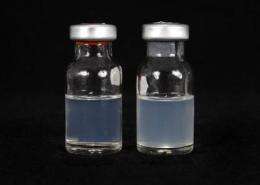
A researcher at the Brooke Army Medical Center (BAMC)/San Antonio Military Medical Center (SAMMC) will present findings this week on a new potential vaccine carrier that he hopes will extend the shelf life of and aid in the stockpiling of critical vaccines.
U.S. Army Maj. Jean M. Muderhwa is slated to present Sunday, April 22, at the Experimental Biology 2012 meeting on a microemulsion he developed and that has been found to be both stable and a good candidate for delivering a variety of antigens. His findings will be presented at the American Society for Biochemistry and Molecular Biology's annual meeting, which is part of EB2012.
"There is a synergy here," Muderhwa said of the microemulsion. "What I found is a composition that is transparent, is liquid and that has been sitting there (on my shelf) for six months" without degrading.
Muderhwa, deputy laboratory director at the Medical Center's Clinical Investigation Department, made the microemulsion with what seems like a simple recipe with five components, but it's how those five components interact that is quite special. He is hopeful that forthcoming animal studies will show the full potential for the recipe.
"There is a need (for new vaccine carriers like this) especially if we want to stockpile a vaccine," he emphasized. "The (U.S. Agency for International Development) and FDA are responsible for stocking, for example, the influenza vaccine in the case of epidemic. They have to deliver them as quickly as possible. So if you have a vaccine just sitting on the shelf for more than 10 or 20 years, you don't have to worry about its stability."
The first two parts of Muderhwa's concotion, oil and water, are the basis for just about any emulsion, many of which reside in most people's bathroom cabinets in the forms of creams and lotions. The third component, glycerol, is also used in a variety of skin-care products. The fourth component is a mixture of two high-molecular-weight, pharmaceutically acceptable surfactants (Span 80 and Tween 60). The fifth component, meanwhile, is an aluminum adjuvant-adsorbed protein used in vaccines to amplify the immune system's protective response to whatever antigen is being delivered.
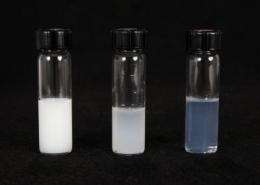
Compared with the particles found in emulsions commonly used in creams and other substances applied topically, the particles in microemulsions are extremely tiny. And it's precisely this property that Muderhwa has harnessed and thinks deserves further study.
"If I were to make an emulsion (of oil and water), which is just a cream and white, that emulsion would separate within weeks," he said. "If you make a vaccine containing an emulsion, it's only (good for) probably a few months because the emulsion is not thermodynamically stable. The surface tension is too high, and the molecules are repelling one another until the emulsion fails." An everyday example of this would be the separation of salad dressing left in a refrigerator or pantry for a couple of days. But when vaccines separate, giving them a good shake doesn't do the trick, making the administration of them more difficult.
"You can make those particles in a cream smaller and smaller and smaller," he explained. "The way you do that is you have to lower the surface tension to near zero. You know if you take water and put it in the oil, they don't mix. So you have to add a compound that can bring them together. If you take egg yolk – it has phospholipids, and these are emulsifiers – that helps to bring the water and oil to combine."
Muderhwa used a series of emulsifiers, such as Span 80 and Tween 60, and glycerol as the co-emulsifier needed to lower the surface tension of the tiny water and oil particles. That was only the first hurdle to overcome. The real worry was how the then-four-part compound would react if he added a fifth, the adjuvant needed to amplify the immune system's response to an antigen.
"Microemulsions are very sensitive to change. If you add an extra compound, they (also) separate quickly," he said. "But what I discovered is that, if I take … an aluminum
adjuvant, which is the only one approved by the (Food and Drug Administration) to be used in humans, and I mix that microemulsion with the aluminum compound, … it is still stable."
The aluminum adjuvant Muderhwa used is found in the influenza vaccine.
While microemulsions are now used for drug delivery, such as antibiotics and syrups, using them for vaccines could open up a new area of study, Maj. Muderhwa said. These microemulsions are formed readily and sometimes spontaneously, he said.
"Another part of the presentation is for the future – to tell people that these products can be used as a tool to investigate the effect of the surface area on the immune response," he explained. "If you make the molecules smaller and smaller and smaller, what happens? What happens if you increase the surface area? It will be interesting for research purposes to see the effects when the surface area increases on the immune response using this compound."


