Autophagy: When 'self-eating' is good for you
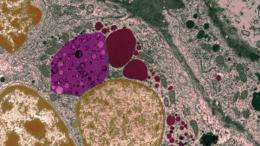
(Medical Xpress) -- New discoveries by Cambridge scientists about a molecular waste-disposal process that ‘eats’ bacteria are influencing the clinical management of cystic fibrosis, and could be the basis of innovative new treatments to fight off bacteria.
Broken pieces of internal structures, damaged organelles and harmful clumps of proteins are all examples of the molecular detritus that builds up continuously in our cells. Fortunately, we are equipped with an intracellular process called autophagy (literally ‘self-eating’) that gathers up the debris, wraps it in a double membrane and delivers it to an intracellular sac called the lysosome. Here, the material is ingested, digested and recycled, ready to be used again.
Recent work has suggested that autophagy may also be important in killing intracellular bacteria that are able to escape the normal processes that control infection within cells. Autophagy appears to be critical in controlling infections of Mycobacterium tuberculosis (MTB) and related species called non-tuberculous mycobacteria (NTM), which are able to block degradation by lysosomes and thereby replicate within cells.
Researchers working at the University’s Cambridge Institute for Medical Research (CIMR) and Papworth Hospital have noticed that patients with chronic lung diseases such as cystic fibrosis (CF) are becoming increasingly infected with a highly pathogenic, multi-drug-resistant (MDR) NTM called Mycobacterium abscessus. Their research, published recently in the Journal of Clinical Investigation, suggests that M. abscessus infection may be linked to long-term use of azithromycin, an antibiotic with anti-inflammatory properties. They propose that azithromycin blocks autophagy in a type of white blood cell called the macrophage, effectively tipping the balance in favour of the Mycobacterium surviving in the cell.
It’s an ominous outcome for patients, as lead researcher Dr. Andres Floto explained: “Developing an infection with Mycobacterium abscessus is a big deal for patients with CF. It’s resistant to virtually all antibiotics, is very hard to treat, can accelerate lung damage and may rule out future lung transplantation. While the benefits of long-term azithromycin therapy in CF are clear, our data suggest that there may also be a downside to watch out for.”
He added: “Recent studies showing the benefit of azithromycin therapy in asthma and smoking-related chronic obstructive pulmonary disease (COPD) will no doubt increase the numbers of patients on long- term azithromycin therapy. Physicians will need to be aware of the potential for harm with this treatment, and carefully monitor patients for mycobacterial disease”.
‘Forced stoppage’ of the cleaning crew
Floto is a Wellcome Trust Senior Clinical Fellow in the Department of Medicine and Principal Investigator in the CIMR. He is also Director of Research at the Cambridge Centre for Lung Infection at Papworth Hospital. The Centre cares for over 260 adults with CF and almost 2,000 patients with recurrent or difficult lung infections.
“We’d been struck by the rising rates of M. abscessus infection in CF patients in centres around the world and wondered whether it could be connected to an increased use of long-term azithromycin,” explained Floto. “Azithromycin is a broad-spectrum antibiotic which paradoxically is used to treat some mycobacterial infections. In patients with CF and, more recently, other inflammatory lung diseases such as asthma and COPD, it’s being prescribed as a long-term anti-inflammatory therapy.”
The association between azithromycin use and M. abscessus infection was first suggested when Floto and colleagues carried out an epidemiological study of adult patients with CF at Papworth Hospital and found that those patients with NTM infection were much more likely to be taking long-term azithromycin. When they looked at cells in culture, they discovered that the antibiotic impaired autophagy, effectively causing a ‘forced stoppage’ of the waste-recycling unit and preventing cells from clearing infecting mycobacteria. Moreover, azithromycin had a profound effect on M. abscessus infection of a mouse model; whereas untreated mice were able to clear the infection rapidly, those given the drug developed persistent lung infection.
Exploiting autophagy
The interactions of mycobacteria with immune cells are extremely complex and poorly understood. In a paper published in 2006 in Science, Floto together with Professor Paul Lehner at the CIMR began to define how immune cells respond to specific proteins from mycobacteria which then control the immune response. Subsequent work has suggested that the ability of macrophages to kill mycobacteria can be enhanced through a number of pathways, including autophagy.
Working with Professor David Rubinsztein at the CIMR, who has been interested in enhancing autophagy to clear the build-up of damaging clumps of proteins in neurodegenerative diseases, Floto has begun to study whether autophagy might be exploited therapeutically to treat multi-drug- resistant tuberculosis (MDR-TB), for which there is an urgent need to find new treatments. In 2008, the World Health Organization estimated that of the 9.4 million new TB cases 440,000 were MDR-TB. “It’s a massive challenge”, explained Floto, “We believe that stimulating autophagy to kill TB will bypass the problem of multi-drug resistance and may lead to potential new treatments for MDR-TB.”
Meanwhile, Floto’s work on azithromycin has already begun to influence clinical practice in a number of major CF centres in the UK. Although at pains to stress that a larger, prospective multi-centre study is needed before universal guidance can be given for the management of patients on chronic azithromycin therapy, Floto explained how the Cambridge Centre for Lung Infection has adopted a policy that is already proving successful: “We give patients who are not doing as well as we’d expect a holiday off the medication for a month while we screen carefully for NTM. When we do this, we often find a mycobacterial infection brewing in the lungs and can treat it immediately, instead of allowing the infection to take hold covertly without being detected.”
Floto’s research exemplifies the importance of a seamless link between fundamental research and clinical translation, and will benefit still further from the planned move of Papworth Hospital to the Cambridge Biomedical Campus (see panel). “Papworth has a unique group of patients and an international reputation for the treatment of patients with difficult lung infections,” he explained. “Forging greater links between Papworth and the University will inevitably promote research into a number of clinically important areas and smooth the route from bench to bedside, and back again.”


