Babalung gets babies breathing again
April 13, 2012 By Mike Williams in Other
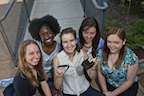
A team of students at Rice University has engineered the Babalung, a monitor that prompts premature infants who suffer from apnea to start breathing again and gives a visual alarm if they don’t. From left: Andrea Ulrich, Bridget Ugoh, Rachel Gilbert, Jordan Schermerhorn and Rachel Alexander. Credit: Jeff Fitlow/Rice University
(Medical Xpress) -- Rice University students have developed an inexpensive, battery-powered neonatal monitor for infants that could save many lives in the developing world.
Five bioengineering students created the Babalung Apnea Monitor for a yearlong senior capstone project that is required of all graduating engineering students at Rice. The device consists of a small electronic microcontroller connected to an adjustable strap with a stretch sensor.
Team Breath Alert Rachel Alexander, Rachel Gilbert, Jordan Schermerhorn, Bridget Ugoh and Andrea Ulrich began with the knowledge that nearly half of the 12 million babies born prematurely in developing countries experience episodes of apnea, a sudden stoppage of breathing. In general, a tap on the foot can prompt the child to resume breathing, but the widespread occurrence of the problem means there isnt always someone available to administer that simple remedy.
The Babalung may be the next best thing, an ingenious combination of low- and high-tech that tries on its own to restart a babys breathing and raises a flag if it cant, the students said.
The first line of defense is the elastic sensor contained within the strap surrounding the infants chest. The strap expands and contracts, which the system sees as a sine wave, said Ulrich. When the wave stops for 20 seconds, the attached microcontroller turns on a vibrating motor to prompt the infant to take a breath. If the child still isnt breathing five seconds later, a visual alarm is triggered.
We thought about an audio alarm, but theres the risk that a nurse wouldnt hear it in a large room. And an alarm loud enough to hear might damage the babys hearing, Alexander said.
This video is not supported by your browser at this time.
So we went with a flashing bike light raised above the crib, so you can see it across a room, Gilbert said. Now were doing research into what frequencies of pulsation attract the most attention.This team has worked tirelessly to design a useful technology for very-low-resource settings, said Maria Oden, director of Rices Oshman Engineering Design Kitchen and an adviser to the team. They sought feedback from physicians who work in those settings and incorporated this advice into their prototype. The unique feature of the device is the system that alerts a baby as an intervention to apnea all without requiring a nurse to intervene.
Gary Woods, a Rice professor in the practice of computer technology in the department of electrical and computer engineering, is also advising the team. Woods own students have designed a smartphone app to receive data from the device via Bluetooth.
The team hopes to send three prototypes for testing in developing nations through Beyond Traditional Borders, part of the Rice 360˚: Institute for Global Health Technologies, this summer. But they envision uses for parents closer to home as well. While their primary goal is saving babies in developing countries, they would love to see Babalung on American shelves to give parents peace of mind.
We did a survey in January, asking recent mothers whether or not they use a SIDS monitor or an apnea monitor for their infants, and if they did, what their biggest complaint was. The No. 1 complaint was the number of false alarms, Alexander said.
In 50 tests that the students performed mostly on themselves, the Babalung gave no false alarms. We caught every actual case of apnea, Gilbert said. We also learned how hard it is to stop breathing for 20 seconds.
Team members said the device costs about $25 to build now, but they hope that continued development will drive the price down further for units bound to aid global health. In developing nations, caregivers are so understaffed and overwhelmed that to provide something this simple feels like a straightforward solution, Ugoh said.
Her incentive to join the project came from a place closer to her heart, though. My sister had a baby last year, and she would stay up, not go to sleep, because she was worried whether her son was breathing or not, Ugoh said. I told her, You know what? Next year Im going to make you a device that detects breathing and will let you know. Lo and behold, this project was offered and it was on the top of my list.
Provided by
Rice University
-
Laser music: BYU electrical engineers use light to beam songs across a room
Dec 20, 2011 |
not rated yet |
0
-
Is that sleepiness during pregnancy normal or a sign of sleep apnea?
Feb 10, 2012 |
not rated yet |
0
-
New sleep apnea device may reduce cost, time required for diagnosis
Jan 05, 2012 |
not rated yet |
0
-
High school students test best with 7 hours' rest
Feb 10, 2012 |
not rated yet |
0
-
Researcher argues 'pretending to listen' OK, sometimes necessary in education
Oct 13, 2011 |
not rated yet |
0
-
Motion perception revisited: High Phi effect challenges established motion perception assumptions
Apr 23, 2013 |
3 / 5 (2) |
2
-
Anything you can do I can do better: Neuromolecular foundations of the superiority illusion (Update)
Apr 02, 2013 |
4.5 / 5 (11) |
5
-
The visual system as economist: Neural resource allocation in visual adaptation
Mar 30, 2013 |
5 / 5 (2) |
9
-
Separate lives: Neuronal and organismal lifespans decoupled
Mar 27, 2013 |
4.9 / 5 (8) |
0
-
Sizing things up: The evolutionary neurobiology of scale invariance
Feb 28, 2013 |
4.8 / 5 (10) |
14
-
Classical and Quantum Mechanics via Lie algebras
Apr 15, 2011
- More from Physics Forums - Independent Research
More news stories
Decisions to forgo life support may depend heavily on the ICU where patients are treated
The decision to limit life support in patients in the intensive care unit (ICU) appears to be significantly influenced by physician practices and/or the culture of the hospital, suggests new findings from researchers at the ...
Other
37 minutes ago |
not rated yet |
0
People on higher incomes are happier with new knees
Knee replacement surgery is a very common procedure. However, it does not always resolve function or pain in all the recipients of new knees. A study by Robert Barrack, MD and his colleagues from the Washington University ...
Other
2 hours ago |
not rated yet |
0
New search engine finds rare diagnoses
Doctors are trained to think "common disease" when they meet patients in their practices, and as they rarely or never meet a rare disease, it often takes many years to reach the right diagnosis. A new search tool called FindZebra ...
Other
3 hours ago |
not rated yet |
0
Delayed transfer to the ICU increases risk of death in hospital patients
Delayed transfer to the intensive care unit (ICU) in hospitalized patients significantly increases the risk of dying in the hospital, according to a new study from researchers in Chicago.
Other
4 hours ago |
not rated yet |
0
Free distribution of auditory orientation training system for the visually impaired
Researchers from the National Institute of Advanced Industrial Science and Technology (AIST), and the Research Institute of Electrical Communication (RIEC) of Tohoku University have jointly developed an auditory ...
Other
5 hours ago |
not rated yet |
0
Drugs found to both prevent and treat Alzheimer's disease in mice
Researchers at USC have found that a class of pharmaceuticals can both prevent and treat Alzheimer's Disease in mice.
Enrichment therapy effective among children with autism, study finds
Children with autism showed significant improvement after six months of simple sensory exercises at home using everyday items such as scents, spoons and sponges, according to UC Irvine neurobiologists.
Poliovirus vaccine trial shows early promise for recurrent glioblastoma
An attack on glioblastoma brain tumor cells that uses a modified poliovirus is showing encouraging results in an early study to establish the proper dose level, researchers at Duke Cancer Institute report.
'Doctor shopping' by obese patients negatively affects health
Overweight and obese patients are significantly more likely than their normal-weight counterparts to repeatedly switch primary care doctors, a practice that disrupts continuity of care and leads to more emergency room visits, ...
Better behavior after tonsil/adenoid surgery for kids with sleep breathing trouble?
Children with obstructive sleep apnea who had a common surgery to remove their tonsils and adenoids showed notable improvements in behavior, quality of life and other symptoms compared to those treated with "watchful waiting" ...
If you can remember it, you can remember it wrong
(Medical Xpress)—Native peoples in regions where cameras are uncommon sometimes react with caution when their picture is taken. The fear that something must have been stolen from them to create the photo ...