Brain network reveals disorders
April 13, 2012 By Kay H. Brodersen in Neuroscience
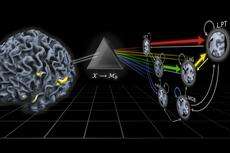
Brain model (left) depicting brain activity stimulated by speech processing (yellow). The new method allows for the mathematical modeling of interactions between regions within the brain (right). The prism represents the transition or “Generative Embedding.” Credit: Brodersen KH/ ETH Zurich
(Medical Xpress) -- Researchers at ETH Zurich and the University of Zurich identify a new method of unerringly detecting the presence of pathophysiological changes in the brain. The new method was developed in order to gain a mechanistic understanding of schizophrenia and other spectrum disorders, which will lead to more accurate diagnoses and more effective treatments.
When mathematical genius John Nash was diagnosed with schizophrenia, the chance for recovery was slim. Medicine in the 1960s simply had no convincing explanations for his condition. Alarmingly, things dont look much better nowadays: depression, addiction, schizophrenia, and other spectrum disorders remain among the toughest challenges for medicine. This is because they are caused by complicated and largely unknown interactions between genes and the environment. Different disease mechanisms may underlie similar, or even identical, symptoms. This means that the effect of any given drug may vary hugely across individuals, resulting in trial-and-error treatment. In addition, conditions whose biological basis is not well-understood may be perceived as particularly stigmatizing.
Most spectrum disorders lack a physiological definition altogether; they are simply described in terms of particular symptoms. This is problematic when these symptoms are caused by different disease mechanisms. Conversely, existing disease classifications frequently group patients with disjoint symptoms under the same label: a person with delusions and disorganized thought, for instance, can be diagnosed with schizophrenia, just as somebody else suffering from hallucinations and movement problems. Examples such as this one show that the development of more specific diagnoses and more effective treatment will require a mechanistic understanding of the pathophysiological mechanisms underlying spectrum disorders.
One step in this direction has recently been made by Kay Henning Brodersen and Klaas Enno Stephan at ETH Zurich and the University of Zurich. Within the framework of the SystemsX.ch project Neurochoice, the two researchers investigate how insights gained from mathematical models of decision making and underlying brain function can be translated into clinical applications. Put simply, we develop mathematical microscopes that allow us to estimate physiological or computational quantities that cannot be measured directly, says Klaas Enno Stephan, director of the newly founded Translational Neuromodeling Unit (TNU) in Zurich. This allows us to obtain more accurate classifications and gain deeper mechanistic insights into the underlying condition than previous attempts.
To demonstrate the plausibility of their idea, the two scientists collaborated with a clinical team led by Alex Leff at University College London. They analyzed brain activity from two groups of participants: one group of stroke patients that suffered from language impairments; and one group of healthy volunteers. While undergoing functional magnetic resonance imaging (fMRI), participants were asked to passively listen to speech. A mathematical model was then used to assess, separately within each participant, how brain regions involved in speech processing interacted. Notably, none of the brain regions included in the model had been affected by the stroke in the patients.
The researchers then asked whether it was possible to automatically detect the presence of a remote lesion from patterns of brain connectivity in the healthy part of the brain. Using our model of brain function, we were able to diagnose patients with an accuracy of 98%, says Brodersen, first author of the study. This became possible by tying together dynamic causal models of neuronal dynamics with mathematical techniques from machine learning and Bayesian inference. In contrast to subtle spectrum disorders, of course, this initial proof-of-principle study concerned a rather salient clinical condition, that is, language impairments caused by a stroke. In the future, Stephan and Brodersen therefore plan to investigate whether their approach might work equally well for those diseases where contemporary medicine is struggling, such as schizophrenia, depression, and addiction. The two researchers hope that their approach will help dissect these spectrum disorders into pathophysiologically well-defined subgroups. Identifying such subgroups would provide an important step towards more specific diagnoses and may eventually predict the most effective treatment for an individual patient.
More information: Brodersen KH, Schofield TM, Leff AP, Ong CS, Lomakina EI, Buhmann JM & Stephan KE. Generative embedding for model-based classification of fMRI data. PLoS Computional Biology, 7 (6): e1002079. doi:10.1371/journal.pcbi.1002079
Provided by
ETH Zurich
-
Study compares traits of autism, schizophrenia
Feb 27, 2012 |
not rated yet |
0
-
Potential target for treating schizophrenia found
May 11, 2011 |
not rated yet |
0
-
Novel analysis offers clues to schizophrenia underpinnings
Feb 20, 2012 |
not rated yet |
0
-
Siblings of schizophrenia patients display subtle shape abnormalities in brain
Feb 19, 2008 |
not rated yet |
0
-
New brain link as cause of schizophrenia
Oct 27, 2008 |
not rated yet |
0
-
Motion perception revisited: High Phi effect challenges established motion perception assumptions
Apr 23, 2013 |
3 / 5 (2) |
2
-
Anything you can do I can do better: Neuromolecular foundations of the superiority illusion (Update)
Apr 02, 2013 |
4.5 / 5 (11) |
5
-
The visual system as economist: Neural resource allocation in visual adaptation
Mar 30, 2013 |
5 / 5 (2) |
9
-
Separate lives: Neuronal and organismal lifespans decoupled
Mar 27, 2013 |
4.9 / 5 (8) |
0
-
Sizing things up: The evolutionary neurobiology of scale invariance
Feb 28, 2013 |
4.8 / 5 (10) |
14
-
Why is zone 1 in liver more prone to ischemic injury?
15 hours ago
-
How can there be villous adenoma in colon, if there are no villi there
May 22, 2013
-
How can there be a term called "intestinal metaplasia" of stomach
May 21, 2013
-
Pressure-volume curve: Elastic Recoil Pressure don't make sense
May 18, 2013
-
If you became brain-dead, would you want them to pull the plug?
May 17, 2013
-
MRI bill question
May 15, 2013
- More from Physics Forums - Medical Sciences
More news stories
Controlling mood through the motions of mitochondria
(Medical Xpress)—Regulating the distribution of power in neurons is done by a system that makes the national electric grid look simple by comparison. Each neuron has several thousand mitochondria confined ...
Neuroscience
1 hour ago |
4 / 5 (1) |
0
|
Brain uses internal 'average voice' prototype to identify who is talking
(Medical Xpress)—The human brain is able to identify individuals' voices by comparing them against an internal 'average voice' prototype, according to neuroscientists.
Neuroscience
5 hours ago |
1 / 5 (1) |
0
|
Depression common among children with temporal lobe epilepsy
A new study determined that children and adolescents with seizures involving the temporal lobe are likely to have clinically significant behavioral problems and psychiatric illness, especially depression. Findings published ...
Neuroscience
5 hours ago |
not rated yet |
0
The secret lives, and deaths, of neurons
As the human body fine-tunes its neurological wiring, nerve cells often must fix a faulty connection by amputating an axon—the "business end" of the neuron that sends electrical impulses to tissues or other ...
Neuroscience
7 hours ago |
5 / 5 (2) |
0
|
Regenerating spinal cord fibers may be treatment for stroke-related disabilities
A study by researchers at Henry Ford Hospital found "substantial evidence" that a regenerative process involving damaged nerve fibers in the spinal cord could hold the key to better functional recovery by most stroke victims.
Neuroscience
7 hours ago |
not rated yet |
0
|
Statin use is linked to increased risk of developing diabetes, warn researchers
Treatment with high potency statins (especially atorvastatin and simvastatin) may increase the risk of developing diabetes, suggests a paper published today in BMJ.
Consumers largely underestimating calorie content of fast food
People eating at fast food restaurants largely underestimate the calorie content of meals, especially large ones, according to a paper published today in BMJ.
Dual-source cardiac CT IDs CAD in hard-to-image patients
(HealthDay)—In patients who have previously been considered difficult to image, dual-source cardiac (DSC) computed tomography (CT) can identify clinically significant coronary artery disease, according ...
WHO: Scientific red tape mars efforts vs. virus
International efforts to combat a new pneumonia-like virus that has now killed 22 people are being slowed by unclear rules and competition for the potentially profitable rights to disease samples, the head ...
Future doctors unaware of their obesity bias
Two out of five medical students have an unconscious bias against obese people, according to a new study by researchers at Wake Forest Baptist Medical Center. The study is published online ahead of print in the Journal of ...
When oxygen is short, EGFR prevents maturation of cancer-fighting miRNAs
Even while being dragged to its destruction inside a cell, a cancer-promoting growth factor receptor fires away, sending signals that thwart the development of tumor-suppressing microRNAs (miRNAs) before it's dissolved, researchers ...