Dissolvable heart artery stents appear safe in study
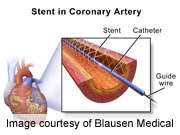
April 16, 2012 By Denise Mann, HealthDay Reporter in Cardiology

Dissolvable heart artery stents appear safe in study

Biodegradable stents might lower risk of heart attack, Japanese researchers suggest.

(HealthDay) -- New long-term research now suggests that fully biodegradable stents are safe to use in heart arteries.

Reporting in the April 16 issue of Circulation, said a 10-year study has shown the biodegradable Igaki-Tamai stent, made of a cornstarch-based material, dissolves into the , leaving no permanent foreign material in an artery and reducing the occurrence of an in-stent blood clot.

According to the study, from all causes was 87 percent and rates of major heart-related complications were similar to those seen with .

Stents, the tiny mesh tubes inserted into heart arteries to keep open and allow blood to flow to the heart, are far from fail-safe. New can -- and do -- occur. So scientists have been trying to develop new stents, including ones coated with blood-thinning medications. Metal stents, sometimes coated with drugs, remain in the body where they can reclog.

The Igaki-Tamai stent, developed by Kyoto Medical Planning Co., is used in nine European Union countries and Turkey to treat , or blocked arteries in the legs. It is not used to treat blocked in any country.

Study author Dr. Kunihiko Kosuga, director of cardiology at Shiga Medical Center for Adults in Moriyama City, predicted in a journal news release that "fully biodegradable stents may hold an important position as the next generation of coronary devices."

In the study, 50 people received 84 Igaki-Tamai stents between September 1998 and April 2000. Researchers report that the survival rate from heart-related death was 98 percent. Half of the individuals experienced major heart-related complications, which is in line with studies of metal stents. The stent was totally absorbed in three years.

"There is a risk of heart attack if a stent does not get incorporated into the blood vessel wall," explained Dr. Barry Kaplan, vice chairman of cardiology at North Shore University Hospital in Manhasset, N.Y., and Long Island Jewish Medical Center in New Hyde Park, N.Y. Once the metal stent is absorbed, the risk theoretically should decrease or go away. The problem is that metal stents are not always absorbed. In theory, biodegradable stents should be.

"The panacea would be a drug-eluding biodegradable stent where the drug is released into the before the stent gets absorbed," he said. "This would lower the re-stenosis or re-blockage rate, yet eliminate risk of heart attacks or blood clot," Kaplan said. "From a technical standpoint, this particular stent is providing a similar risk to a bare-metal stent."

The new study is "helping us feeling more comfortable that this is a good line of research to pursue and that there is no special concern about hidden dark sides with this biodegradable stent," added Dr. Kirk Garratt, clinical director of interventional cardiovascular research at Lenox Hill Hospital in New York City.

More information: What is a stent? Learn more from the U.S. National Heart, Lung, and Blood Institute.

Copyright © 2012 HealthDay. All rights reserved.

5 /5 (1 vote)  

Rank 5 /5 (1 vote)
Relevant PhysicsForums posts

More news stories

Free fatty acids linked to cardiac risk in late adulthood

(HealthDay)—Blood levels of free fatty acids are associated with insulin resistance during young adulthood and cardiovascular risk factors in later adulthood, according to a study published online May 13 ...

Cardiology created May 17, 2013 | popularity not rated yet | comments 0 | with audio podcast

Diagnosing heart attacks: There's an app for that

An experimental, inexpensive iPhone application transmitted diagnostic heart images faster and more reliably than emailing photo images, according to a research study presented at the American Heart Association's Quality ...

Cardiology created May 17, 2013 | popularity not rated yet | comments 0

Study suggests new role for ECMO in treating patients with cardiac arrest and profound shock

Extracorporeal membrane oxygenation (ECMO), a procedure traditionally used during cardiac surgeries and in the ICU that functions as an artificial replacement for a patient's heart and lungs, has also been used to resuscitate ...

Cardiology created May 17, 2013 | popularity not rated yet | comments 0

Stroke patients respond similarly to after-stroke care, despite age difference

Age has little to do with how patients should be treated after suffering a stroke, according to new research from the University of Georgia.

Cardiology created May 17, 2013 | popularity not rated yet | comments 0 | with audio podcast

Depression linked to almost doubled stroke risk in middle-aged women

Depressed middle-aged women have almost double the risk of having a stroke, according to research published in Stroke: Journal of the American Heart Association.

Cardiology created May 16, 2013 | popularity not rated yet | comments 0


Ketamine shows significant therapeutic benefit in people with treatment-resistant depression

Patients with treatment-resistant major depression saw dramatic improvement in their illness after treatment with ketamine, an anesthetic, according to the largest ketamine clinical trial to-date led by researchers from the ...

Consuming coffee linked to lower risk of detrimental liver disease, study finds

Regular consumption of coffee is associated with a reduced risk of primary sclerosing cholangitis (PSC), an autoimmune liver disease, Mayo Clinic research shows. The findings were being presented at the Digestive Disease ...

Research examines new methods for managing digestive health

Research presented at Digestive Disease Week (DDW) explores new methods for managing digestive health through diet and lifestyle.

New smartphone application improves colonoscopy preparation

The use of a smartphone application significantly improves patients' preparation for a colonoscopy, according to new research presented today at Digestive Disease Week (DDW). The preparation process, which begins days in ...

New research identifies practice changes to improve value and quality of GI procedures

There are significant cost and risk factors associated with two procedures commonly used to diagnose or treat gastrointestinal problems, according to research presented at Digestive Disease Week (DDW).

New research identifies risks, interventions for children's GI health

An increasing number of U.S. children are experiencing gastrointestinal issues that require interventions to resolve, according to research presented at Digestive Disease Week (DDW).