Early milk feeds best for vulnerable premature babies
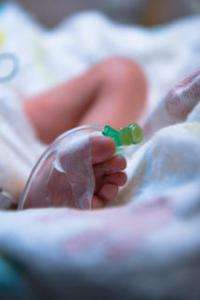
(Medical Xpress) -- The way premature babies are fed in hospitals could change following the results of an Oxford University-led study.
Babies who are born premature and 'growth-restricted' would generally benefit from starting milk feeds within the first 24–48 hours after birth, the study found.
High-risk premature babies are vulnerable to severe bowel problems, which has led previously to a tendency to delay the start of milk feeds. Doctors and nurses can now be more confident in starting to feed these high-risk babies earlier, the researchers said.
The findings could also lead to babies being able to leave specialist care units earlier, freeing up high-dependency care cots for other sick babies to use.
The trial, the largest to date looking at the issue of feeding these high-risk premature babies, was co-ordinated by the National Perinatal Epidemiology Unit at the University of Oxford and carried out at 54 hospitals across UK and Ireland.
The research was funded by children's charity Action Medical Research with support from The Garfield Weston Foundation and is published in the journal Pediatrics.
The study looked at the feeding of babies born five or more weeks early, who were also smaller than they should have been for their age. It was led by consultant neonatologist Dr. Alison Leaf and Professor Peter Brocklehurst from the National Perinatal Epidemiology Unit.
"These babies are a challenge to feed," said Dr. Leaf, who is now an academic consultant at the National Institute for Health Research, Southampton Biomedical Research Centre. "Good nutrition and growth is very important, however their body organs, including the bowel, are immature. They often do not cope well with milk, and may develop severe bowel inflammation, a condition called necrotising enterocolitis, which can make them very ill.
"Because of this, starting milk feeds is often delayed and early nutrition is given intravenously. This also has risks, particularly of infection and liver inflammation. Until now, nobody had tested whether it is better to start milk feeds early or to delay, so the project was designed to answer this question."
The study compared starting milk feeds early with later feeds and involved more than 400 premature babies. Half the babies started milk feeds on day 2 after birth, and the other half started on day 6. Full feeding was achieved earlier in the babies who started milk feeds on day 2. On average, these babies no longer needed an intravenous drip for feeds three days earlier than the babies starting milk feeds on day 6.
There was no difference in the number of babies experiencing severe bowel problems between those who had early feeds and those who started later.
Professor Brocklehurst, who is now Director of the Institute for Women's Health at University College, London, said: 'Early feeding appears to be better for these high risk babies. This research will enable more high-risk premature babies to be fed early, and to achieve full feeding earlier. This will reduce the need for intravenous drips and infusions.
He added: "It will also reduce the duration of occupancy of a high-dependency cot, which will free up resources for other sick babies, thus providing benefit for a wider population of sick infants."
These were vulnerable premature babies: almost half of the babies in the trial required some respiratory support, though really sick babies were not included in the trial.The great majority of the babies received their mother’s breast milk when feeding was started, rather than donor breast milk or formula.
The researchers are confident that the findings from this study can be put into effect immediately, and will result in clearer guidelines on nutrition and feeding for neonatal units across the UK and potentially worldwide.


