How fat are your lab mice?
April 4, 2012 in Medical research
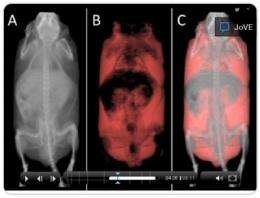
These are representative CT images of a mouse segmented for fat. Credit: © Journal of Visualized Experiments
Researchers are increasingly aware that fat in some parts of the body is more harmful than fat in other places. To help determine how obesity works, scientists turn to animal models and now, they are able to visualize how much fat their lab rats are carrying and where they are storing it. The method will be published in the April issue of the Journal of Visualized Experiments (JoVE).
"One of the key benefits of this technique versus existing methods, like ex vivo analysis, is that this technique allows for non-invasive and longitudinal assessment of fat in small animal disease models," said paper-author Dr. Todd Sasser.
Traditionally, researchers have had to use either invasive techniques, which provide more insight into where fat is being stored specifically but result in the death of the mouse, or less specific, non-invasive imaging techniques. Here, they use dedicated small animal X-ray computed tomography (CT) and customized analytics to see how the fat is distributed inside the animal.
The process is highly visual, resulting in three-dimensional images of the fat within the mouse, which is why the researchers chose to publish their method in JoVE, the only peer reviewed, PubMed-indexed science journal to publish all of its content in both text and video format.
"Generally, individuals new to this method will struggle, because the segmentation and visualization protocol includes several steps that must be completed in succession," said co-author Sarah Chapman, from the University of Notre Dame.
"As obesity and obesity-related illnesses continue to grow into worldwide problems, it is important to understand their fundamental causes and potential interventions," said JoVE Science Editor, Dr. Charlotte Frank Sage. "This technique details imaging and analysis technology that enables researchers to longitudinally and quantitatively study adipose content at a high level of detail."
More information: The article will be published on April 4, and can be found here: www.jove.com/video… d-tomography
Journal reference:
Journal of Visualized Experiments
Provided by The Journal of Visualized Experiments
-
New 3-D stem cell culture method published
Mar 02, 2012 |
not rated yet |
0
-
Researchers print live cells with a standard inkjet printer
Mar 16, 2012 |
not rated yet |
0
-
Opening the brain to new treatments
Mar 13, 2012 |
not rated yet |
0
-
Newly identified cells make fat
Oct 04, 2008 |
not rated yet |
0
-
Researchers quantify muscle soreness
Jan 23, 2012 |
not rated yet |
0
-
Motion perception revisited: High Phi effect challenges established motion perception assumptions
Apr 23, 2013 |
3 / 5 (2) |
2
-
Anything you can do I can do better: Neuromolecular foundations of the superiority illusion (Update)
Apr 02, 2013 |
4.5 / 5 (11) |
5
-
The visual system as economist: Neural resource allocation in visual adaptation
Mar 30, 2013 |
5 / 5 (2) |
9
-
Separate lives: Neuronal and organismal lifespans decoupled
Mar 27, 2013 |
4.9 / 5 (8) |
0
-
Sizing things up: The evolutionary neurobiology of scale invariance
Feb 28, 2013 |
4.8 / 5 (10) |
14
-
Pressure-volume curve: Elastic Recoil Pressure don't make sense
May 18, 2013
-
If you became brain-dead, would you want them to pull the plug?
May 17, 2013
-
MRI bill question
May 15, 2013
-
Ratio of Hydrogen of Oxygen in Dessicated Animal Protein
May 13, 2013
-
Alcohol and acetaminophen
May 13, 2013
-
Marie Curie's leukemia
May 13, 2013
- More from Physics Forums - Medical Sciences
More news stories
Now we know why old scizophrenia medicine works on antibiotics-resistant bacteria
In 2008 researchers from the University of Southern Denmark showed that the drug thioridazine, which has previously been used to treat schizophrenia, is also a powerful weapon against antibiotic-resistant bacteria such as ...
Medical research
May 17, 2013 |
3.7 / 5 (3) |
0
|
SUMO wrestling cells reveal new protective mechanism target for stroke
Scientists investigating the interaction of a group of proteins in the brain responsible for protecting nerve cells from damage have identified a new target that could increase cell survival.
Medical research
May 17, 2013 |
5 / 5 (1) |
0
How serotonin receptors can shape drug effects, from LSD to migraine medication
New findings by researchers carrying out experiments at the U.S. Department of Energy Office of Science's Advanced Photon Source (APS) help explain why some drugs that interact with two kinds of human serotonin ...
Medical research
May 17, 2013 |
4 / 5 (1) |
0
|
Preventing blood poisoning
Peptide molecules derived from the body's natural immune system can help boost the body's defence against life-threatening blood poisoning, joint University research has uncovered.
Medical research
May 17, 2013 |
4 / 5 (1) |
0
|
New mechanism to prevent type 2 diabetes in obese individuals
A new Montréal study conducted by Dr. May Faraj, associate research professor at the Université de Montréal and invited scientist at the IRCM, along with her research team and medical collaborators, shows ...
Medical research
May 17, 2013 |
not rated yet |
0
|
Alzheimer's leaves bilingual victims stranded in Canada
The devastating effect of Alzheimer's disease on bilingual people has been thrown into focus in Canada, where the sudden loss of a second language can leave sufferers feeling like strangers in their own country.
'Gap' for HIV vaccine efforts after latest setback
The hunt for an HIV vaccine has gobbled up $8 billion in the past decade, and the failure of the most recent efficacy trial has delivered yet another setback to 26 years of efforts.
Consuming coffee linked to lower risk of detrimental liver disease, study finds
Regular consumption of coffee is associated with a reduced risk of primary sclerosing cholangitis (PSC), an autoimmune liver disease, Mayo Clinic research shows. The findings were being presented at the Digestive Disease ...
Ketamine shows significant therapeutic benefit in people with treatment-resistant depression
Patients with treatment-resistant major depression saw dramatic improvement in their illness after treatment with ketamine, an anesthetic, according to the largest ketamine clinical trial to-date led by researchers from the ...
Research examines new methods for managing digestive health
Research presented at Digestive Disease Week (DDW) explores new methods for managing digestive health through diet and lifestyle.
New smartphone application improves colonoscopy preparation
The use of a smartphone application significantly improves patients' preparation for a colonoscopy, according to new research presented today at Digestive Disease Week (DDW). The preparation process, which begins days in ...