Fertility treatment bans in Europe draw criticism
(AP) -- More than three decades after Britain produced the world's first test-tube baby, Europe is a patchwork of restrictions for people who need help having a child.
Many countries have strict rules on who is allowed to get fertility treatments. And recent court rulings suggest nothing's likely to change anytime soon.
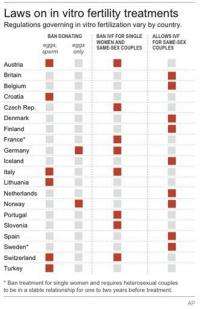
France and Italy forbid single women and lesbian couples from using artificial insemination and in vitro fertilization, or IVF, to conceive. Austria and Italy are among those banning all egg and sperm donations for IVF. Germany and Norway ban donating eggs, but not sperm.
Countries including Sweden require couples to have a stable relationship for at least a year to qualify for fertility treatment. Switzerland, among others, requires couples to be married.
And nearly everywhere in Europe except Ukraine, couples are banned from hiring a woman to carry a pregnancy for them.
"These laws are completely out of date," said Dr. Francoise Shenfield, a fertility expert at University College London.
"It's a medical treatment and the decision to treat should be up to doctors," not judges, said Shenfield, an ethics expert for the European Society for Human Reproduction and Embryology.
Placing bans on egg and sperm donation is "discriminating against infertile couples," she added, although she acknowledged there were valid medical reasons for not treating some patients, like women over 50.
The European laws stand in contrast to comparatively few restrictions elsewhere, including in the U.S., Australia, Brazil and Canada.
Experts estimate thousands of Europeans travel to another country each year for help having a baby, though exact figures aren't recorded. Many are single women who go abroad to get artificial insemination, which is banned for single women in countries including Sweden, Germany and Italy.
Marie Eriksson, a 36-year-old single mother in Sweden, described the restrictions as prejudice. "Having a child is not a right, but the possibility should not be forbidden because you don't have a partner," she said.
Eriksson, a librarian, traveled to a fertility clinic in Denmark after deciding she wanted to have a child on her own. "The alternative was to go out and meet a stranger at a pub," she said.
She gave birth to her daughter, Sonja, in 2008. "It was totally worth it," she said of the seven treatments she paid for.
Reasons for the restrictions vary from country to country. Many cite concerns about creating "unnatural" relationships between donors, parents and children. Others are driven by religious or cultural objections.
Recent attempts to change the laws have so far failed. Last November, the European Court of Human Rights upheld an Austrian regulation that forbids using sperm and egg donors for IVF.
In that case, two married couples sued the Austrian government, arguing the ban violated their right to a "private and family life" under the European Convention on Human Rights. The court ultimately ruled the restriction was justified and cited problems like "splitting motherhood" between a biological mother and the woman carrying the fetus.
"I'm often dumbfounded by the position some European countries take on IVF," said Dr. Norbert Gleicher, medical director of the Center for Human Reproduction, a private clinic in New York City.
The restrictions in many European countries would be unthinkable in the U.S., Gleicher said, adding about 40 percent of his patients travel from abroad, many from Europe.
In Sweden, lawmakers are considering whether to change the law so that all single women have access to fertility treatment.
Eriksson said the restrictions no longer match reality. "There are so many different kinds of families today that it is not sustainable to maintain laws and regulations based on traditional family ideals," she said.
For IVF, women must undergo hormone stimulation to produce eggs and a procedure to extract them from the ovaries. Embryos are created by mixing sperm and eggs together in a lab, then transferred into a woman's womb.
Fertility treatment remains a taboo subject in many countries.
Germany's history of eugenics - where Nazi doctors forcibly sterilized or euthanized people in an attempt to eliminate hereditary illnesses and handicapped people - makes officials nervous about any procedures that handle embryos. It was only last year that Germany approved an embryo test commonly used elsewhere to spot genetic problems. The test, generally used only in IVF pregnancies, is still banned in Austria and Italy.
In other countries, religion carries more weight. France and Italy both have strong historic ties to the Roman Catholic Church, which forbids IVF, primarily because the procedure may involve the destruction of embryos. The church is also against artificial insemination because it believes procreation should only be by a husband and wife through the natural act of sex.
Until 2004, Italy's fertility laws were fairly lax, leading to pregnancies in women as old as 60, and a proliferation of woman "renting" their wombs. A law supported by leading Catholic groups that year clamped down on egg and sperm donation, limited the number of embryos transferred, and outlawed the practice of freezing embryos. The law restricts IVF to "stable, heterosexual couples who live together and are of childbearing age."
Italy says allowing donated eggs could exploit women and that the practice "would lead to a weakening of the entire structure of society."
Most couples seeking fertility treatments don't need donated eggs and sperm. And many government health systems will pay for fertility treatments for those who have been trying at least three years to conceive.
People in Western Europe who seek medical treatment elsewhere cannot be prosecuted at home even if the treatment is illegal in their own country. But there can be other complications. For example, in France, children born through surrogacy are not entitled to a French passport.
Still, authorities are struggling with how to deal with the complexity of IVF families. Last month, France's Court of Appeal upheld a decision to grant civil status - similar to nationality - to twins carried by a surrogate mother in India for a French couple. But in 2011, the French Supreme Court denied civil status to twins born to a surrogate mother in the U.S.
For gay and lesbian couples in France, Italy, Switzerland and elsewhere, only one partner can be the child's legal father or mother.
"These restrictions imply that gays and lesbians are second-class citizens and that a child has to be raised in a conventional family," said Angelo Berbotto, a lawyer and acting secretary of NELFA, Europe's largest organization for gay and lesbian families.
Opponents say national health systems are not obligated to allow artificial reproduction techniques for same-sex couples.
"The desire to be a parent does not create the right to have children," said Gregor Puppinck, director general of the European Center for Law and Justice, a Christian group that lobbies European lawmaking bodies.
"What's lost is the best interests of the child," Puppinck said. "The child has a right not to have two fathers or two mothers."
Dr. Heinz Strohmer, a fertility doctor at a Vienna clinic, said most of his clients needing egg or sperm donations were more concerned about the logistics of getting treatment abroad than challenging Austria's law banning them.
"The only question they have is if we can organize everything for them," he said. Strohmer often works with clinics in the Czech and Slovak republics and Spain to get around the Austrian rules on IVF.
When Italian residents Giuseppina La Delfa and Raphaelle Hoedts decided to have a baby, they knew that would mean crossing borders. Needing a sperm donation for IVF that they couldn't get in Italy, the lesbian couple went to Belgium for more than a dozen cycles of fertility treatment. La Delfa gave birth to daughter Lisa-Marie in 2003.
"It was very difficult and it cost a lot of money, but it was the only way," said La Delfa, a 49-year-old French teacher. "Nothing was more important to us than her."
La Delfa considers the restrictions imposed on IVF for lesbian and gay couples not only archaic, but ineffective.
"They think there's only one way to be a parent," she said, of governments that ban fertility treatments. "They don't realize people will do whatever it takes to have a family."
For the two women, that meant another IVF trip last year, this time to Spain. Hoedts is currently pregnant with the couple's second child.
La Delfa said Lisa-Marie, now 8, is proud of her unusual origins.
"I joke with her that her big ears come from her donor," La Delfa said.
More information: Fertility group: http://www.fertilityeurope.eu/
©2012 The Associated Press. All rights reserved. This material may not be published, broadcast, rewritten or redistributed.


