Genes that promote cartilage healing protect against arthritis
April 27, 2012 By Jim Dryden in Arthritis & Rheumatism
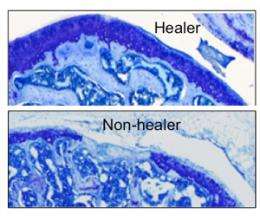
In mice with ears that heal rapidly, cartilage (shown in the thick blue border) also regenerates and heals more quickly. Washington University researchers found that the same genes that promote healing after cartilage damage also appear to protect against osteoarthritis. (SANDELL LABORATORY)
(Medical Xpress) -- The same genes that promote healing after cartilage damage also appear to protect against osteoarthritis, a condition caused by years of wear-and-tear on the cartilage between joints, new research at Washington University School of Medicine in St. Louis shows.
Although the research was conducted in mice, the genes also are likely to be important in people.
Our goal is to see whether we can protect cartilage in people by detecting the early biological changes that occur in osteoarthritis and prevent it from progressing to the stage where joint replacement becomes necessary, says principal investigator Linda J. Sandell, PhD, the Mildred B. Simon Professor of Orthopaedic Surgery. The main problem with biological treatments is that currently, we cant detect osteoarthritis in its early stages. Better understanding of the genes that influence the disorder may help us do that.
The researchers reported their findings in a pair of studies, published online in the journals Arthritis & Rheumatism and Osteoarthritis and Cartilage.
Osteoarthritis is the most common form of arthritis, affecting 25 million people in the United States. It is linked to the breakdown of cartilage, which acts as a shock absorber to cushion the joints. Osteoarthritis causes pain, swelling and reduced motion and is most common in the hands, knees, hips or spine.
This video is not supported by your browser at this time.
Scientists first discovered cartilage-healing properties in some strains of laboratory mice when they pierced their ears as a means to tag and identify them. But in some mice, the holes in their ears closed and quickly healed. Because so much of the ear is made from cartilage and healing occurred so rapidly in the mice ears, the researchers suspected that these mice also may be able to regenerate cartilage in their joints.Sandell and her team bred the mice that healed rapidly with other mice that healed more slowly, and they found that the mice that could quickly heal and regenerate cartilage in the knee also were less susceptible to osteoarthritis.
In people, a breakdown of cartilage causes the bones to rub together and damage the joint. If the damage becomes too extensive, joint replacement surgery may be necessary.
Injury to a joint is a major risk factor for osteoarthritis, but not everyone is equally susceptible.
Some people and these mouse studies suggest that someday we may be able to predict which people fare much better after an injury, Sandell says. We want to find a way to identify the genes that protect them.
Sandell, director of the universitys Core Center for Musculoskeletal Biology and Medicine, and co-investigator James M. Cheverud, PhD, professor of anatomy and neurobiology, now are studying several other strains of mice on the spectrum between the good healers and those that heal poorly. Theyve looked at the cartilage tissue under the microscope to determine the extent of osteoarthritis following an injury and analyzed the DNA in cartilage.
Weve identified genes that correlate with healing and with protection from osteoarthritis, Sandell says. The work is in its beginning stages, but now that weve found a correlation, we want to look at even more strains of mice so that we can actually map the location of the genes that cause osteoarthritis and help to repair cartilage.
She says osteoarthritis, like several other disorders, will ultimately involve many genes that each contribute in a small way to the disease process. By looking at more strains of mice, the research team believes it will become easier to identify the subtle genetic influences on osteoarthritis risk. As they clarify which genes are protecting the mice, it will be possible to look for similar genes in humans.
More information: Rai MF, Hashimoto S, Johnson EE, Janiszak KL, Fitzgerald J, Heber-Katz E, Cheverud JM, Sandell LJ. Heritability of articular cartilage regeneration and its association with ear-wound healing. Arthritis & Rheumatism, vol. 64 (published online). DOI 10.1002/art.34396
Hashimoto S, Rai MF, Janiszak KL, Cheverud JM, Sandell LJ. Cartilage and bone changes during development of post-traumatic osteoarthritis in selected LGXSM recombinant inbred mice. Osteoarthritis and Cartilage, vol. 20 (published online). doi: 10.1016/j.joca.2012.01.022
Provided by
Washington University School of Medicine in St. Louis
-
Research team finds compound that can spur cartilage growth
Apr 06, 2012 |
not rated yet |
0
-
Scientists find cause of cartilage degeneration in osteoarthritis
Jan 12, 2009 |
not rated yet |
0
-
Progress in tissue engineering to repair joint damage in osteoarthritis
Jun 08, 2011 |
not rated yet |
0
-
'Lubricin' molecule discovered to reduce cartilage wear
Oct 21, 2010 |
not rated yet |
0
-
Glucocorticoid treatment may prevent long-term damage to joints
Sep 02, 2011 |
not rated yet |
0
-
Motion perception revisited: High Phi effect challenges established motion perception assumptions
Apr 23, 2013 |
3 / 5 (2) |
2
-
Anything you can do I can do better: Neuromolecular foundations of the superiority illusion (Update)
Apr 02, 2013 |
4.5 / 5 (11) |
5
-
The visual system as economist: Neural resource allocation in visual adaptation
Mar 30, 2013 |
5 / 5 (2) |
9
-
Separate lives: Neuronal and organismal lifespans decoupled
Mar 27, 2013 |
4.9 / 5 (8) |
0
-
Sizing things up: The evolutionary neurobiology of scale invariance
Feb 28, 2013 |
4.8 / 5 (10) |
14
-
Calculating on-axis elements of a solenoid
1 hour ago
-
latitude & longitude & air pressure
2 hours ago
-
Differences of Classical Mechanics when learned with Calc vs algebra?
5 hours ago
-
what is the distance traveled
9 hours ago
-
Image of a Convex Lens Cut in Half Horizontally
13 hours ago
-
Ray tracing throught optical system of thick lenses
13 hours ago
- More from Physics Forums - Classical Physics
More news stories
Enzyme-activating antibodies revealed as marker for most severe form of rheumatoid arthritis
In a series of lab experiments designed to unravel the workings of a key enzyme widely considered a possible trigger of rheumatoid arthritis, researchers at Johns Hopkins have found that in the most severe ...
Arthritis & Rheumatism
8 hours ago |
5 / 5 (1) |
0
|
Sugar injections for knee arthritis may ease pain
(HealthDay)—Injections of a sugar solution appear to help relieve knee pain and stiffness related to osteoarthritis, a new study suggests.
Arthritis & Rheumatism
May 21, 2013 |
4.5 / 5 (2) |
0
|
Blame your parents for bunion woes
A novel study reports that white men and women of European descent inherit common foot disorders, such as bunions (hallux valgus) and lesser toe deformities, including hammer or claw toe. Findings from the Framingham Foot ...
Arthritis & Rheumatism
May 20, 2013 |
not rated yet |
0
|
New theory on genesis of osteoarthritis comes with successful therapy in mice
Scientists at Johns Hopkins have turned their view of osteoarthritis (OA) inside out. Literally. Instead of seeing the painful degenerative disease as a problem primarily of the cartilage that cushions joints, ...
Arthritis & Rheumatism
May 19, 2013 |
4.9 / 5 (8) |
0
|
Ultrasound findings can improve classification of RA
(HealthDay)—Compared to clinical diagnosis of synovitis, ultrasound-detected synovitis provides either improved sensitivity or specificity when used with the American College of Rheumatology/European League ...
Arthritis & Rheumatism
May 15, 2013 |
not rated yet |
0
Slowing the aging process—only with antibiotics
Swiss scientists reveal the mechanism responsible for aging hidden deep within mitochondria—and dramatically slow it down in worms by administering antibiotics to the young.
Researchers complete largest genetic sequencing study of human disease
Researchers from Queen Mary, University of London have led the largest sequencing study of human disease to date, investigating the genetic basis of six autoimmune diseases.
Brain can be trained in compassion, study shows
Until now, little was scientifically known about the human potential to cultivate compassion—the emotional state of caring for people who are suffering in a way that motivates altruistic behavior.
Having both migraines, depression may mean smaller brain
(HealthDay)—Migraines and depression can each cause a great deal of suffering, but new research indicates the combination of the two may be linked to something else entirely—a smaller brain.
Novel approach for influenza vaccination shows promise in early animal testing
A new approach for immunizing against influenza elicited a more potent immune response and broader protection than the currently licensed seasonal influenza vaccines when tested in mice and ferrets. The vaccine ...
Research offers promising new approach to treatment of lung cancer
Researchers have developed a new drug delivery system that allows inhalation of chemotherapeutic drugs to help treat lung cancer, and in laboratory and animal tests it appears to reduce the systemic damage ...