Good long-term outcomes for drug-eluting stents
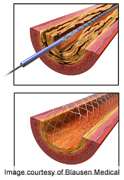
Meta-analysis of randomized clinical trials suggests that drug-eluting stents (DESs) significantly reduce repeat revascularizations, with no increase in stent thrombosis (ST), mortality, or recurrent myocardial infarction, but data from observational studies indicate an increased risk of ST with DES use, according to research published in the April 1 issue of The American Journal of Cardiology.
(HealthDay) -- Meta-analysis of randomized clinical trials (RCTs) suggests that drug-eluting stents (DESs) significantly reduce repeat revascularizations, with no increase in stent thrombosis (ST), mortality, or recurrent myocardial infarction, but data from observational studies indicate an increased risk of ST with DES use, according to research published in the April 1 issue of The American Journal of Cardiology.
To investigate the long-term outcomes of DESs and bare metal stents (BMSs) after primary percutaneous coronary intervention (PPCI), Eric L. Wallace, D.O., of the University of Kentucky in Lexington, and associates conducted a meta-analysis of eight RCTs involving 5,797 patients and five observational studies with 4,650 patients.
In the RCTs, the researchers found that patients receiving sirolimus- or paclitaxel-eluting stents, compared with BMSs, had a significantly lower risk of target lesion revascularization (odds ratio [OR], 0.48), target vessel revascularization (OR, 0.53), and major adverse cardiac events (OR, 0.69). ST, mortality, and recurrent myocardial infarction were not significantly different between the groups. In the observational studies, at three or more years follow-up, there was a small but significant increase in ST with DES use (OR, 1.62), with no evidence of recurrent myocardial infarction. DES use was associated with significantly reduced mortality compared with BMS use (OR, 0.65).
"This meta-analysis of RCTs examining the long-term outcomes of first-generation DESs versus BMSs in PPCI, DES use resulted in decreased repeat revascularization with no increase in ST, mortality, or recurrent myocardial infarction," the authors write. "The meta-analysis of observational studies demonstrates a small increase in the risk of ST and improved survival associated with DES use."
More information: Abstract
Full Text (subscription or payment may be required)
Copyright © 2012 HealthDay. All rights reserved.
-
No increased risk with drug eluting stents -- but late stent thrombosis remains a concern
Aug 31, 2009 |
not rated yet |
0
-
Better patient outcomes with drug eluting stents
Dec 18, 2008 |
not rated yet |
0
-
Analysis of drug-eluting stents data demonstrates safety, efficacy in on-and-off-label use
Jun 16, 2009 |
not rated yet |
0
-
Results of the DEB-AMI Trial reported at TCT 2011
Nov 10, 2011 |
not rated yet |
0
-
Drug-eluting stents are preferred therapy for revascularization of chronic total occlusions
Feb 09, 2011 |
not rated yet |
0
-
Motion perception revisited: High Phi effect challenges established motion perception assumptions
Apr 23, 2013 |
3 / 5 (2) |
2
-
Anything you can do I can do better: Neuromolecular foundations of the superiority illusion (Update)
Apr 02, 2013 |
4.5 / 5 (11) |
5
-
The visual system as economist: Neural resource allocation in visual adaptation
Mar 30, 2013 |
5 / 5 (2) |
9
-
Separate lives: Neuronal and organismal lifespans decoupled
Mar 27, 2013 |
4.9 / 5 (8) |
0
-
Sizing things up: The evolutionary neurobiology of scale invariance
Feb 28, 2013 |
4.8 / 5 (10) |
14
-
Assumptions of Griffith's fracture theory
5 hours ago
-
Current leading voltage or vice versa concept
6 hours ago
-
Angular Frequency of AC voltage
9 hours ago
-
Modeling Rigid Body - Unsure about Euler angles and angular velocity
9 hours ago
-
Function for a bullet's path
11 hours ago
-
Elementary questions relating to Newton's laws of motion
12 hours ago
- More from Physics Forums - Classical Physics
More news stories
Biomarker trio predicts near-term heart risk
(Medical Xpress)—Cardiologists have identified a trio of biomarkers that may predict which patients with heart disease have a high risk of heart attack or death in the next two years.
Cardiology
55 minutes ago |
not rated yet |
0
|
Hospitals' cardiac arrest incidence and survival rates go hand in hand
Hospitals with the highest rates of cardiac arrests tend to have the poorest survival rates for those cases, new University of Michigan Health System research shows.
Cardiology
15 hours ago |
not rated yet |
0
Effect of fluid and sodium restrictions on weight loss among patients with heart failure
A clinical trial of 75 patients hospitalized with acute decompensated heart failure (ADHF) suggests that aggressive fluid and sodium restriction has no effect on weight loss or clinical stability at three days but was associated ...
Cardiology
15 hours ago |
not rated yet |
0
Which women should be screened for high cholesterol?
National guidelines recommend that at-risk women be screened for elevated cholesterol levels to reduce their chances of developing cardiovascular disease. But who is 'at risk?' The results of a study by investigators ...
Cardiology
18 hours ago |
not rated yet |
0
Atherosclerotic disease heredity mapped in nationwide study
Researchers at Lund University in Sweden have mapped the significance of heredity for common forms of atherosclerotic disease. No studies have previously examined whether different forms of the disease share heredity.
Cardiology
20 hours ago |
not rated yet |
0
Anti-CD47 antibody may offer new route to successful cancer vaccination
(Medical Xpress)—Scientists at the School of Medicine have shown that their previously identified therapeutic approach to fight cancer via immune cells called macrophages also prompts the disease-fighting killer T cells ...
Primary care docs should play role in kids' dental health, experts say
(HealthDay)—When it comes to the care of your children's teeth, dentists aren't the only experts who can help.
New theory offers clues to vital 'repair and maintenance' role of sleep
(Medical Xpress)—We spend about a third of our life asleep, but why we need to do so remains a mystery. In a recent publication, researchers at University of Surrey and University College London suggest a new hypothesis, ...
Salt consumption in India: The need for data to initiate population-based prevention efforts
(Medical Xpress)—International researchers are studying the salt intake of Indian adults to provide vital new data to aid the development of a national salt reduction strategy.
Eyes on the sun: Child sunshine exposure and eye development
(Medical Xpress)—Exposure to sunshine as a small child is crucial to the development of a healthy eye according to results of long-term myopia study conducted by University of Sydney researchers.
ATS: Early prone positioning reduces mortality in ARDS
(HealthDay)—For patients with acute respiratory distress syndrome (ARDS), prolonged prone positioning during mechanical ventilation is associated with significantly reduced mortality at 28 and 90 days, ...