Heart failure patients with diabetes may benefit from higher glucose levels
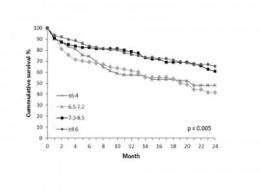
Advanced heart failure patients with diabetes with the higher levels of glycosylated hemoglobin had better survival outcomes and less need for urgent heart transplants. Credit: University of California Los Angeles
Lowering glucose levels for people with diabetes is normally critical to improving health outcomes. But for those with heart failure, that might not always be the case, say UCLA researchers.
A new study found that for advanced heart failure patients with diabetes, having higher blood glucose levels may actually help improve survival rates.
Currently published online in the American Journal of Cardiology, UCLA researchers compared levels of a marker used to track glucose levels called glycosylated hemoglobin in advanced heart failure patients with and without diabetes. The marker is gauged through a simple blood test.
The study assessed the relationship between levels of the marker and mortality outcomes. Researchers found that for heart failure patients with diabetes, for every unit increase in the marker, there was a 15 percent decrease in mortality.
"We were surprised that the optimal level of glycosylated hemoglobin in this patient population with diabetes was higher than levels in current treatment guidelines," said senior author Dr. Tamara Horwich, assistant professor of cardiology, David Geffen School of Medicine at UCLA. "We may find that doctors who treat patients who have both advanced heart failure and diabetes may not need to focus on aggressively lowering blood sugar, but rather keep it under moderate control."
Approximately 25 to 50 percent of patients with heart failure also have diabetes, compared to just 7 percent of the general population. The relation could be due to similar physiologic processes that underlie both conditions such as oxidative stress, patterns of hormonal activity and vascular lining dysfunction that can lead to conditions like atherosclerosis.
For the study, researchers assessed medical records of 845 patients with advanced heart failure, referred to a single university center, the Ahmanson-UCLA Cardiomyopathy Center. Most of the patients (72 percent) were men and the average age was 55.
Patients were classified as having diabetes or not and also grouped by four levels of glycosylated hemoglobin. Using statistical analysis, researchers calculated risk of death or need for an urgent heart transplant.
"For heart failure patients with diabetes, we found that higher, not lower levels, of the marker had better outcomes," said first author Sofia Tomova, a medical student in the division of cardiology, Geffen School of Medicine.
Researchers found that for diabetic heart failure patients, two-year event-free survival was highest amongst patients with the highest elevated glycosylated hemoglobin levels: 65 percent survival rate for patients with level four (greater than 8.6 percent of the marker) and 61 percent survival rate with level three (7.3 to 8.5 percent of the marker).
Patients with lower levels of the marker had worse survival rates: 48 percent survival rate for patients with level one (less than 6.4 percent of the marker) and 42 percent survival rate with level two (6.5 to 7.2 percent of the marker).
According to researchers, the ideal level of glycosylated hemoglobin in heart failure patients with diabetes appeared to be in the 8.3 to 8.9 percent range. Current national treatment targets aim much lower at 7 percent.
In the heart failure patients without diabetes, there was no significant mortality risk difference between the glycosylated hemoglobin levels.
Researchers note that for those without heart failure, having diabetes and elevated glycosylated hemoglobin levels is a risk factor for developing the condition. However, the study shows that if a patient already has heart failure, having higher glycosylated hemoglobin levels may be protective.
The next steps are studies to test the optimal glucose management goals as well as assess the best anti-diabetic medications for heart failure patients with diabetes.
Heart failure affects six million in the United States alone and is caused by weakened heart muscle function that can cause build-up of fluid in the lungs and other organs due to the heart's inability to pump effectively.
Provided by University of California - Los Angeles
-
Extreme glucose levels in diabetic patients with heart failure linked to increase risk of deaths
Jul 20, 2009 |
not rated yet |
0
-
Study shows metformin is safe for patients with advanced heart failure and diabetes mellitus
Jan 07, 2010 |
not rated yet |
0
-
Elevated glucose associated with undetected heart damage
Feb 02, 2012 |
not rated yet |
0
-
Standard test for blood sugar control not accurate in diabetic dialysis patients
Feb 20, 2008 |
not rated yet |
0
-
New research says heart failure worse when right ventricle goes bad
Feb 16, 2010 |
not rated yet |
0
-
Motion perception revisited: High Phi effect challenges established motion perception assumptions
Apr 23, 2013 |
3 / 5 (2) |
2
-
Anything you can do I can do better: Neuromolecular foundations of the superiority illusion (Update)
Apr 02, 2013 |
4.5 / 5 (11) |
5
-
The visual system as economist: Neural resource allocation in visual adaptation
Mar 30, 2013 |
5 / 5 (2) |
9
-
Separate lives: Neuronal and organismal lifespans decoupled
Mar 27, 2013 |
4.9 / 5 (8) |
0
-
Sizing things up: The evolutionary neurobiology of scale invariance
Feb 28, 2013 |
4.8 / 5 (10) |
14
-
Calculating on-axis elements of a solenoid
9 hours ago
-
latitude & longitude & air pressure
10 hours ago
-
Differences of Classical Mechanics when learned with Calc vs algebra?
13 hours ago
-
what is the distance traveled
17 hours ago
-
Image of a Convex Lens Cut in Half Horizontally
21 hours ago
-
Ray tracing through optical system of thick lenses
21 hours ago
- More from Physics Forums - Classical Physics
More news stories
Costs to treat stroke in America may double by 2030
Costs to treat stroke are projected to more than double and the number of people having strokes may increase 20 percent by 2030, according to the American Heart Association/American Stroke Association.
Cardiology
18 hours ago |
not rated yet |
0
New blood-thinner measures may cut medication errors
Blood thinners are the preferred treatment option to prevent heart attacks, blood clots and stroke, but they are not without risk, and not just because of their side effects. These high-risk drugs, known as anticoagulants, ...
Cardiology
21 hours ago |
not rated yet |
0
Registry questions superiority of bivalirudin over heparin
Results from a large observational study reported at EuroPCR 2013 today question whether bivalirudin is superior to heparin in the absence of GPIIb/IIIa blockade, showing similar 30-day mortality in patients with non-ST segment ...
Cardiology
21 hours ago |
not rated yet |
0
Study shows low rate of late lumen loss with bioresorbable DESolve device
The DESolve bioresorbable coronary scaffold system achieves good efficacy and safety with low rates of late lumen loss and major coronary adverse events at six months, show first results from the pivotal DESolve Nx trial ...
Cardiology
21 hours ago |
not rated yet |
0
Biodegradable stent proves non-inferior to drug-eluting stent
The Orsiro stent, which is a novel stent platform eluting sirolimus from a biodegradable polymer, demonstrated non-inferiority to the Xience Prime everolimus-eluting stent for the primary angiographic endpoint of in-stent ...
Cardiology
May 21, 2013 |
5 / 5 (1) |
0
US teen birth rate drops to record low
US teen births have dropped to a record low, but the country still has one of the highest rates among developed nations, the US Centers for Disease Control and Prevention said Thursday.
Slowing the aging process—only with antibiotics
Swiss scientists reveal the mechanism responsible for aging hidden deep within mitochondria—and dramatically slow it down in worms by administering antibiotics to the young.
Researchers complete largest genetic sequencing study of human disease
Researchers from Queen Mary, University of London have led the largest sequencing study of human disease to date, investigating the genetic basis of six autoimmune diseases.
Brain can be trained in compassion, study shows
Until now, little was scientifically known about the human potential to cultivate compassion—the emotional state of caring for people who are suffering in a way that motivates altruistic behavior.
Rate of bicycle-related fatalities significantly lower in states with helmet laws
Existing research shows that bicyclists who wear helmets have an 88 percent lower risk of brain injury, but researchers at Boston Children's Hospital found that simply having bicycle helmet laws in place showed a 20 percent ...
Having both migraines, depression may mean smaller brain
(HealthDay)—Migraines and depression can each cause a great deal of suffering, but new research indicates the combination of the two may be linked to something else entirely—a smaller brain.