Huge study finds brain networks connected to teen drug abuse
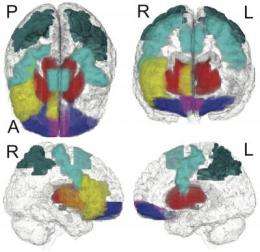
Why do some teenagers start smoking or experimenting with drugs—while others don't?
In the largest imaging study of the human brain ever conducted—involving 1,896 14-year-olds—scientists have discovered a number of previously unknown networks that go a long way toward an answer.
Robert Whelan and Hugh Garavan of the University of Vermont, along with a large group of international colleagues, report that differences in these networks provide strong evidence that some teenagers are at higher risk for drug and alcohol experimentation—simply because their brains work differently, making them more impulsive.
Their findings are presented in the journal Nature Neuroscience, published online April 29, 2012.
This discovery helps answer a long-standing chicken-or-egg question about whether certain brain patterns come before drug use—or are caused by it.
"The differences in these networks seem to precede drug use," says Garavan, Whelan's colleague in UVM's psychiatry department, who also served as the principal investigator of the Irish component of a large European research project, called IMAGEN, that gathered the data about the teens in the new study.
In a key finding, diminished activity in a network involving the "orbitofrontal cortex" is associated with experimentation with alcohol, cigarettes and illegal drugs in early adolescence.
"These networks are not working as well for some kids as for others," says Whelan, making them more impulsive.
Faced with a choice about smoking or drinking, the 14-year-old with a less functional impulse-regulating network will be more likely to say, "yeah, gimme, gimme, gimme!" says Garavan, "and this other kid is saying, 'no, I'm not going to do that.'"
Testing for lower function in this and other brain networks could, perhaps, be used by researchers someday as "a risk factor or biomarker for potential drug use," Garavan says.
The researchers were also able to show that other newly discovered networks are connected with the symptoms of attention-deficit hyperactivity disorder. These ADHD networks are distinct from those associated with early drug use.
In recent years, there has been controversy and extensive media attention about the possible connection between ADHD and drug abuse. Both ADHD and early drug use are associated with poor inhibitory control—they're problems that plague impulsive people.
But the new research shows that these seemingly related problems are regulated by different networks in the brain—even though both groups of teens can score poorly on tests of their "stop-signal reaction time," a standard measure of overall inhibitory control used in this study and other similar ones. This strengthens the idea that risk of ADHD is not necessarily a full-blown risk for drug use as some recent studies suggest.
The impulsivity networks—connected areas of activity in the brain revealed by increased blood flow—begin to paint a more nuanced portrait of the neurobiology underlying the patchwork of attributes and behaviors that psychologists call impulsivity—as well as the capacity to put brakes on these impulses, a set of skills sometimes called inhibitory control.
Edythe London, Professor of Addiction Studies and Director of the UCLA Laboratory of Molecular Pharmacology, who was not part of the new study, described it as "outstanding," noting that the work by Whelan and others "substantially advances our understanding of the neural circuitry that governs inhibitory control in the adolescent brain."
Using a complex mathematical approach called factor analysis, Whelan and colleagues were able to fish out seven networks involved when impulses were successfully inhibited and six networks involved when inhibition failed—from the vast and chaotic actions of a teenage brain at work. These networks "light up," Whelan says, in a functional MRI scanner during trials when the teenagers were asked to perform a repetitive task that involved pushing a button on a keyboard, but then were able to successfully stop—or inhibit—the act of pushing the button in mid-action. Those teens with better inhibitory control were able to succeed at this task faster.
But the underlying networks behind these tasks could not have been detectable in a "typical fMRI study of about 16 or 20 people," says Whelan. "This study was orders of magnitude bigger, which lets us overcome much of the randomness and noise—and find the brain regions that actually vary together."
"The take-home message is that impulsivity can be decomposed, broken down into different brain regions," says Garavan, "and the functioning of one region is related to ADHD symptoms, while the functioning of other regions is related to drug use.
The new study draws on the multi-year work of the IMAGEN Consortium, funded by the European Union, and headed by Prof. Gunter Schumann at the Institute of Psychiatry, King's College London. IMAGEN, lead by a team of scientists across Europe, carried out neuroimaging, genetic and behavioral analyses in 2000 teenage volunteers in Ireland, England, France, and Germany and will be following them for several years, investigating the roots of risk-taking behavior and mental health in teenagers.
That teenagers push against boundaries—and sometimes take risks—is as predictable as the sunrise. It happens in all cultures and even across all mammal species: adolescence is a time to test limits and develop independence.
But death among teenagers in the industrialized world is largely caused by preventable or self-inflicted accidents that are often launched by impulsive risky behaviors, often associated with alcohol and drug use. Additionally, "addiction in the western world is our number one health problem," says Garavan. "Think about alcohol, cigarettes or harder drugs and all the consequences that has in society for people's health." Understanding brain networks that put some teenagers at higher risk for starting to use them could have large implications for public health.


