Invisible helpers: How probiotic bacteria protect against inflammatory bowel diseases
April 26, 2012 in Medical research

Invisible helpers: How probiotic bacteria protect against inflammatory bowel diseases

Enlarge

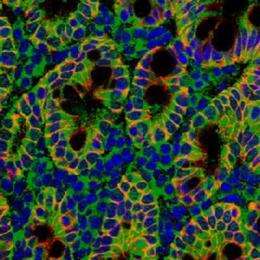
Green indicates the presence of inflammatory messenger substances (chemokines) in the bowel tissue. Credit: Dirk Haller / TUM

Yoghurt has been valued for centuries for its health-promoting effects. These effects are thought to be mediated by the lactic acid bacteria typically contained in yoghurt. Evidence from recent scientific studies show that some bacterial strains actually have a probiotic effect and can thus prevent disease. A team of biologists and nutrition scientists working with Prof. Dirk Haller from the Technische Universitaet Muenchen (TUM) has now discovered the mechanisms at work behind this protective effect (Cell Host & Microbe).

In experiments with mice, the scientists observed that lactocepin – an enzyme produced from the bacterium Lactobacillus paracasei – can selectively interrupt inflammatory processes. As the scientists observed, lactocepin degrades messengers from the immune system, known as chemokines, in the diseased tissue. As a part of the "normal" immune response, chemokines are needed to guide defense cells to the source of the infection. In chronic intestinal disorders like Crohn's disease and ulcerative colitis, the otherwise highly effective defense mechanism against infectious agents is malfunctioning. Chemokines such as "IP-10" then contribute to the tissue damage due to chronic inflammatory processes, preventing the tissue from healing.

"Lactocepin is a familiar element in food technology research," says Prof. Dirk Haller, who holds the Chair for Biofunctionality of Food at the TUM. "What is surprising, however, is its biomedical effect, namely the force with which the enzyme attacks and degrades very specific inflammatory mediators." Haller is certain that, based on this mechanism, it will be possible to develop new approaches to the targeted prevention and treatment of chronic bowel diseases as well as skin disorders: "The anti-inflammatory effect of lactocepin is limited to specific areas and up to now it has no known side effects."

The scientist therefore plans to carry out clinical studies in order to test the possible pharmaceutical application of the enzyme. Questions also remain to be answered in relation to the "production" of lactocepin by . Some , such as Lactobacillus paracasei, produce highly potent lactocepins; however, the effectiveness of other microorganisms has not yet been proven. Dirk Haller therefore warns against false promises: "Not every product labeled as 'probiotic' actually earns this name."

More information: M.-A. von Schillde, G. Hörmannsperger, M. Weiher, C.-A. Alpert, H. Hahne, C. Bäuerl, K. van Huynegem, L. Steidler, T. Hrncir, G. Pérez-Martínez, B. Kuster, D. Haller (2012): Lactocepin Secreted By Lactobacillus Exerts Anti-Inflammatory Effects By Selectively Degrading Proinflammatory Chemokines, Cell Host & Microbe, doi: 10.1016/j.chom.2012.02.006

Journal reference: Cell Host & Microbe search and more info website

Provided by Technische Universitaet Muenchen

2.5 /5 (2 votes)  

Rank 2.5 /5 (2 votes)
Relevant PhysicsForums posts

More news stories

Computational tool translates complex data into simplified 2-dimensional images

In their quest to learn more about the variability of cells between and within tissues, biomedical scientists have devised tools capable of simultaneously measuring dozens of characteristics of individual ...

Medical research created 9 hours ago | popularity 5 / 5 (2) | comments 0 | with audio podcast

Now we know why old scizophrenia medicine works on antibiotics-resistant bacteria

In 2008 researchers from the University of Southern Denmark showed that the drug thioridazine, which has previously been used to treat schizophrenia, is also a powerful weapon against antibiotic-resistant bacteria such as ...

Medical research created May 17, 2013 | popularity 4 / 5 (4) | comments 0 | with audio podcast

SUMO wrestling cells reveal new protective mechanism target for stroke

Scientists investigating the interaction of a group of proteins in the brain responsible for protecting nerve cells from damage have identified a new target that could increase cell survival.

Medical research created May 17, 2013 | popularity 5 / 5 (1) | comments 0

How serotonin receptors can shape drug effects, from LSD to migraine medication

New findings by researchers carrying out experiments at the U.S. Department of Energy Office of Science's Advanced Photon Source (APS) help explain why some drugs that interact with two kinds of human serotonin ...

Medical research created May 17, 2013 | popularity 4 / 5 (1) | comments 0 | with audio podcast

Preventing blood poisoning

Peptide molecules derived from the body's natural immune system can help boost the body's defence against life-threatening blood poisoning, joint University research has uncovered.

Medical research created May 17, 2013 | popularity 4 / 5 (1) | comments 0 | with audio podcast


Researchers identify a potential new risk for sleep apnea: Asthma

Researchers at the University of Wisconsin have identified a potential new risk factor for obstructive sleep apnea: asthma. Using data from the National Institutes of Health (Heart, Lung, and Blood Institute)-funded Wisconsin ...

New theory on genesis of osteoarthritis comes with successful therapy in mice

Scientists at Johns Hopkins have turned their view of osteoarthritis (OA) inside out. Literally. Instead of seeing the painful degenerative disease as a problem primarily of the cartilage that cushions joints, ...

Study finds that sleep apnea and Alzheimer's are linked

A new study looking at sleep-disordered breathing (SDB) and markers for Alzheimer's disease (AD) risk in cerebrospinal fluid (CSF) and neuroimaging adds to the growing body of research linking the two.

'Gap' for HIV vaccine efforts after latest setback

The hunt for an HIV vaccine has gobbled up $8 billion in the past decade, and the failure of the most recent efficacy trial has delivered yet another setback to 26 years of efforts.

Ginger compounds may be effective in treating asthma symptoms

Gourmands and foodies everywhere have long recognized ginger as a great way to add a little peppery zing to both sweet and savory dishes; now, a study from researchers at Columbia University shows purified components of the ...

Ketamine shows significant therapeutic benefit in people with treatment-resistant depression

Patients with treatment-resistant major depression saw dramatic improvement in their illness after treatment with ketamine, an anesthetic, according to the largest ketamine clinical trial to-date led by researchers from the ...