Kinase test may yield big gains for drug-resistant cancers
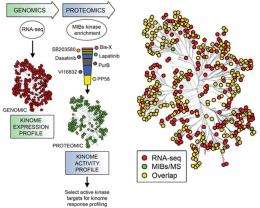
This shows the experimental strategy for the rational design of kinase inhibitor combination therapies. Expression profiling is used to define what kinases are expressed in cancer cells. Kinase capture using technology developed by the Johnson laboratory is used to measure which of the expressed kinases are activated in cancer cells. The kinome tree on the right shows the comprehensive capture of expressed kinases (yellow dots). Defining which kinases are activated in cancer is then used to design and test combination therapies in preclinical models of triple negative breast cancer. Courtesy of Gary Johnson, Ph.D., University of North Carolina at Chapel Hill
In a paper published today in the journal Cell, a team from the University of North Carolina at Chapel Hill unveils the first broad-based test for activation of protein kinases "en masse", enabling measurement of the mechanism behind drug-resistant cancer and rational prediction of successful combination therapies.
Kinases are proteins expressed in human tissues that play a key role in cell growth, particularly in cancer. Of the 518 known human kinases, about 400 are expressed in cancers, but which ones and how many are actually active in tumors has been difficult to measure. Tremendous efforts have been made to develop kinase inhibitors as cancer treatments, which have resulted in key drugs such as Herceptin, Tykerb, and Gleevec. However, in spite of the effectiveness of this class of cancer drugs, most cancers eventually become resistant. The UNC team has developed a test that can measure both the presence and activity of 60-70 percent of all kinases simultaneously, allowing investigators to see how cancers evade treatment with kinase inhibitors so that they can combine drugs to block resistance.
Gary Johnson, PhD, the project's principal investigator, says, "Single-agent kinase inhibitors are promising in principle, but often fail in practice because the network of tumor kinases learns how to get around the inhibitor, leading to rapid drug resistance. We're very excited about the test our lab has developed because it works very well in a model of breast cancer to predict the success of combination therapies."
Johnson, who is the Kenan Distinguished Professor and chair of the department of pharmacology in the UNC School of Medicine and a member of UNC Lineberger Comprehensive Cancer Center, is working with UNC Breast Center medical director Lisa Carey, MD, UNC Lineberger director Shelley Earp, MD, and surgical oncologist Keith Amos, MD, to perform clinical trials using the technology with the goal of real-time, personalized therapies for breast cancer.
"One of the most frustrating things as an oncologist is when a patient's tumor develops resistance to a treatment," says Carey, who is also a member of UNC Lineberger. "We are excited about the ability to examine tumor samples before, during, and after kinase inhibitor treatment to see how the tumor kinase profile changes, and potentially respond to those changes using different inhibitors."
The team hopes to be able to track and define the kinase 'reprogramming' that takes place in tumors during therapy and to use the new test to identify combinations of drugs that will block the cancer's adaptive behavior that leads to drug resistance. A patent application has been filed for the testing technology.
Provided by
University of North Carolina School of Medicine
-
Combination therapies for drug-resistant cancers
Oct 10, 2011 |
not rated yet |
0
-
Map of substrate-kinase interactions may lead to more effective cancer drugs
Mar 27, 2012 |
not rated yet |
0
-
Research points to new target for stopping colon cancer
Aug 17, 2009 |
not rated yet |
0
-
First-of-its-kind study creates new tool for targeted cancer drug development
Oct 30, 2011 |
not rated yet |
0
-
Two specific agents worse than one in treating endocrine resistant breast cancer cells
Apr 02, 2012 |
not rated yet |
0
-
Motion perception revisited: High Phi effect challenges established motion perception assumptions
Apr 23, 2013 |
3 / 5 (2) |
2
-
Anything you can do I can do better: Neuromolecular foundations of the superiority illusion (Update)
Apr 02, 2013 |
4.5 / 5 (11) |
5
-
The visual system as economist: Neural resource allocation in visual adaptation
Mar 30, 2013 |
5 / 5 (2) |
9
-
Separate lives: Neuronal and organismal lifespans decoupled
Mar 27, 2013 |
4.9 / 5 (8) |
0
-
Sizing things up: The evolutionary neurobiology of scale invariance
Feb 28, 2013 |
4.8 / 5 (10) |
14
-
Why is zone 1 in liver more prone to ischemic injury?
May 23, 2013
-
How can there be villous adenoma in colon, if there are no villi there
May 22, 2013
-
How can there be a term called "intestinal metaplasia" of stomach
May 21, 2013
-
Pressure-volume curve: Elastic Recoil Pressure don't make sense
May 18, 2013
-
If you became brain-dead, would you want them to pull the plug?
May 17, 2013
-
MRI bill question
May 15, 2013
- More from Physics Forums - Medical Sciences
More news stories
New fluorescent tools for cancer diagnosis
In recent years, microRNAs (miRNAs) and other non-coding RNAs are small molecules that help control the expression of specific proteins. In recent years they have emerged as disease biomarkers. miRNA profiles have been used ...
Cancer
21 hours ago |
not rated yet |
0
Modulating the immune system to combat metastatic cancer
Cancer cells spread and grow by avoiding detection and destruction by the immune system. Stimulation of the immune system can help to eliminate cancer cells; however, there are many factors that cause the immune system to ...
Cancer
21 hours ago |
5 / 5 (1) |
0
Scientists put bowel cancer under the microscope
Researchers from London's Kingston University have begun a two-year study which could help prolong the lives of people with colorectal tumours.
Cancer
May 24, 2013 |
5 / 5 (1) |
0
Researcher identifies breast cancer fighting hormone
Transformative research from Western University has identified new hormones in the body which may suppress breast cancer and stimulate the regression of breast tumors.
Cancer
May 24, 2013 |
5 / 5 (2) |
0
Ground breaking cancer research finds immune system link
(Medical Xpress)—Curtin University researchers have found evidence that targeting specific cells in the body can reverse the effects of cancer on the immune system.
Cancer
May 24, 2013 |
5 / 5 (4) |
0
First drug to improve heart failure mortality in over a decade
Coenzyme Q10 decreases all cause mortality by half, according to the results of a multicentre randomised double blind trial presented today at Heart Failure 2013 congress. It is the first drug to improve heart failure mortality ...
Heart failure accelerates male 'menopause'
Heart failure accelerates the aging process and brings on early andropausal syndrome (AS), according to research presented today at the Heart Failure Congress 2013. AS, also referred to as male 'menopause', was four times ...
Hormone levels may provide key to understanding psychological disorders in women
Women at a particular stage in their monthly menstrual cycle may be more vulnerable to some of the psychological side-effects associated with stressful experiences, according to a study from UCL.
Researchers identify first drug targets in childhood genetic tumor disorder
Two mutations central to the development of infantile myofibromatosis (IM)—a disorder characterized by multiple tumors involving the skin, bone, and soft tissue—may provide new therapeutic targets, according to researchers ...
Feds fight morning-after pill age ruling in NY
(AP)—Department of Justice lawyers have again asked a federal appeals court in New York to delay lifting age restrictions and prescription requirements on an emergency contraceptive popularly known as the morning-after ...
Death highest in heart failure patients admitted in January, on Friday, and overnight
Mortality and length of stay are highest in heart failure patients admitted in January, on Friday, and overnight, according to research presented today at the Heart Failure Congress 2013. The analysis of nearly 1 million ...