Parkinson's protein causes disease spread in animal model, suggesting way disorder progresses over time in humans
April 17, 2012 in Parkinson's & Movement disorders
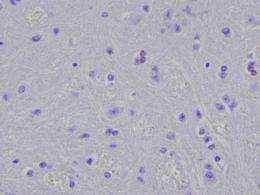
Brainstem from a control animal and an animal injected with pathologic alpha-synuclein. Brown spots are immunostaining using an antibody specifically recognizing an abnormal form of alpha-synuclein. Credit: Kelvin C. Luk, Ph.D., Perelman School of Medicine, University of Pennsylvania
(Medical Xpress) -- Penn researchers have shown that brain tissue from a Parkinson's disease mouse model , as well as synthetically produced disease protein fibrils, injected into young, symptom-free PD mice led to spreading of PD pathology.
Last year, researchers from the Perelman School of Medicine at the University of Pennsylvania found that small amounts of a misfolded brain protein can be taken up by healthy neurons, replicating within them to cause neurodegeneration. The protein, alpha-synuclein (a-syn), is commonly found in the brain, but forms characteristic clumps called Lewy bodies, in neurons of patients with Parkinson's disease (PD) and other neurodegenerative disorders. They found that abnormal forms of a-syn called fibrils acted as "seeds" that induced normal a-syn to misfold and form aggregates.
In earlier studies at other institutions, when fetal nerve cells were transplanted into the brains of PD patients, some of the transplanted cells developed Lewy bodies. This suggested that the corrupted form of a-syn could somehow be transmitted from diseased neurons to healthy ones.
Now, in a follow-up study published in the Journal of Experimental Medicine, the team, led by senior author Virginia M.-Y Lee, PhD, director of the Center for Neurodegenerative Disease Research and professor of Pathology and Laboratory Medicine, showed that brain tissue from a PD mouse model , as well as synthetically produced a-syn fibrils, injected into young, symptom-free PD mice led to spreading of a-syn pathology. By three months after a single injection, neurons containing abnormal a-syn clumps were detected throughout the mouse brains. The inoculated mice died between 100 to 125 days post-inoculation, out of their typical two-year life span.
"We think the spreading is via white-matter tracks through brain neural network connections," explains Lee. "This study will open new opportunities for novel Parkinson's disease therapies."
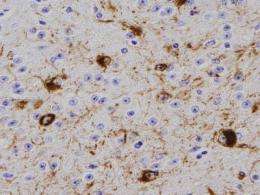
Brainstem from a control animal and an animal injected with pathologic alpha-synuclein. Brown spots are immunostaining using an antibody specifically recognizing an abnormal form of alpha-synuclein. Credit: Kelvin C. Luk, Ph.D., Perelman School of Medicine, University of Pennsylvania
One of the remaining questions is how, once inside a neuron, does the misfolded a-syn protein spread from cell to cell."It's like a biochemical chain reaction," says first author Kelvin C. Luk, Ph.D., research associate, in the CNDR. Once inside the confines of a neuron, the misfolded a-syn recruits normally shaped a-syn protein that is present in the cell, causing them to eventually misfold. This occurs along the axons and dendrites (neuronal extensions that reach other neurons), leading to a dramatic accumulation of the abnormal protein. The misshapen a-syn then invades other neurons when they reach the synapse, the small space between neurons.
This transmission process is remarkably similar to what is seen in prions, the protein agents responsible for conditions such as transmissible spongiform encephalopathies ( mad cow disease). However, the researchers are quick to caution that there is no evidence that Parkinson's or any related neurodegenerative diseases is either infectious or acquired.
The accumulation of misfolded proteins is a fundamental pathogenic process in neurodegenerative diseases, but the factors that trigger aggregation of a-syn are poorly understood.
The Penn team saw that misfolded a-syn propagated along major central nervous system pathways, reaching regions far beyond injection sites. What's more, they showed for the first time that synthetically produced a-syn fibrils are sufficient to initiate a vicious cycle of Lewy body formation and transmission of the misfolded a-syn in mice.
The study demonstrates just how the Parkinson's disease protein can spread in a patient's brain in terms of uptake into a healthy neuron, expansion within the cell, and finally release to a neighboring neuron.
"Knowing this mechanism allows for possible immunotherapies to interrupt the chain reaction by stopping the mutant protein from spreading at the synapse," says Lee.
"Shedding light on how α-synuclein contributes to Parkinson's disease and related Lewy body disorders is of significant interest both for understanding these diseases and developing potential treatments," said Beth-Anne Sieber, Ph.D., of the National Institute of Neurological Disorders and Stroke (NINDS), part of the National Institutes of Health. "This study provides evidence for the progressive, pathological spread of α-synuclein through the brain."
Provided by
University of Pennsylvania School of Medicine
-
Seeds of destruction in Parkinson's disease: Spread of diseased proteins kills neurons
Oct 05, 2011 |
not rated yet |
0
-
Lessons from yeast: A possible cure for Parkinson's disease?
Aug 14, 2008 |
not rated yet |
0
-
Synergistic interaction enhances pathogenesis of Parkinson's disease
Dec 23, 2009 |
not rated yet |
0
-
Rare genetic disorder provides unique insight into Parkinson's disease
Jun 23, 2011 |
not rated yet |
0
-
How Parkinson's disease starts and spreads
Apr 16, 2012 |
not rated yet |
0
-
Motion perception revisited: High Phi effect challenges established motion perception assumptions
Apr 23, 2013 |
3 / 5 (2) |
2
-
Anything you can do I can do better: Neuromolecular foundations of the superiority illusion (Update)
Apr 02, 2013 |
4.5 / 5 (11) |
5
-
The visual system as economist: Neural resource allocation in visual adaptation
Mar 30, 2013 |
5 / 5 (2) |
9
-
Separate lives: Neuronal and organismal lifespans decoupled
Mar 27, 2013 |
4.9 / 5 (8) |
0
-
Sizing things up: The evolutionary neurobiology of scale invariance
Feb 28, 2013 |
4.8 / 5 (10) |
14
-
Magnetic field and repulsion bewteen wires
1 hour ago
-
Enthalpy of reaction
7 hours ago
-
Harmonic oscillation problem -Dancing pot
7 hours ago
-
Ultracapacitor to power electromagnet?
8 hours ago
-
Confusion in Electro Statics
8 hours ago
-
simple gravity question
10 hours ago
- More from Physics Forums - Classical Physics
More news stories
Diabetes drug tested in Parkinson's disease patients
Parkinson's disease (PD) is a degenerative neurological disorder marked by a progressive loss of motor control. Despite intensive research, there are currently no approved therapies that have been demonstrated to alter the ...
Parkinson's & Movement disorders
3 hours ago |
not rated yet |
0
Faulty energy production in brain cells leads to disorders ranging from Parkinson's to intellectual disability
Neuroscientist Patrik Verstreken of VIB (Flanders Institute for Biotechnology) and KU Leuven has shown for the first time that dysfunctional mitochondria in brain cells can lead to learning disabilities. The link between ...
Parkinson's & Movement disorders
May 17, 2013 |
4 / 5 (2) |
0
Unleashing the watchdog protein
McGill University researchers have unlocked a new door to developing drugs to slow the progression of Parkinson's disease. Collaborating teams led by Dr. Edward A. Fon at the Montreal Neurological Institute and Hospital -The ...
Parkinson's & Movement disorders
May 09, 2013 |
5 / 5 (1) |
0
|
Could eating peppers prevent Parkinson's? Dietary nicotine may hold protective key
New research reveals that Solanaceae—a flowering plant family with some species producing foods that are edible sources of nicotine—may provide a protective effect against Parkinson's disease. The study appearing today ...
Parkinson's & Movement disorders
May 09, 2013 |
not rated yet |
0
Study reveals probable role of Parkinson's protein in healthy brain
(Medical Xpress)—Researchers at the Stanford University School of Medicine have exposed the possible function, in the healthy brain, of a mysterious molecule that has been strongly implicated in Parkinson's ...
Parkinson's & Movement disorders
May 01, 2013 |
5 / 5 (3) |
0
|
The compound in the Mediterranean diet that makes cancer cells 'mortal'
New research suggests that a compound abundant in the Mediterranean diet takes away cancer cells' "superpower" to escape death. By altering a very specific step in gene regulation, this compound essentially re-educates cancer ...
Do salamanders hold the solution to regeneration?
Salamanders' immune systems are key to their remarkable ability to regrow limbs, and could also underpin their ability to regenerate spinal cords, brain tissue and even parts of their hearts, scientists have ...
Scientists identify molecular trigger for Alzheimer's disease
Researchers have pinpointed a catalytic trigger for the onset of Alzheimer's disease – when the fundamental structure of a protein molecule changes to cause a chain reaction that leads to the death of neurons ...
Study shows premature birth interrupts vital brain development processes leading to reduced cognitive abilities
Researchers from King's College London have for the first time used a novel form of MRI to identify crucial developmental processes in the brain that are vulnerable to the effects of premature birth. This new study, published ...
Leading explanations for whooping cough's resurgence don't stand up to scrutiny
Whooping cough has exploded in the United States and some other developed countries in recent decades, and many experts suspect ineffective childhood vaccines for the alarming resurgence.
72 percent of pregnant women experience constipation and other bowel problems
Nearly three out of four pregnant women experience constipation, diarrhea or other bowel disorders during their pregnancies, a Loyola University Medical Center study has found.
