Photoreceptor transplant restores vision in mice
April 18, 2012 in Medical research

Photoreceptor transplant restores vision in mice

Enlarge

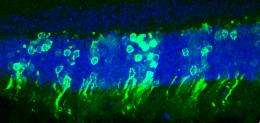
Transplanted photoreceptor cells (green) can integrate and make functional connections in the adult retina. Credit: UCL/Robin Ali

Scientists funded by the Medical Research Council (MRC) have shown for the first time that transplanting light-sensitive photoreceptors into the eyes of visually impaired mice can restore their vision.

The research, published in Nature, suggests that transplanting – light-sensitive nerve cells that line the back of the eye – could form the basis of a new treatment to restore sight in people with degenerative eye diseases.

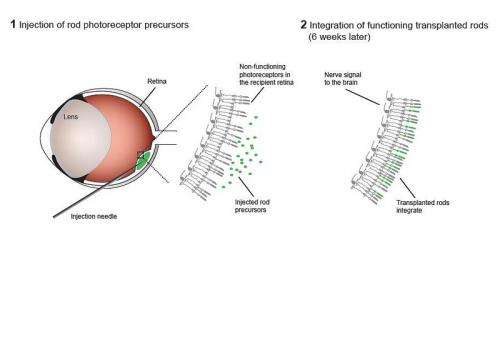
Scientists from UCL Institute of Ophthalmology injected cells from young healthy mice directly into the retinas of adult mice that lacked functional rod-photoreceptors. Loss of photoreceptors is the cause of blindness in many human eye diseases including age-related macular degeneration, retinitis pigmentosa and diabetes-related blindness.

This video is not supported by your browser at this time.

Professor Robin Ali and his team at the UCL Institute of Ophthalmology have shown that transplanting photoreceptor cells into the retina of a mouse with night blindness can restore vision in dim light.

There are two types of photoreceptor in the eye – rods and cones. The cells transplanted were immature (or progenitor) rod-photoreceptor cells. Rod cells are especially important for seeing in the dark as they are extremely sensitive to even low levels of light.

After four to six weeks, the transplanted cells appeared to be functioning almost as well as normal rod-photoreceptor cells and had formed the connections needed to transmit visual information to the brain.

The researchers also tested the vision of the treated mice in a dimly lit maze. Those mice with newly transplanted rod cells were able to use a visual cue to quickly find a hidden platform in the maze whereas untreated mice were able to find the hidden platform only by chance after extensive exploration of the maze.

Professor Robin Ali at UCL Institute of Ophthalmology, who led the research, said:
Photoreceptor transplant restores vision in mice
Enlarge

Schematic of photoreceptor transplantation. Credit: UCL/Robin Ali

"We've shown for the first time that transplanted photoreceptor cells can integrate successfully with the existing retinal circuitry and truly improve vision. We're hopeful that we will soon be able to replicate this success with photoreceptors derived from embryonic stem cells and eventually to develop human trials.

"Although there are many more steps before this approach will be available to patients, it could lead to treatments for thousands of people who have lost their sight through degenerative eye disorders. The findings also pave the way for techniques to repair the central nervous system as they demonstrate the brain's amazing ability to connect with newly transplanted neurons."

Dr Rachael Pearson from UCL Institute of Ophthalmology and principal author, said:

"We are now finding ways to improve the efficiency of cone photoreceptor transplantation and to increase the effectiveness of transplantation in very degenerate retina. We will probably need to do both in order to develop effective treatments for patients."

Dr Rob Buckle, head of regenerative medicine at the MRC said:

"This is a landmark study that will inform future research across a wide range of fields including vision research, neuroscience and regenerative medicine. It provides clear evidence of functional recovery in the damaged eye through cell transplantation, providing great encouragement for the development of stem cell therapies to address the many debilitating eye conditions that affect millions worldwide."

The researchers demonstrated previously, in another study published in Nature, that it is possible to transplant photoreceptor cells into an adult mouse retina, provided the cells from the donor mouse are at a specific stage of development - when the retina is almost, but not fully, formed. In this study they optimised the rod transplantation procedure to increase the number of integrated into the recipient and so were able to restore vision.

More information: DOI: 10.1038/nature10997

Provided by University College London search and more info website

5 /5 (4 votes)  

Rank 5 /5 (4 votes)
Relevant PhysicsForums posts

More news stories

Study suggests new source of kidneys for transplant

Nearly 20 percent of kidneys that are recovered from deceased donors in the U.S. are refused for transplant due to factors ranging from scarring in small blood vessels of the kidney's filtering units to the organ going too ...

Medical research created 16 hours ago | popularity 5 / 5 (2) | comments 0 | with audio podcast

Discovery of circadian clock in mice hair reveals period of time when damage from radiotherapy can be quickly repaired

Discovering that mouse hair has a circadian clock - a 24-hour cycle of growth followed by restorative repair - researchers suspect that hair loss in humans from toxic cancer radiotherapy and chemotherapy ...

Medical research created 16 hours ago | popularity 5 / 5 (2) | comments 1 | with audio podcast

Do salamanders hold the solution to regeneration?

Salamanders' immune systems are key to their remarkable ability to regrow limbs, and could also underpin their ability to regenerate spinal cords, brain tissue and even parts of their hearts, scientists have ...

Medical research created 17 hours ago | popularity 4.9 / 5 (7) | comments 3 | with audio podcast

New study finds blind people have the potential to use their 'inner bat' to locate objects

New research from the University of Southampton has shown that blind and visually impaired people have the potential to use echolocation, similar to that used by bats and dolphins, to determine the location of an object.

Medical research created 20 hours ago | popularity not rated yet | comments 1 | with audio podcast

Germ-fighting vaccine system makes great strides in delivery

A novel vaccine study from South Dakota State University (SDSU) will headline the groundbreaking research that will be unveiled at the American Association of Pharmaceutical Scientists' (AAPS) National Biotechnology Conference ...

Medical research created 20 hours ago | popularity not rated yet | comments 0


Sugar injections for knee arthritis may ease pain

(HealthDay)—Injections of a sugar solution appear to help relieve knee pain and stiffness related to osteoarthritis, a new study suggests.

Anti-CD47 antibody may offer new route to successful cancer vaccination

(Medical Xpress)—Scientists at the School of Medicine have shown that their previously identified therapeutic approach to fight cancer via immune cells called macrophages also prompts the disease-fighting killer T cells ...

Evaluating a new way to open clogged arteries

Over the past few decades, scientists have developed many devices that can reopen clogged arteries, including angioplasty balloons and metallic stents. While generally effective, each of these treatments ...

Losing weight may ease chronic heartburn

(HealthDay)—Obese and overweight men and women who suffer from heartburn often report relief when they lose weight, a new study shows.

Primary care docs should play role in kids' dental health, experts say

(HealthDay)—When it comes to the care of your children's teeth, dentists aren't the only experts who can help.

Study identifies superior hypertension treatment, efficacy between sexes

(Medical Xpress)—In a recent subgroup analysis of the largest blood pressure treatment trial in history, University of Alabama at Birmingham (UAB) researchers found that women and men react the same to ...