Scientists achieve breakthrough in understanding sense of touch
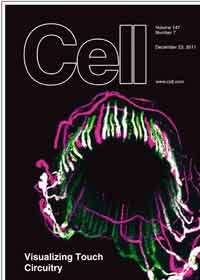
The journal Cell's cover story features research findings by University of Wyoming neurobiologist Jeff Woodbury. He was part of a research team that is providing a new understanding of the sense of touch.
(Medical Xpress) -- A research team including University of Wyoming neurobiologist Jeff Woodbury has discovered a new technique to determine how the touch sensory system is organized in hairy skin, providing a new understanding of the sense of touch.
Their findings were selected to appear as the feature and cover article in Cell, one of the pre-eminent international journals in the biological sciences.
The research provides the first picture of how nerve cells that carry signals from hair on the skin are organized. Unlike all other senses, the skin is least amenable to study and has remained the most poorly understood.
"We have described the system that is in place to help explain how sensory information is processed to perceive the sense of touch," says Woodbury, an associate professor in the UW Department of Zoology and Physiology. He was part of a multidisciplinary research team led by David Ginty from Johns Hopkins University. Colleen Cassidy, a doctoral student in Woodbury's lab, was a co-author of the study, which also included colleagues from the Howard Hughes Medical Institute at Rockefeller University, University of Pennsylvania and University of Pittsburgh.
"We have also been able to identify how combinations of nerve cells respond to fine-tactile stimuli, so we can now really begin to tease apart the circuitry of touch sensation," Woodbury adds. "One of the real breakthroughs is that, for the first time in more than 200 years of study, we now know the specific functions of some of the many different kinds of nerve endings in the skin. This is truly exciting and a major advance."
Mice have several different types of hair follicles in their coat, each of which is linked to the central nervous system by low-threshold wire-like nerve cells that stretch all the way to the spinal cord. There, the myriad signals carried from the skin are integrated, processed and sent to the brain.
This network of nerve endings in the skin of most hairy mammals, including humans, allows them to perceive fine tactile sensations, such as a drop of rain or an insect landing on their skin. The researchers now have a better understanding of how this complex system is organized. Before this discovery, Woodbury says there was no way to see how all of these different nerve cells were arranged -- both in the skin and at the top of the spinal cord, where they end up.
The study, Woodbury says, opens doors to understanding not only touch, but skin senses such as temperature detection and pain.
"Touch is ultimately felt in the brain; it alerts us that something is going on," he says. "We have identified the logic of how this system is organized. We now know that each individual hair is a distinct sensory organ, and each one will detect different forces. A broad spectrum of frequencies within a given stimulus are ultimately recombined and analyzed until we become aware that something has happened, like a drop of rain or a light breeze."
Once the different sensory neurons are identified, researchers could test hypotheses about the role of these cells in the process of sensation.
"For example, researchers could study the animal, in the presence or absence of each of the different types of sensory cells, to determine differences in the animal's behavior," Woodbury says. "It will be possible to shut them off, take them out of the picture, to see how the animal responds to different types of stimulation. The key to understanding any system is first to gain a marker to identify all the different components, and we have made a major step in that direction."
Provided by University of Wyoming
-
How skin is wired for touch
Dec 22, 2011 |
not rated yet |
0
-
People with DFNA2 hearing loss show increased touch sensitivity
Dec 09, 2011 |
not rated yet |
0
-
The molecular basis of touch sensation: New function of a well-known gene identified
Feb 21, 2012 |
not rated yet |
0
-
Researchers finds hidden sensory system in the skin
Dec 08, 2009 |
not rated yet |
0
-
Cold feeling traced to source
Dec 18, 2007 |
not rated yet |
0
-
Motion perception revisited: High Phi effect challenges established motion perception assumptions
Apr 23, 2013 |
3 / 5 (2) |
2
-
Anything you can do I can do better: Neuromolecular foundations of the superiority illusion (Update)
Apr 02, 2013 |
4.5 / 5 (11) |
5
-
The visual system as economist: Neural resource allocation in visual adaptation
Mar 30, 2013 |
5 / 5 (2) |
9
-
Separate lives: Neuronal and organismal lifespans decoupled
Mar 27, 2013 |
4.9 / 5 (8) |
0
-
Sizing things up: The evolutionary neurobiology of scale invariance
Feb 28, 2013 |
4.8 / 5 (10) |
14
-
Why is zone 1 in liver more prone to ischemic injury?
May 23, 2013
-
How can there be villous adenoma in colon, if there are no villi there
May 22, 2013
-
How can there be a term called "intestinal metaplasia" of stomach
May 21, 2013
-
Pressure-volume curve: Elastic Recoil Pressure don't make sense
May 18, 2013
-
If you became brain-dead, would you want them to pull the plug?
May 17, 2013
-
MRI bill question
May 15, 2013
- More from Physics Forums - Medical Sciences
More news stories
New neuron formation could increase capacity for new learning, at the expense of old memories
New research presented today shows that formation of new neurons in the hippocampus - a brain region known for its importance in learning and remembering - could cause forgetting of old memories by causing a reorganization ...
Neuroscience
May 24, 2013 |
4 / 5 (4) |
0
Help at hand for people with schizophrenia
How can healthy people who hear voices help schizophrenics? Finding the answer for this is at the centre of research conducted at the University of Bergen.
Neuroscience
May 24, 2013 |
4 / 5 (2) |
2
Japanese research organizations contribute to Human Brain Project
One of the major frontiers of modern science is a comprehensive understanding of the human brain and its functions to guide the development of new technologies in information and communication. In a major announcement for ...
Neuroscience
May 24, 2013 |
3.7 / 5 (3) |
0
Controlling mood through the motions of mitochondria
(Medical Xpress)—Regulating the distribution of power in neurons is done by a system that makes the national electric grid look simple by comparison. Each neuron has several thousand mitochondria confined ...
Neuroscience
May 23, 2013 |
4.9 / 5 (9) |
0
|
Brain uses internal 'average voice' prototype to identify who is talking
(Medical Xpress)—The human brain is able to identify individuals' voices by comparing them against an internal 'average voice' prototype, according to neuroscientists.
Neuroscience
May 23, 2013 |
3.7 / 5 (3) |
3
|
First drug to improve heart failure mortality in over a decade
Coenzyme Q10 decreases all cause mortality by half, according to the results of a multicentre randomised double blind trial presented today at Heart Failure 2013 congress. It is the first drug to improve heart failure mortality ...
Heart failure accelerates male 'menopause'
Heart failure accelerates the aging process and brings on early andropausal syndrome (AS), according to research presented today at the Heart Failure Congress 2013. AS, also referred to as male 'menopause', was four times ...
Death highest in heart failure patients admitted in January, on Friday, and overnight
Mortality and length of stay are highest in heart failure patients admitted in January, on Friday, and overnight, according to research presented today at the Heart Failure Congress 2013. The analysis of nearly 1 million ...
Feds fight morning-after pill age ruling in NY
(AP)—Department of Justice lawyers have again asked a federal appeals court in New York to delay lifting age restrictions and prescription requirements on an emergency contraceptive popularly known as the morning-after ...
Researchers identify first drug targets in childhood genetic tumor disorder
Two mutations central to the development of infantile myofibromatosis (IM)—a disorder characterized by multiple tumors involving the skin, bone, and soft tissue—may provide new therapeutic targets, according to researchers ...
Driving and hands-free talking lead to spike in errors, study shows
Talking on a hands-free device while behind the wheel can lead to a sharp increase in errors that could imperil other drivers on the road, according to new research from the University of Alberta.