Students focus on creating a better cervical collar
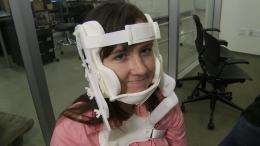
Undergraduate students at Rice University have come up with what they hope will prove to be a better and safer version of cervical collars to stabilize the heads and necks of accident victims. Cervical collars have been in common use since their introduction during the Vietnam War.
The Rice seniors known as Team CivSAFE took on the challenge of a Houston researcher, an expert in spine mechanics, to develop safe and effective cervical spine protection for trauma victims.
The team of three mechanical engineering and three bioengineering students responded to the challenge with a prototype that immobilizes the head without putting pressure on the neck. Kelsey Horter, a bioengineering student and a certified emergency medical technician, said the students tested a cervical collar currently used and found that when a patient's neck is injured, the collar can push the head away from the body. "That separates the vertebrae and can make neck injuries worse. Some physicians believe the current collar may have compounded injuries," she said.
"The collar was developed during the Vietnam War as a device that could be put on really quickly and would be easy to use," said Rice senior Georgia Lagoudas.
"Now problems with the current collar are being discovered," Horter said. "We went back to basic emergency-care ideas. As EMTs, we're taught that if the knee is hurt, you stabilize above and below it. You never just stabilize the part that's injured – which is exactly what we think the current cervical collar does. We jumped on the premise that if we could stabilize the head and the torso right beneath the neck, then we could stabilize the neck. That's what our device does."
Standard collars wrap around the neck. The Rice device, called the HeadCase, takes a very different approach. "We placed the support on the side of the cheeks and the chest, and the top of the back," said team member Sailesh Prabhu. "The result has been greater immobilization. Also, you're immobilizing with contacts in places that won't hurt the patient."
The disposable HeadCase is expected to cost less than the $15 price tag on current disposable collars, of which 15 million are used in the United States each year, the students said. "Mass production will drive down the cost," said team member Oviea Akpotaire.
The HeadCase stores flat for easy transport and can be placed on a patient in 60 seconds, team members said.
Inspiration for the device came from John Hipp, former director of the Spine Research Laboratory at Baylor College of Medicine (BCM) in Houston, who has long sought a replacement for standard cervical collars. A team led by Hipp published a study in the Journal of Trauma in 2010 showing abnormal separation between vertebrae due to cervical collars.
"Our interest in cervical stabilization began with the realization that the collars themselves may do more harm than good," Hipp said. "The BCM research team then confirmed through multiple experiments that conventional collars not only do not protect an injured cervical spine, but have clear potential to exacerbate cervical spine injuries. The Rice design team has arrived at what is likely to be a viable solution to the problem. Their design has the potential to save the lives of many people following severe blunt trauma."
He approached Maria Oden, a professor in the practice of engineering education and director of Rice's Oshman Engineering Design Kitchen, about offering this challenge to engineering students, who are required to complete a senior capstone design project.
"This challenge was very interesting for our mechanical engineering and bioengineering students because they could see that a successful design, which would require creativity and excellent engineering, could make a huge difference in trauma victim care and potentially save these patients from additional injuries," Oden said. "And the market size for this product is large, a big plus for students interested in entrepreneurship."
All of the students on Team CivSAFE have spent time wearing both the original collar and their prototype, and found the new device to be much more comfortable. "We hope that will reduce the chance patients will have pressure sores," said team member Elias Hoban.
The team, which has filed a provisional patent through Rice, is testing student volunteers to develop statistics on just how immobilized a variety of patients wearing the HeadCase will be. Horter and Prabhu have volunteers bite down on a popsicle stick attached to an accelerometer, like those now commonly found in smartphones, to measure the range of motion they're able to achieve both with the standard collar and the HeadCase in place.
"One of the critical questions we've asked is, When a patient is turned on his side, will his head flop to the ground?" Hoban said. "We've found ours just does a better job" compared with standard collars, he said.
Michael Zylberman, a mechanical engineering member of the team and an EMT with Rice's Emergency Medical Services, has extensive experience with the use of standard collars over the past three years. "In the simplest terms, we think ours works better," he said.
The team will take its HeadCase prototype to IShow, a student engineering design competition to be held in Montreal in June. The high-profile competition is sponsored by ASME, formerly the American Society of Mechanical Engineers. Ten student teams, including CivSAFE, have been named finalists in the competition, two of them from Rice.
CivSAFE's device will be on display during Rice's UnConvention, April 12-14, during which the public is invited to take part in a wide range of activities, including the 2012 Engineering Design Showcase at Tudor Fieldhouse April 12.
More information: CivSAFE: oedk.rice.edu/Content/Members/ … 258&memberId=5614580
Journal of Trauma abstract, "Extrication Collars Can Result in Abnormal Separation Between Vertebrae in the Presence of a Dissociative Injury": journals.lww.com/jtrauma/Abstr … _in_Abnormal.30.aspx


