Virtual slides reveal disease in 3D
April 23, 2012 in Medical research
(Medical Xpress) -- Computing experts and medical researchers at the University of Leeds have developed a fast, easy-to-use way of studying tissue samples in 3D using virtual microscope slides.
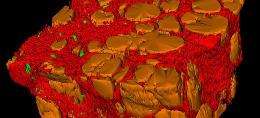
The novel digital scanning system produces high-resolution, multicoloured images that can be rotated and examined from any angle.
The new approach is revealing more information about disease processes - information that could be used in future to develop new therapies or explain why conventional treatments are not working. Such 3D views of tissue samples may also eventually play a role in clinical practice, as medical imaging technology provides even higher resolution images of tissue.
Digital 3D reconstruction of tissue has many uses in biological and medical research. Viewing tissue in 3D allows researchers to study its shape in ways that would not be possible with conventional methods. For example, a biologist may want to study the structure of developing organs, a cancer specialist may study the branching of blood vessels supplying a tumour, or a liver specialist may need to understand how this vital organ reacts to damage caused by hepatitis C. All of these require an understanding of the shape of the tissue in three dimensions.
At the moment, hospital pathologists and medical researchers cut tissue samples into ultra-thin slices and examine these by hand, one-by-one, on a microscope. This is a fairly labour-intensive process - a single slide can contain several hundred thousand cells - and the number of slices examined will be limited by the time available. To do a true 3D analysis, users would need to look at 100s of different 2D sections - something that would be prohibitively expensive by hand.
In contrast, the system developed at the University of Leeds requires almost no extra manual input once the tissue has been cut and mounted onto glass slides. An automated system turns batches of the slides into high-resolution digital images, which are then aligned using image registration software. Users can then study these virtual blocks of tissue in 3D and zoom in on particular areas of interest.
The researchers have now tested the system on eight different types of tissue, using more than 13000 virtual slides to create around 400 separate 3D volumes. The system and selected case studies, including examples of liver disease, cancer and embryology, are described in the May issue of the American Journal of Pathology.
"Up until now, the use of 3D imaging technology to study disease has been limited because of low resolution, and the time and difficulty associated with acquiring large numbers of images with a microscope," said lead investigator Dr. Darren Treanor, pathologist at the University of Leeds and the Leeds Teaching Hospitals NHS Trust. "Our virtual system means that users can look at the shape and structure of cells and the 'micro-architecture' of blood vessels and tumours on large tissue samples. This can all be done without input from computing specialists."
"Having a 3D view can often make a real difference," said Dr Derek Magee, from the University of Leeds' School of Computing who developed the software behind the system. "For instance, if you want to understand how a system of blood vessels supplying a tumour connects up, you really need to see that in 3D, not as a series of separate 2D sections."
The work was funded by the National Cancer Research Institute informatics initiative, Leeds Teaching Hospital Trust Research and Development, National Institute for Health Research, West Yorkshire Comprehensive Local Research Network, and UK Department of Health.
More information: "Towards Routine Use of 3D Histopathology As a Research Tool," by N. Roberts, et al. (DOI: dx.doi.org/10.1016… .2012.01.033) will appear in the American Journal of Pathology, Volume 180, Issue 5 (May 2012).
Provided by
University of Leeds
-
New software opens the door to wider use of 3-D imaging in the study of disease
Apr 16, 2012 |
not rated yet |
0
-
SUNY researcher issued patent for virtual telemicroscope
Mar 27, 2008 |
not rated yet |
0
-
Can you feel the force?
Aug 15, 2011 |
not rated yet |
0
-
3D Anatomy online: one step closer to the real thing?
May 16, 2011 |
not rated yet |
0
-
World's Highest Resolution 3D Images
Aug 31, 2004 |
not rated yet |
0
-
Motion perception revisited: High Phi effect challenges established motion perception assumptions
Apr 23, 2013 |
3 / 5 (2) |
2
-
Anything you can do I can do better: Neuromolecular foundations of the superiority illusion (Update)
Apr 02, 2013 |
4.5 / 5 (11) |
5
-
The visual system as economist: Neural resource allocation in visual adaptation
Mar 30, 2013 |
5 / 5 (2) |
9
-
Separate lives: Neuronal and organismal lifespans decoupled
Mar 27, 2013 |
4.9 / 5 (8) |
0
-
Sizing things up: The evolutionary neurobiology of scale invariance
Feb 28, 2013 |
4.8 / 5 (10) |
14
-
Pressure-volume curve: Elastic Recoil Pressure don't make sense
May 18, 2013
-
If you became brain-dead, would you want them to pull the plug?
May 17, 2013
-
MRI bill question
May 15, 2013
-
Ratio of Hydrogen of Oxygen in Dessicated Animal Protein
May 13, 2013
-
Alcohol and acetaminophen
May 13, 2013
-
Marie Curie's leukemia
May 13, 2013
- More from Physics Forums - Medical Sciences
More news stories
Computational tool translates complex data into simplified 2-dimensional images
In their quest to learn more about the variability of cells between and within tissues, biomedical scientists have devised tools capable of simultaneously measuring dozens of characteristics of individual ...
Medical research
9 minutes ago |
not rated yet |
0
|
Now we know why old scizophrenia medicine works on antibiotics-resistant bacteria
In 2008 researchers from the University of Southern Denmark showed that the drug thioridazine, which has previously been used to treat schizophrenia, is also a powerful weapon against antibiotic-resistant bacteria such as ...
Medical research
May 17, 2013 |
3.7 / 5 (3) |
0
|
SUMO wrestling cells reveal new protective mechanism target for stroke
Scientists investigating the interaction of a group of proteins in the brain responsible for protecting nerve cells from damage have identified a new target that could increase cell survival.
Medical research
May 17, 2013 |
5 / 5 (1) |
0
How serotonin receptors can shape drug effects, from LSD to migraine medication
New findings by researchers carrying out experiments at the U.S. Department of Energy Office of Science's Advanced Photon Source (APS) help explain why some drugs that interact with two kinds of human serotonin ...
Medical research
May 17, 2013 |
4 / 5 (1) |
0
|
Preventing blood poisoning
Peptide molecules derived from the body's natural immune system can help boost the body's defence against life-threatening blood poisoning, joint University research has uncovered.
Medical research
May 17, 2013 |
4 / 5 (1) |
0
|
New theory on genesis of osteoarthritis comes with successful therapy in mice
Scientists at Johns Hopkins have turned their view of osteoarthritis (OA) inside out. Literally. Instead of seeing the painful degenerative disease as a problem primarily of the cartilage that cushions joints, ...
'Gap' for HIV vaccine efforts after latest setback
The hunt for an HIV vaccine has gobbled up $8 billion in the past decade, and the failure of the most recent efficacy trial has delivered yet another setback to 26 years of efforts.
Alzheimer's leaves bilingual victims stranded in Canada
The devastating effect of Alzheimer's disease on bilingual people has been thrown into focus in Canada, where the sudden loss of a second language can leave sufferers feeling like strangers in their own country.
Consuming coffee linked to lower risk of detrimental liver disease, study finds
Regular consumption of coffee is associated with a reduced risk of primary sclerosing cholangitis (PSC), an autoimmune liver disease, Mayo Clinic research shows. The findings were being presented at the Digestive Disease ...
Ketamine shows significant therapeutic benefit in people with treatment-resistant depression
Patients with treatment-resistant major depression saw dramatic improvement in their illness after treatment with ketamine, an anesthetic, according to the largest ketamine clinical trial to-date led by researchers from the ...
Research examines new methods for managing digestive health
Research presented at Digestive Disease Week (DDW) explores new methods for managing digestive health through diet and lifestyle.