Vt. debates letting parents say no to vaccines
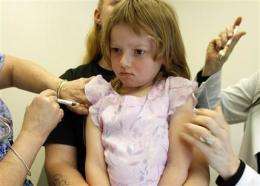
(AP) -- For Jennifer Stella, it's a question of informed consent. Her son had a seizure after getting childhood vaccinations and her daughter suffered a "head-to-toe" eczema outbreak; she says parents should research the risks and benefits of immunizations and decide which ones are appropriate.
For Jill Olson, a mother of two, it's a matter of trusting the experts. "There's not really any way that as an individual I can do more scientific study and research than the American Academy of Pediatrics or the Centers for Disease Control."
For Vermont House Speaker Shap Smith, the state motto sums it up: "freedom and unity" - individual choice versus the public health benefit of having a high percentage of kids vaccinated.
"It's a balance between individual rights and our obligations to each other in society," the Democratic speaker said.
For much of the legislative session, Vermont has been embroiled in a debate over whether to end the "philosophical exemption" - essentially a right of refusal for parents who want to enroll their children in school or child care without immunizations. The list of shots called for by the state Health Department and the CDC is roughly 20 by the time a child enters kindergarten.
The CDC and state health officials say Vermont is among the states with the highest exemption rates for childhood vaccinations. Some say it's no coincidence that Vermont recently has seen an outbreak of one of the diseases the vaccines target: pertussis, or whooping cough.
In 2010-11, the latest school year for which data is available, an Associated Press analysis of state health department data showed Alaska with nearly 9 percent of kindergarten children exempted. Colorado's rate was 7 percent and Vermont and Washington state each had 6 percent.
As the 2012 legislative session winds down, lawmakers are at loggerheads: The Senate voted 26-4 in early March to eliminate the philosophical exemption; the House voted 93-36 earlier this month to keep it.
If no agreement is reached, the legislation will die and Vermont will remain among the 20 states that allow some form of philosophical exemption from required childhood immunizations. All but a handful of states offer religious exemptions, and all allow medical exemptions for kids.
Many of Vermont's more vocal vaccine skeptics are active in alternative health and natural food movements and are critical of what they see as a profit-driven pharmaceutical industry. Stella, a homeopathic health practitioner, works at a clinic that also offers massage and herbal medicine.
Critics of the philosophical exemption say Vermont's immunization rates have been dropping, a slide that must be halted to preserve what public health officials call "herd immunity." That's when most of the population is immunized against a specific disease to keep outbreaks from occurring.
Christine Finley, immunization program manager at the state Health Department, said the percentage of Vermont kindergarteners with all their required immunizations dropped from 93 percent in 2005 to 83 percent in 2010.
Aside from pertussis, Finley said, Vermont has not seen big increases in other vaccine-preventable diseases, but she argued prevention is necessary. "Do you want to wait until you've got a measles outbreak?" she asked.
Stella's group, the Vermont Coalition for Vaccine Choice, says the rate of vaccination decline is exaggerated, since kids are counted as unvaccinated if they miss just one of the required shots.
Finley said Vermont and other states with high exemption rates have seen recent outbreaks of pertussis, or whooping cough, a sometimes fatal bacterial infection of the upper respiratory tract. Pertussis vaccine is part of the required childhood immunization schedule. And because the immunity wears off over time, the CDC advises everyone 11 and older to get a booster shot, Finley said.
Vermont saw 102 pertussis cases between January and the first week of April, Finley said, more than were reported in the state all last year. Washington state had 640 cases of pertussis from January through March, up from 94 for the same period last year.
One of the most vocal Vermont lawmakers pushing to end the philosophical exemption has been Rep. George Till, D-Jericho, an obstetrician-gynecologist. He has complained bitterly of parents failing to get their children immunized and putting other children at risk.
"The question is whether they have the right to endanger other children in the school setting," he said during a recent House debate on ending the philosophical exemption.
Stella dismissed that criticism, saying vaccines aren't always effective in all children and that some who have received shots are as susceptible to disease as those who have not.
One hot spot for the immunization debate in Vermont has been Middlesex, just outside the capital of Montpelier, where 41 of 157 elementary children at Rumney Memorial School come from families filling out a state form and exempting them from vaccines.
Rumney school nurse Martha Israel - who was quick to say she was speaking only for herself and not for the school - said she does not want to see kids kicked out of school because their parents won't have them vaccinated.
"I don't think we deny our children in Vermont a public school education because we don't agree with the medical choices their parents make, when we're not in a public health crisis," said Israel, a school nurse since 1989.
Gov. Peter Shumlin has sided with the House's push for more education on immunizations over the Senate's push to remove the philosophical exemption - a 180-degree turn from the position his health commissioner, Dr. Harry Chen, pushed for earlier in this year's legislative session.
"I do not believe that in the end the government should dictate to parents what inoculations their kids have to get in order to get a public education in Vermont," the governor said. He said he wants Vermont to "start with more education, to separate the myths that you read about on the Internet with the facts that health care providers will give you on this."
©2012 The Associated Press. All rights reserved. This material may not be published, broadcast, rewritten or redistributed.


