Britain bedeviled by binge drinking
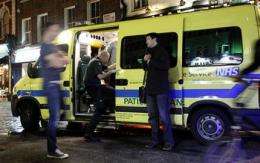
(AP) -- The girls slumped in wheelchairs look barely conscious, their blond heads lolling above the plastic vomit bags tied like bibs around their necks.
It's an hour to midnight on Friday, and the two girls, who look no older than 18, are being wheeled from an ambulance to a clinic set up discreetly in a dark alley in London's Soho entertainment district.
They're the first of many to be picked up on this night by the ambulance, known as a "booze bus," and carried to the clinic - both government services dedicated to keeping drunk people out of trouble, and out of emergency rooms.
Binge drinking has reached crisis levels in Britain, health experts say, costing the cash-strapped National Health Service 2.7 billion pounds (US$4.4 billion) a year, including the cost of hospital admissions related to booze-fueled violence and longer-term health problems. Unlike all other major health threats, liver disease is on the rise in Britain, increasing by 25 percent in the last decade and causing a record level of deaths, according to recent government figures.
Doctors believe rising obesity is combining with heavy drinking to fuel the spike in liver disease, which is hitting more young people than ever.
"Undoubtedly professionals are seeing more (patients) in their late-20s to mid-30s, which would have been unusual 20 years ago," said Chris Day, a liver disease specialist at Newcastle University.
On the streets of Soho, most people are too busy drinking to notice passed-out partyers. The streets, lined with pubs and nightclubs, are just beginning to get rowdy: Men chasing each other and shrieking like teenagers; women stumbling and falling over in their too-short skirts and high heels. Soon the sidewalks are littered with empty beer bottles and reeking puddles.
Such public displays of extreme drunkenness are inexplicable and shocking to many foreigners living in Britain, even those who hail from heavy drinking cultures.
"(At home) it's embarrassing to be drunk. Here it's kind of something you brag about," said Kaisa Toroskainen, a Finnish graduate student in London having a beer with her friends.
The headline-grabbing figures about ever-younger liver disease victims may seem to suggest that Britain has quite recently turned into a nation of raging alcoholics. But it's not news that the British like their tipple. This is, after all, a nation known around the world for its ales and its pubs, the default venue for any British social gathering from a quiet date to after-work networking.
Despite that, most experts agree that Britons, on the whole, don't drink more than other Europeans - in fact, overall alcohol consumption levels here have come down since the mid 2000s.
But that's the average. The problem seems to lie with a minority of hard-core drinkers who tend to down a huge amount in a short time.
"The key point is the ways in which we behave when we're drinking - it involves very public displays of reckless drunkenness," said Jamie Bartlett, a researcher at the London-based think tank Demos who has written about alcohol abuse.
"It's not an issue of consumption. It's an issue of behavior."
Anyone who's gone out on a Friday night in any of Britain's larger towns and cities will be familiar with boozed out groups of people shouting, brawling and causing a scene as they spill out of bars and pubs. Commuters aren't immune to the antics - especially on evenings when soccer matches are on.
"We are the whites, we are we are the whites!" one clearly intoxicated young man was heard relentlessly singing on a train carriage on a recent night, urging wary strangers to join in.
The problem isn't confined to a particular class, and even members of the social elite can be caught in embarrassing drink-fueled trouble. In 2000, the teenage son of then Prime Minister Tony Blair was arrested for being "drunk and incapable" when he was found semiconscious and vomiting on the sidewalk in London's Leicester Square.
The event was remarkable only because of his father's prominence.
The legal drinking age in Britain is 18, compared to 21 in the U.S., but many drinkers start younger. Social workers say lax control of retail sales and cheap alcohol - commonly available for less than 70 pence ($1.10) a can in supermarkets and liquor stores - makes it easy for young people to experiment with liquor.
Cut-price booze has been blamed for the increasingly popular practice of "pre-loading," where drinkers indulge in shop-bought drink at home before they head out to bars and pubs, where the drinks are much more expensive.
Prime Minister David Cameron has declared binge drinking a national "scandal," and the government is seeking to curb the excess by introducing a minimum price for each unit of alcohol sold. Scotland, which has long struggled with a dire alcohol abuse problem, announced Monday it wants to set a minimum price of 50 pence (80 U.S. cents) per unit - which would mean an average bottle of wine could cost no less than about 4.70 pounds ($7.55).
The proposals have sparked lively debate - not least because of the unusually interventionist stance taken by the Conservatives. More to the point are questions about whether higher prices will actually cut excessive indulgence.
Simon Antrobus at the drug and alcohol treatment charity Addaction is hopeful that the proposals will increase public awareness.
"We're beginning to see people thinking, `I have to do something about this,'" he said. "The challenging bit is getting people to understand the potential harmful consequences of alcohol. People need to know their limits."
©2012 The Associated Press. All rights reserved. This material may not be published, broadcast, rewritten or redistributed.


