Fighting cancer
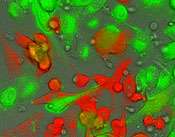
Image shows the serial killing of three melanoma cells (red) by a single non-cancer-specific Tcell (green) in the presence of the drug, IMCgp100.
(Medical Xpress) -- Hijacking cells that normally attack common infections to target cancer instead could offer the body a ready-made army against the killer disease University researchers and Oxford-based biotech company, Immunocore Limited have uncovered.
Published in Nature Medicine, the study examined the potential of molecules on the surface of anti-cancer killer T cells, known as T cell receptors (TCRs) to be used to treat cancers for which few disease-specific targets are available.
The Immunocore team engineered a range of TCRs to bind very tightly to cancer cells and equipped them with the ability to activate non-cancer specific T cells. This new class of drug, named ImmTACs (Immune Mobilising mTCR against Cancer), can be used to hi-jack the bodys existing T cells that normally kill viruses and redirect them to kill cancer cells instead.
The team included Nat Liddy and Katy Adams, Immunocore employees and PhD students at Cardiff University, as well as Professors Andy Sewell and David Price, School of Medicine.
This video is not supported by your browser at this time.
Nat Liddy said: "With Immuncores novel ImmTAC drugs we found we could effectively target cancer cells and mark them for destruction by the killer T cells that might normally fight common infections."Our initial studies and findings show that administration of ImmTAC could, potentially, result in the regression of established tumors".
Recent advances have enabled molecular targeting of disease using immune molecules called antigen receptors. There are two main classes of antigen receptor: antibodies and T cell receptors.
Therapeutic application of antibodies has been a huge medical success over the last decade and over 40% of the new drugs on the market in 2011 were based on these molecules.
Exploitation of T cell receptors (TCRs) has so far lagged behind, but research led by Immunocore Ltd, with help from Cardiff Universitys Institute of Infection and Immunity, is set to close the gap and open up an entirely new field of medical treatments.
Professor Andy Sewell, School of Medicine, said: "T cell receptors have advantages over antibodies as these molecules can see inside cells and tell if they are abnormal. Similar technology based around antibodies has shown great promise in clinical trials. This new TCR-based research technology extends this potential as it could possibly be applied to any form of cancer."
The most advanced of Immunocores ImmTACs, a drug called IMCgp100, is already in clinical trials in the UK and US for the treatment of melanoma. A second oncology ImmTAC, IMCmage1, is set to enter the clinic in both countries later this year and is applicable to the treatment of a large number of poorly served cancer indications.
James Noble, Immunocores CEO, said: "The power of this new technology lies in its ability to be used for a host of cancers that are currently very difficult to treat. We look forward to building on the emerging clinical data and generating a robust pipeline of products over the coming years".
More information: Immunocore
Provided by
Cardiff University
-
Scientists discover important cancer defence switch
Dec 14, 2011 |
not rated yet |
0
-
Taking a closer look at cancer
Sep 12, 2011 |
not rated yet |
0
-
CRT unveils 'screen test' for potential drugs to treat oestrogen positive breast cancer
Mar 06, 2012 |
not rated yet |
0
-
Researchers’ blood cancer breakthrough
Aug 10, 2011 |
not rated yet |
0
-
Group develops method of killing cancer cells with antibodies and light
Nov 07, 2011 |
not rated yet |
0
-
Motion perception revisited: High Phi effect challenges established motion perception assumptions
Apr 23, 2013 |
3 / 5 (2) |
2
-
Anything you can do I can do better: Neuromolecular foundations of the superiority illusion (Update)
Apr 02, 2013 |
4.5 / 5 (11) |
5
-
The visual system as economist: Neural resource allocation in visual adaptation
Mar 30, 2013 |
5 / 5 (2) |
9
-
Separate lives: Neuronal and organismal lifespans decoupled
Mar 27, 2013 |
4.9 / 5 (8) |
0
-
Sizing things up: The evolutionary neurobiology of scale invariance
Feb 28, 2013 |
4.8 / 5 (10) |
14
-
Pressure-volume curve: Elastic Recoil Pressure don't make sense
May 18, 2013
-
If you became brain-dead, would you want them to pull the plug?
May 17, 2013
-
MRI bill question
May 15, 2013
-
Ratio of Hydrogen of Oxygen in Dessicated Animal Protein
May 13, 2013
-
Alcohol and acetaminophen
May 13, 2013
-
Marie Curie's leukemia
May 13, 2013
- More from Physics Forums - Medical Sciences
More news stories
New smartphone application improves colonoscopy preparation
The use of a smartphone application significantly improves patients' preparation for a colonoscopy, according to new research presented today at Digestive Disease Week (DDW). The preparation process, which begins days in ...
Cancer
19 hours ago |
not rated yet |
0
Research examines new methods for managing digestive health
Research presented at Digestive Disease Week (DDW) explores new methods for managing digestive health through diet and lifestyle.
Cancer
19 hours ago |
not rated yet |
1
New colonoscope provides ground-breaking view of colon
A ground-breaking advance in colonoscopy technology signals the future of colorectal care, according to research presented today at Digestive Disease Week(DDW). Additional research focuses on optimizing the minimal withdrawal ...
Cancer
May 18, 2013 |
5 / 5 (2) |
0
ASCO: combo antibody therapy effective for melanoma
(HealthDay)—Concurrent use of two immune checkpoint antibodies—ipilimumab and nivolumab—may be effective for the treatment of advanced melanoma, according to a proof-of-principal study presented in ...
Cancer
May 17, 2013 |
not rated yet |
0
Risk factors ID'd for poor cutaneous cell CA outcomes
(HealthDay)—The risks of metastasis and death associated with cutaneous squamous cell carcinoma (CSCC) are low, but significant, and risk factors for poor outcome include tumor diameter, invasion beyond ...
Cancer
May 17, 2013 |
not rated yet |
0
|
Researchers identify a potential new risk for sleep apnea: Asthma
Researchers at the University of Wisconsin have identified a potential new risk factor for obstructive sleep apnea: asthma. Using data from the National Institutes of Health (Heart, Lung, and Blood Institute)-funded Wisconsin ...
Computational tool translates complex data into simplified 2-dimensional images
In their quest to learn more about the variability of cells between and within tissues, biomedical scientists have devised tools capable of simultaneously measuring dozens of characteristics of individual ...
Study finds that sleep apnea and Alzheimer's are linked
A new study looking at sleep-disordered breathing (SDB) and markers for Alzheimer's disease (AD) risk in cerebrospinal fluid (CSF) and neuroimaging adds to the growing body of research linking the two.
New theory on genesis of osteoarthritis comes with successful therapy in mice
Scientists at Johns Hopkins have turned their view of osteoarthritis (OA) inside out. Literally. Instead of seeing the painful degenerative disease as a problem primarily of the cartilage that cushions joints, ...
'Gap' for HIV vaccine efforts after latest setback
The hunt for an HIV vaccine has gobbled up $8 billion in the past decade, and the failure of the most recent efficacy trial has delivered yet another setback to 26 years of efforts.
Ginger compounds may be effective in treating asthma symptoms
Gourmands and foodies everywhere have long recognized ginger as a great way to add a little peppery zing to both sweet and savory dishes; now, a study from researchers at Columbia University shows purified components of the ...