Common genetic mutation increases sodium retention, blood pressure
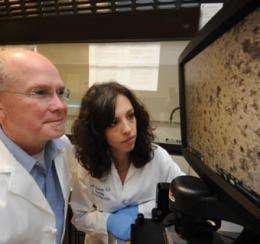
Dr. William E. Rainey confers with Dr. Silvia Monticone, a physician scientist at the University of Torino, Italy. Monticone worked with Rainey for a year in his laboratory at Georgia Health Sciences University on research linking a genetic mutation found in some adrenal gland tumors to increased sodium retention and worsening blood pressure in patients. Credit: Phil Jones, GHSU Photographer
Nearly 40 percent of the small adrenal tumors that cause big problems with high blood pressure share a genetic mutation that causes patients to retain too much sodium, researchers report.
The study of 47 human, benign adrenal gland tumors also showed a mutation of the gene KCNJ5 is twice as likely to occur in women 71 versus 29 percent as it points to potential new treatments for some patients who don't respond to current hypertension regimens, said Dr. William E. Rainey, Scientific Director of the Adrenal Center at Georgia Health Sciences University.
Addititionally, when scientists put the mutated gene into an adrenal cell, it immediately starts producing the sodium-retaining hormone aldosterone. "We found it turned on a whole series of genes that cause the cell to produce aldosterone," Rainey said.
Typically, KCNJ5 appears to help normalize levels of the sodium-retaining hormone aldosterone by regulating how much potassium is pumped in and out of aldosterone-producing cells on the outer layer of the adrenal glands. Abnormal protein produced by the mutated gene alters the cells' electrical status.
"When this gene has a mutation, the cells lose control and just start producing aldosterone all the time," said Rainey, corresponding author of the study in the Journal of Clinical Endocrinology and Metabolism.
"The combination of too much salt and too much of this hormone leads to high blood pressure and tissue damage," said Rainey. He notes that the vast majority of the 311 million Americans consume too much salt, even if they never pick up a salt shaker, because of high content in breads, processed and fast foods and the like. An estimated 33 percent of Americans are hypertensive and an estimated 1 in 10 have adrenal problems as the cause.
A 2011 study led by Yale University and published in the journal Science showed that the tumors had a KCNJ5 mutation. GHSU researchers, along with colleagues at University of Michigan Medical School, Ann Arbor; University of Torino and University of Padova, Italy; University of Texas Southwestern Medical Center, Dallas; and Keio University,Tokyo linked the gene to aldosterone production.
Now the GHSU Adrenal Center is moving forward with studies to determine why women with adrenal tumors have more of the mutated gene Rainey suspects it's estrogen-related. They also want to know if any of the dozen potassium channel inhibitors already on the market for heart and other disorders can help these patients as well.
Rainey said the gene mutation is one that occurs after birth when most mutations occur and the cause is unknown. About half the people who produce too much aldosterone have tumors, which tend to affect only one of the 2-by-1-inch glands that sit like hats on top of the two kidneys and surgical removal typically fixes their problem. Unexplained enlargement of both glands likely also has a genetic basis and may be medically managed, Rainey said.
One of the many goals of the GHSU Adrenal Center, one of a handful of multidisciplinary centers in the nation, is to better define genes which can result in whole families being impacted. To date, only three genes are known to contribute to the familial form. Aldosterone excess, by whatever means, also is suspected when people under age 40 become hypertensive for no other obvious reason.
The adrenals are extremly efficient glands, producing three additional hormone groups that help maintain homeostasis including cortisol needed for glucose/carbohydrate metabolism, weak sex steroids that likely are the major source of androgens, or male hormones, in women; and the fight or flight hormones epinephrine and norepinephrine. In the event both glands are removed, the vital hormones must be supplemented, Rainey said.
Patients typically come to the GHSU Adrenal Center with unexplained hypertension that isn't responding to traditional therapy. "They are typically on three or four medications and their blood pressure is still not under control," said Dr. Michael A. Edwards, Clinical Director of the Adrenal Center and Chief of the MCG Section of Minimally Invasive and Digestive Diseases Surgery. Computerized tomography done for other reasons can detect over-sized glands or tumors that may be the culprit.
Journal reference:
Journal of Clinical Endocrinology and Metabolism
Provided by
Georgia Health Sciences University
-
Researchers discover important link between adrenal gland hormone and brain in hypertension
Nov 09, 2010 |
not rated yet |
0
-
High blood pressure may be caused by mutation in adrenal gland
Feb 10, 2011 |
not rated yet |
0
-
Genetic data related to sodium-regulating hormone may help explain hypertension risk
Oct 14, 2010 |
not rated yet |
0
-
Gene Associated with Rare Adrenal Disorder Appears To Trigger Cell Death
Jul 13, 2010 |
not rated yet |
0
-
Overweight male teens with normal blood pressures showing signs of heart damage
Jun 01, 2009 |
not rated yet |
0
-
Motion perception revisited: High Phi effect challenges established motion perception assumptions
Apr 23, 2013 |
3 / 5 (2) |
2
-
Anything you can do I can do better: Neuromolecular foundations of the superiority illusion (Update)
Apr 02, 2013 |
4.5 / 5 (11) |
5
-
The visual system as economist: Neural resource allocation in visual adaptation
Mar 30, 2013 |
5 / 5 (2) |
9
-
Separate lives: Neuronal and organismal lifespans decoupled
Mar 27, 2013 |
4.9 / 5 (8) |
0
-
Sizing things up: The evolutionary neurobiology of scale invariance
Feb 28, 2013 |
4.8 / 5 (10) |
14
-
Classical and Quantum Mechanics via Lie algebras
Apr 15, 2011
- More from Physics Forums - Independent Research
More news stories
Researchers develop model for better testing, targeting of malignant peripheral nerve sheath tumors
University of Minnesota Medical School researchers from the Masonic Cancer Center, University of Minnesota, in partnership with the University's Brain Tumor Program, have developed a new mouse model of malignant peripheral ...
Genetics
May 20, 2013 |
5 / 5 (1) |
0
|
Researchers identify new circadian clock component
Northwestern University scientists have shown a gene involved in neurodegenerative disease also plays a critical role in the proper function of the circadian clock.
Genetics
May 16, 2013 |
3 / 5 (1) |
1
|
Returning genetic incidental findings without patient consent violates basic rights, experts say
Informed consent is the backbone of patient care. Genetic testing has long required patient consent and patients have had a "right not to know" the results. However, as 21st century medicine now begins to use the tools of ...
Genetics
May 16, 2013 |
5 / 5 (1) |
3
|
Ethicists provide framework supporting new recommendations on reporting incidental findings in gene sequencing
In a paper published in Science Express, a group of experts led by bioethicists in the Center for Medical Ethics and Health Policy at Baylor College of Medicine provide a framework for the new American College of Medical Geneti ...
Genetics
May 16, 2013 |
not rated yet |
0
Experts urge caution over use of new genetic sequencing techniques
The use of genome-wide analysis (GWA), where the entirety of an individual's DNA is examined to look for the genomic mutations or variants which can cause health problems is a massively useful technology for diagnosing disease. ...
Genetics
May 16, 2013 |
not rated yet |
0
Scientists uncover molecular roots of cocaine addiction in the brain
Researchers at Johns Hopkins have unraveled the molecular foundations of cocaine's effects on the brain, and identified a compound that blocks cravings for the drug in cocaine-addicted mice. The compound, already proven safe ...
Taming suspect gene reverses schizophrenia-like abnormalities in mice
Scientists have reversed behavioral and brain abnormalities in adult mice that resemble some features of schizophrenia by restoring normal expression to a suspect gene that is over-expressed in humans with ...
Costs to treat stroke in America may double by 2030
Costs to treat stroke are projected to more than double and the number of people having strokes may increase 20 percent by 2030, according to the American Heart Association/American Stroke Association.
Acne treatment: Natural substance-based formula is more effective than artificial compounds
University of Granada scientists have patented a new treatment for acne that is based on completely natural substances and is much more effective than artificial formulas because it does not create resistance ...
Study finds new pneumococcal vaccine appears to be as safe as previously used vaccine
The new 13-valent pneumococcal conjugate vaccine (PCV13) appears to be as safe as the previous version used prior to 2010, the 7-valent pneumococcal conjugate vaccine (PCV7), according to a Kaiser Permanente study published ...
A molecular explanation for age-related fertility decline in women
(Medical Xpress)—Scientists supported by the National Institutes of Health have a new theory as to why a woman's fertility declines after her mid-30s. They also suggest an approach that might help slow ...