FlexLeg wants to put injured back in action (w/ Video)
May 8, 2012 by Nancy Owano in Medical research report

FlexLeg wants to put injured back in action (w/ Video)

Enlarge

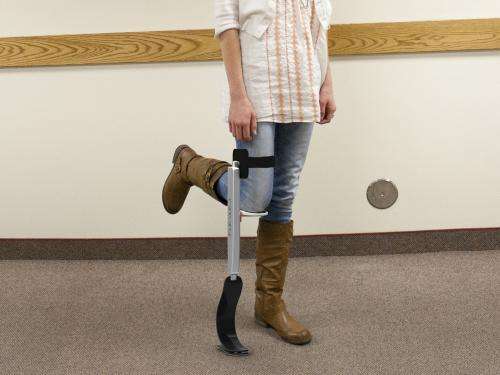
A company called FlexLeg has a motto -- "mobility redefined" -- that may just as well say “crutches redefined.” The three-person team at FlexLeg is offering a hands-free device to serve as a substitute for crutches for those with temporary lower leg injuries, such as a broken ankle. The company’s seeing-is-believing videos show a person with a lower-leg injury wearing FlexLeg and running down a corridor, making it down a flight of stairs, and navigating different terrains, from smooth surfaces to bumpy walkways.

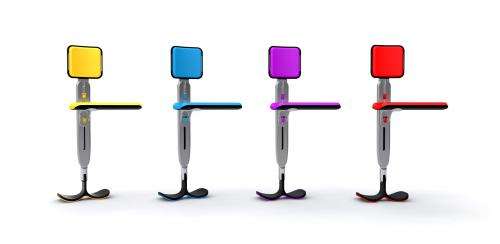
The purpose of the device is to give the user a mobility solution during the recovery state when the person has sustained an injury to the lower leg. The accent could be on “temporary” and “recovery,” as the device should not be confused with the more sophisticated devices that are used as substitutes for missing body parts. “To be clear,” says a FlexLeg comment, “FlexLeg is not a prosthetic, although it draws upon some of the technology in the industry.” The frame is constructed from aircraft grade aluminum and is lightweight.

This video is not supported by your browser at this time.

The creators behind FlexLeg are from Brigham Young University. Mike Sanders, a masters student in mechanical engineering, wanted to develop a better solution than was currently available to help people with injured legs to walk. He traded ideas with another student, Mark Roberts, and they built several prototypes. Seth Gonzalez, an MBA student at BYU, joined FlexLeg to guide the inventors with a business plan to get the company going.

This video is not supported by your browser at this time.

Running on FlexLeg

Those who have experienced hands-on crutches recognize the limitations in mobility, for sure, such as slow movements, difficulty getting through doors, and difficulty in maneuvering narrow aisles. A hands-free device that allows for faster and easier movement across different terrains can make a difference.
FlexLeg wants to put injured back in action (w/ Video)
Enlarge


The company is readying the device to be available for purchase in July this year. The FlexLeg team is completing their beta models “to be distributed to selected patients for testing for several week periods.” The company also says it is working with “strategic partners” for entry into a national market.

More information: www.flexleg.com/

© 2012 Phys.Org

5 /5 (4 votes)  

Filter


Move the slider to adjust rank threshold, so that you can hide some of the comments.


Display comments: newest first

rocky j squirrel
May 08, 2012

Rank: 1 / 5 (1)
Nothing new! My Grandfather built on for himself on on his ranch in Saskatchawan in the 1930s so he could get around after a leg injury.
Rank 5 /5 (4 votes)
Related Stories
Relevant PhysicsForums posts

More news stories

Computational tool translates complex data into simplified 2-dimensional images

In their quest to learn more about the variability of cells between and within tissues, biomedical scientists have devised tools capable of simultaneously measuring dozens of characteristics of individual ...

Medical research created 3 hours ago | popularity 5 / 5 (1) | comments 0 | with audio podcast

Now we know why old scizophrenia medicine works on antibiotics-resistant bacteria

In 2008 researchers from the University of Southern Denmark showed that the drug thioridazine, which has previously been used to treat schizophrenia, is also a powerful weapon against antibiotic-resistant bacteria such as ...

Medical research created May 17, 2013 | popularity 3.7 / 5 (3) | comments 0 | with audio podcast

SUMO wrestling cells reveal new protective mechanism target for stroke

Scientists investigating the interaction of a group of proteins in the brain responsible for protecting nerve cells from damage have identified a new target that could increase cell survival.

Medical research created May 17, 2013 | popularity 5 / 5 (1) | comments 0

How serotonin receptors can shape drug effects, from LSD to migraine medication

New findings by researchers carrying out experiments at the U.S. Department of Energy Office of Science's Advanced Photon Source (APS) help explain why some drugs that interact with two kinds of human serotonin ...

Medical research created May 17, 2013 | popularity 4 / 5 (1) | comments 0 | with audio podcast

Preventing blood poisoning

Peptide molecules derived from the body's natural immune system can help boost the body's defence against life-threatening blood poisoning, joint University research has uncovered.

Medical research created May 17, 2013 | popularity 4 / 5 (1) | comments 0 | with audio podcast


Researchers identify a potential new risk for sleep apnea: Asthma

Researchers at the University of Wisconsin have identified a potential new risk factor for obstructive sleep apnea: asthma. Using data from the National Institutes of Health (Heart, Lung, and Blood Institute)-funded Wisconsin ...

Study finds that sleep apnea and Alzheimer's are linked

A new study looking at sleep-disordered breathing (SDB) and markers for Alzheimer's disease (AD) risk in cerebrospinal fluid (CSF) and neuroimaging adds to the growing body of research linking the two.

'Gap' for HIV vaccine efforts after latest setback

The hunt for an HIV vaccine has gobbled up $8 billion in the past decade, and the failure of the most recent efficacy trial has delivered yet another setback to 26 years of efforts.

New theory on genesis of osteoarthritis comes with successful therapy in mice

Scientists at Johns Hopkins have turned their view of osteoarthritis (OA) inside out. Literally. Instead of seeing the painful degenerative disease as a problem primarily of the cartilage that cushions joints, ...

Ginger compounds may be effective in treating asthma symptoms

Gourmands and foodies everywhere have long recognized ginger as a great way to add a little peppery zing to both sweet and savory dishes; now, a study from researchers at Columbia University shows purified components of the ...

Alzheimer's leaves bilingual victims stranded in Canada

The devastating effect of Alzheimer's disease on bilingual people has been thrown into focus in Canada, where the sudden loss of a second language can leave sufferers feeling like strangers in their own country.