Researchers pinpoint genetic pathway of rare facial malformation in children
May 3, 2012 in Pediatrics

Researchers pinpoint genetic pathway of rare facial malformation in children

Enlarge

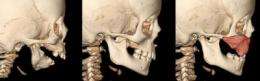
This is a 3-D CT scan of child with ACS.Pictured is a lower jaw is small and malformed (left); same-aged child with normal jaw (middle); lower jaw of child with ACS inverted over upper jaw of normal skull (right). Credit: Seattle Children's Research Institute

Researchers at Seattle Children's Research Institute and their collaborators have discovered a pair of defective genes that cause a rare congenital malformation syndrome that can make it impossible for the child to breathe or eat properly without reparative surgery. In a study led by Michael L. Cunningham, MD, PhD, medical director of the Seattle Children's Hospital's Craniofacial Center, a research team pinpointed two genes known as PLCB4 and GNAI3 in a genetic pathway that affects children with auriculocondylar syndrome (ACS). ACS is a rare disorder in which a child's bottom jaw develops as an upper jaw and, in some cases, incorrectly fuses to the base of the skull.

As part of the study, the DNA of five children with similar facial features characteristic of ACS was sequenced. Cunningham and his colleague Mark J. Rieder, PhD (University of Washington) used exome sequencing, selectively sequencing those regions of the patients' DNA believed to constitute the majority of disease-causing mutations. The study, to be published in the May edition of American Journal of Human Genetics, is one of the first genomic studies to identify causative mutations in two genes for the same disorder in the same pathway in a single analysis, Dr. Cunningham said.

While children with ACS have normal cognitive development, severe cases may require an immediate tracheostomy, feeding tubes, and ultimately extensive facial reconstructive surgery to allow them to eat and breathe properly.

"Although ACS is rare, our findings suggest that these genes may also play a role in more common disorders of the jaw and ears," said Dr. Cunningham, who is also chief of the division of craniofacial medicine and professor of pediatrics in the Department of Pediatrics at the University of Washington School of Medicine. "It's possible that more common jaw problems, like the lower jaw abnormality known as Robin sequence and other skull and such as craniofacial microsomia, are also caused by genes in this pathway."

ACS, a syndrome first described by scientists in 1978, is believed to affect less than one in 50,000 births, though the precise frequency is not known. It is not uncommon for the condition to be misdiagnosed or for diagnosis to be delayed. According to Dr. Cunningham it was the precision of case choice that allowed this discovery.

Of the five cases studied, two of the parents did not have this condition but were carriers for the mutation. "Now that we know the for ACS, we will be able to better identify and counsel people who have normal facial appearances but carry these , about the likelihood of passing on this mutation to their ,'' Dr. Cunningham said.

Journal reference: American Journal of Human Genetics search and more info website

Provided by Seattle Children's Research Institute search and more info website

5 /5 (1 vote)  

Rank 5 /5 (1 vote)
Relevant PhysicsForums posts

More news stories

Rate of bicycle-related fatalities significantly lower in states with helmet laws

Existing research shows that bicyclists who wear helmets have an 88 percent lower risk of brain injury, but researchers at Boston Children's Hospital found that simply having bicycle helmet laws in place showed a 20 percent ...

Pediatrics created May 23, 2013 | popularity not rated yet | comments 0

More kids getting donor organs, but gaps persist, study finds

(HealthDay)—Over the last decade, the number of American children who die each year awaiting an organ donation dropped by more than half, new research reveals. And increasing numbers of children are receiving ...

Pediatrics created May 22, 2013 | popularity not rated yet | comments 0

Phthalates: Study links chemicals widely found in plastics, processed food to elevated blood pressure in children, teens

Plastic additives known as phthalates (pronounced THAL-ates) are odorless, colorless and just about everywhere: They turn up in flooring, plastic cups, beach balls, plastic wrap, intravenous tubing and—according to the ...

Pediatrics created May 22, 2013 | popularity not rated yet | comments 1 | with audio podcast

Less sleep associated with increased risk of crashes for young drivers

A study by Alexandra L. C. Martiniuk, M.Sc, Ph.D., of The George Institute for Global Health, Sydney, Australia, and colleagues suggests less sleep per night is associated with a significant increase in the risk for motor ...

Pediatrics created May 20, 2013 | popularity not rated yet | comments 0

Whole-cell vaccine was more effective than acellular vaccine during CA pertussis outbreak

Whole-cell pertussis vaccines were more effective at protecting against pertussis than acellular pertussis vaccines during a large recent outbreak, according to a new Kaiser Permanente study published in Pediatrics.

Pediatrics created May 20, 2013 | popularity not rated yet | comments 0 | with audio podcast


First drug to improve heart failure mortality in over a decade

Coenzyme Q10 decreases all cause mortality by half, according to the results of a multicentre randomised double blind trial presented today at Heart Failure 2013 congress. It is the first drug to improve heart failure mortality ...

Seniors more likely to crash when driving with pet, study finds

(HealthDay)—Animals make great companions for senior citizens, but elderly people who always drive with a pet in the car are far more likely to crash than those who never drive with a pet, researchers have ...

Heart failure accelerates male 'menopause'

Heart failure accelerates the aging process and brings on early andropausal syndrome (AS), according to research presented today at the Heart Failure Congress 2013. AS, also referred to as male 'menopause', was four times ...

New immune system discovered

(Medical Xpress)—A research team, led by Jeremy Barr, a biology post-doctoral fellow, unveils a new immune system that protects humans and animals from infection.

Death highest in heart failure patients admitted in January, on Friday, and overnight

Mortality and length of stay are highest in heart failure patients admitted in January, on Friday, and overnight, according to research presented today at the Heart Failure Congress 2013. The analysis of nearly 1 million ...

Feds fight morning-after pill age ruling in NY

(AP)—Department of Justice lawyers have again asked a federal appeals court in New York to delay lifting age restrictions and prescription requirements on an emergency contraceptive popularly known as the morning-after ...