Interactive website helps parents keep teen drivers safe
May 22, 2012 By Bernie DeGroat in Health

Interactive website helps parents keep teen drivers safe

Enlarge

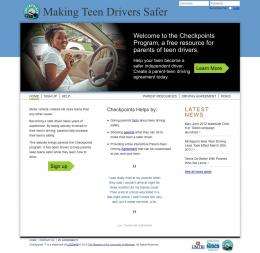
Nearly 30,000 parents around the state are using a free, interactive web resource that provides information and tools to help parents protect their teens while they gain experience driving without adult supervision.

This online program — www.saferdrivingforteens.org — is presented by the University of Michigan Transportation Research Institute and the Michigan Department of Community Health through a grant from the National Center for Injury Prevention and Control, part of the Centers for Disease Control and Prevention.

"Prom season and the end of the school year are an exciting time of year for teens, but it is also a time when they are likely to be more often and to a larger variety of destinations. The special celebrations and year-end activities offered by many schools and communities create more pressure for teens to drive at night and to give other teens rides," said Ray Bingham, a research professor at UMTRI, as well as the U-M schools of medicine and public health.

"Teen drivers are at greater risk in these situations compared to adults, due to their young age and inexperienced driving. The excitement and increased likelihood of exposure to alcohol and drugs that may accompany some celebrations add to teens' risk. Many find that this is a good time to make extra effort to help their teen drivers stay safe."

The website features an easy-to-use, interactive parent-teen driving agreement called Checkpoints that helps clearly establish where and when teens can drive without , and how teens can earn increased driving privileges. Because the agreement is interactive, parents can use it now to establish driving privileges for prom and graduation season and revisit it as their teen gains driving experience. The website also includes information about Michigan's driving laws for teens, and videos about using the agreement and talking with teens about driving.

The Checkpoints parent-teen driving agreement was created by Bruce Simons-Morton of the National Institutes of Health and has been tested multiple times in several states, including Michigan. whose parents use the agreement receive fewer tickets and report less risky driving behaviors (e.g., speeding, tailgating, turning fast, unsafe lane changes, cutting in front of other vehicles, going through yellow or red lights).

More information: www.saferdrivingforteens.org

Provided by University of Michigan search and more info website

not rated yet  

Rank not rated yet
Related Stories
Relevant PhysicsForums posts

More news stories

CDC presents recent trends in health behaviors of US adults

(HealthDay)—In 2008 to 2010, the prevalence of key health behaviors among U.S. adults varied, with about one in five adults current smokers and 62.1 percent overweight or obese, according to a report presented ...

Health created 1 hour ago | popularity not rated yet | comments 0

Americans still making unhealthy choices, CDC reports

(HealthDay)—The overall health of Americans isn't improving much, with about six in 10 people either overweight or obese and large numbers engaging in unhealthy behaviors like smoking, heavy drinking or ...

Health created 1 hour ago | popularity not rated yet | comments 0

US court strikes down Arizona 20-week abortion ban

A federal court in San Francisco Tuesday struck down Arizona's ban on abortions after 20 weeks of pregnancy.

Health created 1 hour ago | popularity 5 / 5 (1) | comments 0

Aggressive behavior linked specifically to secondhand smoke exposure in childhood

Children who are exposed to secondhand smoke in early childhood are more likely to grow up to physically aggressive and antisocial, regardless of whether they were exposed during pregnancy or their parents have a history ...

Health created 4 hours ago | popularity 1 / 5 (1) | comments 0

Most elite athletes believe doping substances are effective in improving performance

Most elite athletes consider doping substances "are effective" in improving performance, while recognising that they constitute cheating, can endanger health and entail the obvious risk of sanction. At the same time, the ...

Health created 5 hours ago | popularity not rated yet | comments 0


Reducing caloric intake delays nerve cell loss

Activating an enzyme known to play a role in the anti-aging benefits of calorie restriction delays the loss of brain cells and preserves cognitive function in mice, according to a study published in the May ...

CDC says high number of public pools contain microbes

(HealthDay)—Three-quarters of public schools in the metro Atlanta area contain microbes, including bacteria indicating the presence of fecal matter, according to research published in the May 17 issue of ...

Researchers find genetic risk factor for pulmonary fibrosis

A paper recently published in the New England Journal of Medicine and co-written by physicians and scientists at the University of Colorado School of Medicine finds that an important genetic risk factor for pulmonary fibros ...

Biomarkers discovered for inflammatory bowel disease

Using the Department of Defense Serum Repository (DoDSR), University of Cincinnati (UC) researchers have identified a number of biomarkers for inflammatory bowel disease (IBD), which could help with earlier diagnosis and ...

Changing cancer's environment to halt its spread

By studying the roles two proteins, thrombospondin-1 and prosaposin, play in discouraging cancer metastasis, a trans-Atlantic research team has identified a five-amino acid fragment of prosaposin that significantly reduces ...

Global recommendations on child medicine

Transparent information on the evidence supporting global recommendations on paediatric medicines should be easily accessible in order to help policy makers decides on what drugs to include in their national drug lists, according ...