Lung cancer CT scans: Just for older heavy smokers
May 20, 2012 By LINDSEY TANNER , AP Medical Writer in Cancer
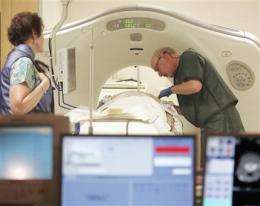
In this June 3, 2010 file photo, Dr. Steven Birnbaum works with a patient in a CT scanner at Southern New Hampshire Medical Center in Nashua, N.H. New lung cancer screening guidelines from three medical groups recommend annual scans but only for an older group of current or former heavy smokers. The advice applies only to those aged 55 to 74. The risks of screening younger or older smokers or nonsmokers outweigh any benefits, according to the guidelines published online Sunday, May 20, 2012, in the Journal of the American Medical Association. (AP Photo/Jim Cole, File)
New lung cancer screening guidelines from three medical groups recommend annual scans but only for an older group of current or former heavy smokers.
The advice applies only to those aged 55 to 74. The risks of screening younger or older smokers or nonsmokers outweigh any benefits, according to the guidelines.
About 8 million Americans would be eligible for screening under the new criteria, and if all of them got the scans, about 4,000 lung cancer deaths per year could be prevented, said Dr. Peter Bach of Memorial Sloan-Kettering Cancer Center in New York.
He chaired the expert panel that wrote the new guidelines for the American College of Chest Physicians, the American Society of Clinical Oncology and the National Comprehensive Cancer Network.
The recommended screening involves low-dose CT scans, which are a special kind of X-ray that can detect lung cancer early, but also can have false-positive results.
Regular chest X-rays can also detect lung cancer but they provide less detailed images than CT scans, can also have false-positive results and have not been recommended as a screening tool because they have not been shown to save lives.
The guidelines were published online Sunday in the Journal of the American Medical Association.
An estimated 226,000 Americans will be diagnosed with lung cancer this year. It is the leading cause of cancer deaths for U.S. men and women. An estimated 160,000 lung cancer deaths nationwide will occur this year. That number has declined in recent years, partly because of better detection and fewer people smoking.
Widespread screening will likely lead to some deaths because abnormal results are typically followed by biopsies and other invasive tests that sometimes have deadly complications. Still, the three groups say those deaths would be far outnumbered by people saved from lung cancer deaths by screening.
The recommendations go slightly further than preliminary guidance issued last year by the American Cancer Society and targeting current or heavy smokers in the same age range. That guidance said eligible adults "may consider" CT screening but should discuss risks and benefits with their physicians.
The new guidelines say screening with low-dose CT scans should be offered, but only in academic medical centers and other sites with specialized radiologists and surgeons on staff.
The guidance is based on a review of evidence including a large National Cancer Institute study involving more than 53,000 people with a history of smoking at least one cigarette pack daily for 30 years or two packs for 15 years. The guidelines recommend screening only for people who have smoked that much.
The study is considered the strongest evidence favoring CT screening and also was the basis for the cancer society's guidance and recent similar guidelines from the American Lung Association.
The U.S. Preventive Services Task Force, a government-appointed panel that issues public health guidance, is evaluating that study as it prepares to update its 2004 stance on lung cancer screening. The task force said then that there was insufficient evidence to recommend lung cancer screening with CT scans, X-rays or sputum tests.
Dr. Otis Brawley, chief medical officer at the American Cancer Society, took part in the new review and said his group likely will issue separate permanent guidelines later this year. The cancer society doesn't issue joint guidelines or endorse other group's guidelines, Brawley said.
"Screening is a double-edged sword," Brawley said. CT screening prevented about 80 lung cancer deaths over six years in the National Cancer Institute study, but 16 study participants died after CT screening, including six who did not have lung cancer.
Brawley and Bach expressed concern about heavy marketing by some centers that overstate benefits from CT lung cancer screening and that recommend the scans for low-risk patients.
Screening nonsmokers and other low-risk patients "will cause more harm, and yield less benefit for the simple reason that ... they're so much less likely to get lung cancer in the first place," Bach said.
Brawley noted that some centers charge at least $300 for these scans, which often aren't covered by insurance, particularly for low-risk patients.
More information: JAMA: http://www.jama.ama-assn.org
Screening info: http://www.cancer.gov/cancertopics/types/lung
©2012 The Associated Press. All rights reserved. This material may not be published, broadcast, rewritten or redistributed.
-
Lung cancer scans: False alarms amid lives saved
Jun 29, 2011 |
not rated yet |
0
-
CT screening improves lung cancer survival
Oct 26, 2006 |
not rated yet |
0
-
CT screening reduces lung-cancer deaths in heavy smokers
Nov 19, 2010 |
not rated yet |
0
-
Asymptomatic often sent for lung cancer screening tests
Mar 13, 2012 |
not rated yet |
0
-
Low-dose CT screening may benefit individuals at increased risk for lung cancer
May 20, 2012 |
not rated yet |
0
-
Motion perception revisited: High Phi effect challenges established motion perception assumptions
Apr 23, 2013 |
3 / 5 (2) |
2
-
Anything you can do I can do better: Neuromolecular foundations of the superiority illusion (Update)
Apr 02, 2013 |
4.5 / 5 (11) |
5
-
The visual system as economist: Neural resource allocation in visual adaptation
Mar 30, 2013 |
5 / 5 (2) |
9
-
Separate lives: Neuronal and organismal lifespans decoupled
Mar 27, 2013 |
4.9 / 5 (8) |
0
-
Sizing things up: The evolutionary neurobiology of scale invariance
Feb 28, 2013 |
4.8 / 5 (10) |
14
-
How can there be a term called "intestinal metaplasia" of stomach
19 hours ago
-
Pressure-volume curve: Elastic Recoil Pressure don't make sense
May 18, 2013
-
If you became brain-dead, would you want them to pull the plug?
May 17, 2013
-
MRI bill question
May 15, 2013
-
Ratio of Hydrogen of Oxygen in Dessicated Animal Protein
May 13, 2013
-
Alcohol and acetaminophen
May 13, 2013
- More from Physics Forums - Medical Sciences
More news stories
Small cancer risk following CT scans in childhood and adolescence confirmed
The gap between life expectancy in patients with a mental illness and the general population has widened since 1985 and efforts to reduce this gap should focus on improving physical health, suggest researchers in a paper ...
Cancer
8 hours ago |
not rated yet |
0
Changing cancer's environment to halt its spread
By studying the roles two proteins, thrombospondin-1 and prosaposin, play in discouraging cancer metastasis, a trans-Atlantic research team has identified a five-amino acid fragment of prosaposin that significantly reduces ...
Cancer
9 hours ago |
not rated yet |
0
Novel RNA-based classification system for colorectal cancer
A novel transcriptome-based classification of colon cancer that improves the current disease stratification based on clinicopathological variables and common DNA markers is presented in a study published in PLOS Medicine this w ...
Cancer
9 hours ago |
not rated yet |
0
Low radiation scans help identify cancer in earliest stages
A study of veterans at high risk for developing lung cancer shows that low-dose computed tomography (LDCT) can be highly effective in helping clinicians spot tiny lung nodules which, in a small number of patients, may indicate ...
Cancer
11 hours ago |
not rated yet |
0
Poliovirus vaccine trial shows early promise for recurrent glioblastoma
An attack on glioblastoma brain tumor cells that uses a modified poliovirus is showing encouraging results in an early study to establish the proper dose level, researchers at Duke Cancer Institute report.
Cancer
13 hours ago |
not rated yet |
0
If you can remember it, you can remember it wrong
(Medical Xpress)—Native peoples in regions where cameras are uncommon sometimes react with caution when their picture is taken. The fear that something must have been stolen from them to create the photo ...
B vitamins could delay dementia
(Medical Xpress)—Despite spending billions of dollars on research and development, drug companies have been unable to come up with effective treatments for dementia and Alzheimer's Disease (AD). Now, A. ...
Insight into the dazzling impact of insulin in cells
Australian scientists have charted the path of insulin action in cells in precise detail like never before. This provides a comprehensive blueprint for understanding what goes wrong in diabetes.
New sleeping pill poised to hit US markets
An experimental sleeping pill from US drug company Merck is effective at helping people fall and stay asleep, according to reviewers at the US Food and Drug Administration, which could soon approve the new drug.
Reducing caloric intake delays nerve cell loss
Activating an enzyme known to play a role in the anti-aging benefits of calorie restriction delays the loss of brain cells and preserves cognitive function in mice, according to a study published in the May ...
Antidepressant reduces stress-induced heart condition
A drug commonly used to treat depression and anxiety may improve a stress-related heart condition in people with stable coronary heart disease, according to researchers at Duke Medicine.